
Penny Dreadfuls, 1850 · page 389 of 394
The Mysteries of London; or, Lights and Shadows of London Life — page 389: what you’re looking at
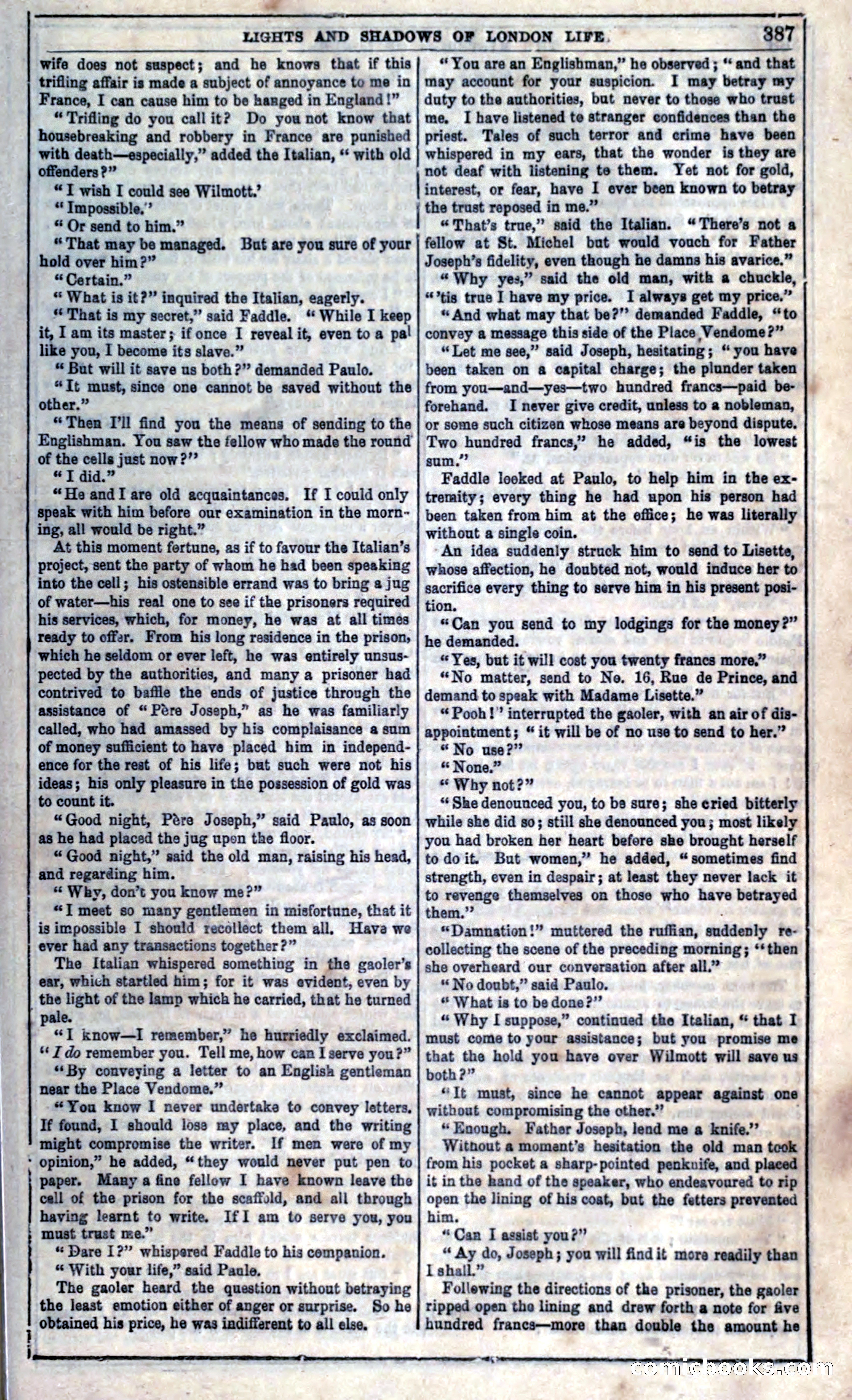
A restored page from Penny Dreadfuls, 1850. Page through the whole issue in the reader above.
📄 Transcribed text from this page (OCR, searchable)
Machine-transcribed from the original scan — historical spelling and the odd misread are preserved.
ull LIGHTS AND SHADOWS OF LONDON LIFE. wife does not suspect; and he knows that if this trifling affair is made a subject of annoyance to me in France, I can cause him to be hanged in England!” “Trifling do you callit? Do you not know that housebreaking and robbery in France are punished with death—especially,” added the Italian, ‘* with old offenders ?” “T wish I could see Wilmott.’ ** Impossible,’ “ Or send to him.” “That may be managed. But are you sure of your hold over him?” “ Certain.” * What is it?” inquired the Italian, eagerly. * That is my secret,” said Faddle. “ While I keep trom te master if once I reveal it, even to a pa! you, I become its slave.” * But will it save us both?” demanded Paulo. “Tt must, since one cannot be saved without the other.” _ “Then I'll find you the means of sending to the Englishman. You saw the fellow who made the round of the cells just now?” “TJ did.” _ “HeandT are old acquaintances. If I could only speak with him before our examination in the morn- ing, all would be right.” At this moment fertune, as if to favour the Italian’s project, sent the party of whom he had been speaking into the cell; his ostensible errand was to bring a jug of water—his real one to see if the prisoners required his services, which, for money, he was at all times ready to offer. From his long residence in the prison, which he seldom or ever left, he was entirely unsus- pected by the authorities, and many a prisoner had contrived to baffle the ends of justice through the assistance of “Pere Joseph,” as he was familiarly called, who had amassed by his complaisance a sum of money sufficient to have placed him in independ- ence for the rest of his life; but such were not his ideas; his only pleasure in the possession of gold was to count it. “Good night, Pére Joseph,” said Paulo, as soon as he had placed the jug upon the floor. “Good night,” said the old man, raising his head, and ing him. *“ Why, don’t you know me?” “T meet so many gentlemen in misfortune, that it is impossible I shonld recollect them all, Hava we ever had any transactions together?” The Italian whispered something in the gaoler’s ear, which startled him; for it was evident, even by the light of the lamp which he carried, that he turned pale. “] know—I remember,” he hurriedly exclaimed. “ 7 do remember you. Tell me, how can I serve you?” “By conveying a letter to an English gentleman near the Place Vendome.” “You know I never undertake to convey letters, If found, I should lose my place, and the writing might compromise the writer. If men were of my _ * opinion,” he added, “they would never put pen to paper. Many a fine fellow I have known leave the cell of the prison for the scaffold, and all through haying learnt to write. IfI am to serve you, you must trust me.” “ Dare 1?” whispered Faddle to his companion. “ With your life,” said Paule. The gaoler heard the question without betraying the least emotion either of anger or surprise. So he ; obtained his price, he was indifferent to all else, 387 “You are an Englishman,” he observed ; “ and that may account for your suspicion. I may betray my duty to the authorities, but never to those who trust me, I have listened te stranger confidences than the priest. Tales of such terror and crime have been whispered in my ears, that the wonder is they are not deaf with listening te them. Yet not for gold, interest, or fear, have I ever been known to betray the trust reposed in me.” “That’s true,” said the Italian. “There’s not a fellow at St. Michel but would vouch for Father Joseph’s fidelity, even though he damns his avarice.” “Why yes,” said the old man, with a chuckle, “tis true I have my price. I always get my price.” “And what may that be?” demanded Faddle, “to convey a message this side of the Place Vendome?” “Let me see,” said Joseph, hesitating; “ you have been taken on a capital charge; the plunder taken from you—and—yes—two hundred francs—paid be- forehand. I never give credit, unless to a nobleman, or some such citizen whose means are beyond dispute. Two hundred francs,” he added, “is the lowest sum.” Faddle loeked at Paulo, to help him in the ex- tremity; every thing he had upon his person had been taken from him at the effice; he was literally without a single coin. ‘An idea suddenly struck him to send to Lisette, whose affection, he doubted not, would induce her to sacrifice every thing to serve him in his present posi- tion. “Can you send to my lodgings for the money?” he demanded. “Yes, but it will cost you twenty francs more,” “No matter, send to Ne. 16, Rue de Prince, and demand to speak with Madame Lisette.” “Pooh!” interrupted the gaoler, with an air of dis- appointment; “ it will be of no use to send to her.” “No use?” “ None.” “ Why not?” ** She denounced you, to be sure; she cried bitterly while she did so; still she denounced you; most likely you had broken her heart before she brought herself to doit. But women,” he added, “sometimes find strength, even in despair; at least they never lack it to revenge themselves on those who have betrayed them.” “Damnation!” muttered the ruffian, suddenly re- collecting the scene of the preceding morning; **then she overheard our conversation after all.” “No doubt,” said Paulo. “* What is to be done?” “ Why I suppose,” continued the Italian, “ that I must come to your assistance; but you promise me that the hold you have over Wilmott will save us both ?” “It must, since he cannot appear against one without compromising the other.” “Enough. Father Joseph, lend me a knife.’’ Without a moment’s hesitation the old man teok from his pocket a sharp-pointed penknife, and placed it in the hand of the speaker, who endeavoured to rip open the lining of his coat, but the fetters prevented him. “Can I assist you?” “ Ay do, Joseph; you will findit more readily than I shall.” Follewing the directions of the prisoner, the gaoler ripped open the lining and drew forth a note for five hundred francs—more than double the amount he Gomicbook O ce —