
Penny Dreadfuls, 1850 · page 373 of 394
The Mysteries of London; or, Lights and Shadows of London Life — page 373: what you’re looking at
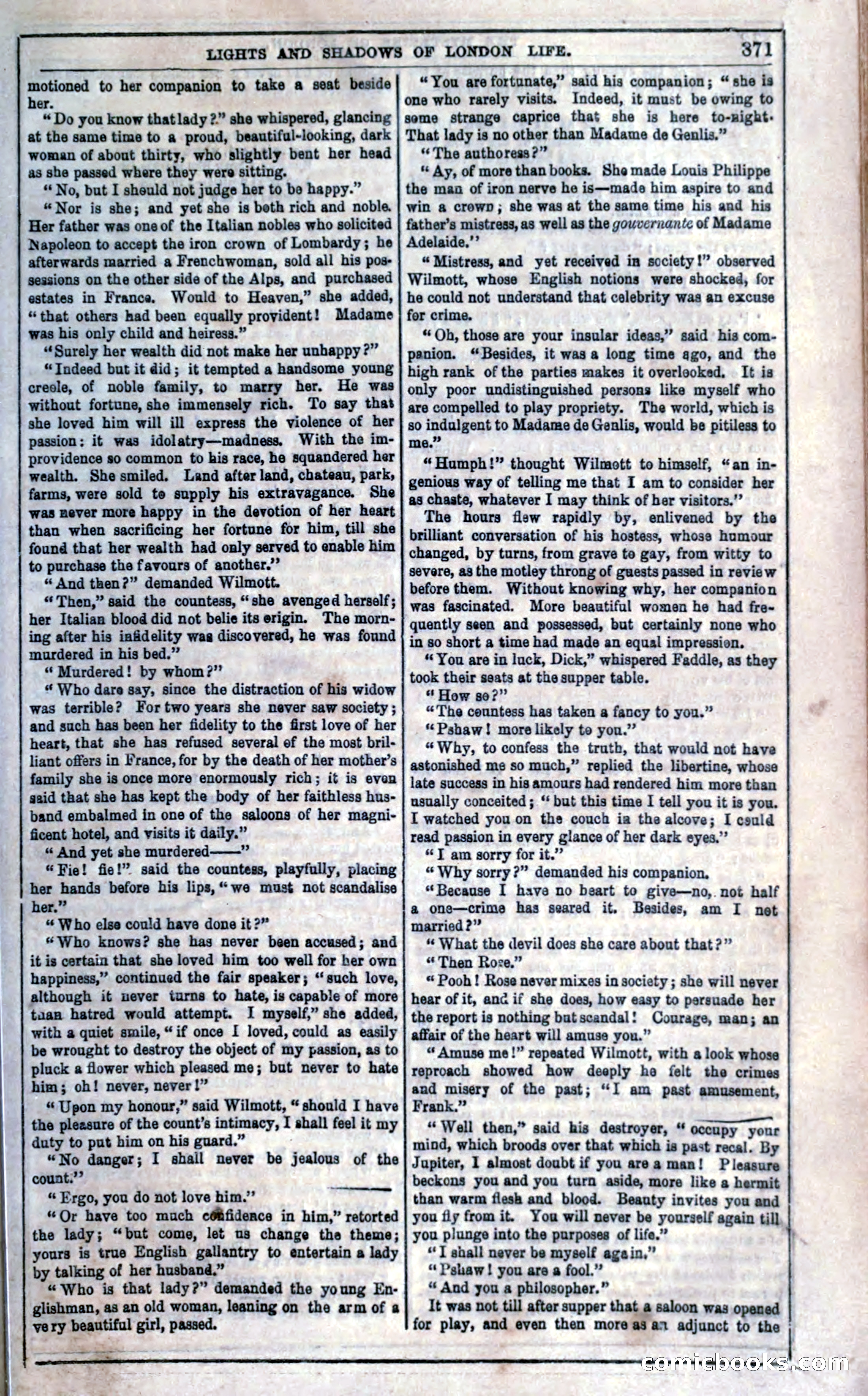
A restored page from Penny Dreadfuls, 1850. Page through the whole issue in the reader above.
📄 Transcribed text from this page (OCR, searchable)
Machine-transcribed from the original scan — historical spelling and the odd misread are preserved.
LIGHTS AND SHADOWS OF LONDON LIFE, motioned to her companion to take a seat beside her. “Do you know that lady 2.” she whispered, glancing at the same time to a proud, beautiful-looking, dark woman of about thirty, who slightly bent her head as she passed where they were sitting. “ No, but I should not judge her to be happy.” “Nor is she; and yet she is beth rich and noble. Her father was one of the Italian nobles who solicited Napoleon to accept the iron crown of Lombardy; he afterwards married a Frenchwoman, sold all his pos- sessions on the other side of the Alps, and purchased estates in France. Would to Heaven,” she added, “that others had been equally provident! Madame was his only child and heiress.” “Surely her wealth did not make her unhappy ?” “Tndeed but it did; it tempted a handsome young creole, of noble family, to marry her. He was without fortune, she immensely rich. To say that she loved him will ill express the violence of her passion: it was idolatry—madness, With the im- providence so common to his race, he squandered her wealth. She smiled. Land after land, chateau, park, farms, were sold te supply his extravagance. She was never more happy in the devotion of her heart than when sacrificing her fortune for him, till she found that her wealth had only served to enable him to purchase the favours of another.” “ And then?” demanded Wilmott. “Then,” said the countess, “she avenged herself; her Italian blood did not belie its erigin. The morn- ing after his infidelity waa discovered, he was found murdered in his bed.” “ Murdered! by whom?” “ Who dare say, since the distraction of his widow was terrible? Fortwo years she never saw society ; and such has been her fidelity to the first love of her heart, that she has refused several of the most bril- liant offers in France, for by the death of her mother’s family she is once more enormously rich; it is even gaid that she has kept the body of her faithless hus- band embalmed in one of the saloons of her magni- ficent hotel, and visits it daily.” “ And yet she murdered——” “Fie! fie!” said the countess, playfully, placing her hands before his lips, “we must not scandalise her.” | “ Who else could have done it ?” “Who knows? she has never been accused; and it is certain that she loved him too well for her own happiness,” continued the fair speaker; ‘‘ such love, although it never turns to hate, is capable of more tuan hatred would attempt. I myself,’ she added, with a quiet smile, “if once I loved, could as easily be wrought to destroy the object of my passion, as to pluck a flower which pleased me; but never to hate him; oh! never, never!” “ Upon my honour,” said Wilmott, “should I have the pleasure of the count’s intimacy, I shall feel it my duty to put him on his guard.” “No danger; I shall never be jealous of the count.’” “ Ergo, you do not love him.” “Or have too much c@Bfidence in him,” retorted the lady; “but come, let us change the theme; yours is true English gallantry to entertain a lady by talking of her husband.” “Who is that lady?” demanded the young En- glishman, as an old woman, leaning on the arm of a “You are fortunate,” said his companion; “ she is one who rarely visits. Indeed, it must be owing to seme strange caprice that she is here to-night. That lady is no other than Madame de Genlis.” “The authoress?” * Ay, of more than books. She made Louis Philippe the man of iron nerve he is—made him aspire to and win a crown; she was at the same time his and his father’s mistress, as well as the gouvernante of Madame Adelaide.”’ “ Mistress, and yet received in society!” observed Wilmott, whose English notions were shocked, for he could not understand that celebrity was an excuse for crime. * Oh, those are your insular ideas,” said his com- panion. “Besides, it was a long time ago, and the high rank of the parties makes it overlooked, It is only poor undistinguished persons like myself who are compelled to play propriety. The world, which is so indulgent to Madame de Genlis, would be pitiless to me.” “Humph!” thought Wilmott to himself, “an in- genious way of telling me that I am to consider her as chaste, whatever I may think of her visitors.”’ The hours flew rapidly by, enlivened by the brilliant conversation of his hostess, whose humour changed, by turns, from grave te gay, from witty to severe, a3 the motley throng of guests passed in review before them. Without knowing why, her companion was fascinated. More beautiful women he had fre~ quently seen and possessed, but certainly none who in so short a time had made an equal impression, “You are in luck, Dick,” whispered Faddle, as they took their seats at the supper table. “ How so?” “The countess has taken a fancy to you.” *Pshaw! more likely toe you.” “Why, to confess the truth, that would not have astonished ms so much,” replied the libertine, whose late success in his amours had rendered him more than usually conceited; “ but this time I tell you it is you. I watched you on the couch ia the alcove; I could read passion in every glance of her dark eyes,”’ “T am sorry for it.” “Why sorry?” demanded his companion, “Because I have no beart to give—no,. not half a one—crime has seared it. Besides, am I net married?” “ What the devil does she care about that?” “Then Rose.” * Pooh! Rose never mixes in society ; she will never hear of it, anc if she does, how easy to persuade her the report is nothing butscandal! Courage, man; an affair of the heart will amuse you.” “ Amuse me!” repeated Wilmott, with a look whose reproach showed how deeply he felt the crimes and misery of the past; “I am past amusement, Frank.” “Well then,” said his destroyer, “ occupy your mind, which broods over that which is past recal. By Jupiter, I almost doubt if you area man! Pleasure beckons you and you turn aside, more like a hermit than warm flesh and blood. Beauty invites you and you fiy from it. You will never be yourself again til} you plunge into the purposes of life.” “T shall never be myself again,” “ shaw! you are a fool.” * And you a philosopher.” It was not till after supper that a saloon was 371 very beautiful girl, passed. for play, and even then more a$ an adjunct to the | S ——— _ are Tae, eo are re ee ee eee (— O11. C L.O.C nC (0) Al