
Penny Dreadfuls, 1850 · page 372 of 394
The Mysteries of London; or, Lights and Shadows of London Life — page 372: what you’re looking at
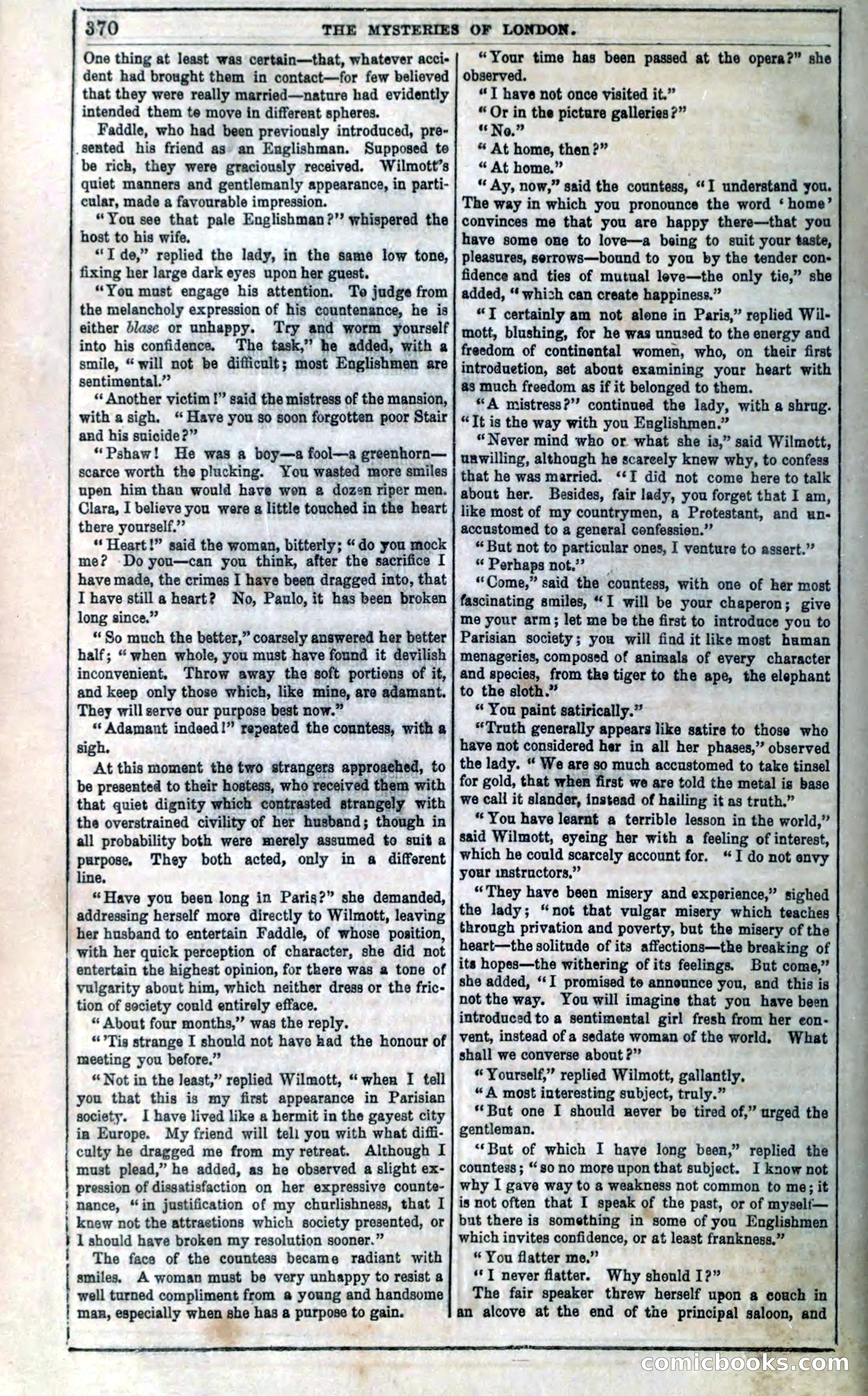
A restored page from Penny Dreadfuls, 1850. Page through the whole issue in the reader above.
📄 Transcribed text from this page (OCR, searchable)
Machine-transcribed from the original scan — historical spelling and the odd misread are preserved.
370 One thing at least was certain—that, whatever acci- dent had brought them in contact—for few believed that they were really married—nature had evidently intended them te move in different spheres. Faddle, who had been previously introduced, pre- .sented his friend as an Englishman. Supposed to be rich, they were graciously received. Wilmott’s quiet manners and gentlemanly appearance, in parti- cular, made a favourable impression. “You see that pale Englishman?’ whispered the host to his wife. “‘T de,” replied the lady, in the same low tone, fixing her large dark eyes upon her guest. “You must engage his attention. To judge from the melancholy expression of his countenance, he is either dlase or unhappy. Try and worm yourself into his confidence. The task,” he added, with a smile, “will not be difficult; most Englishmen are sentimental.” ‘‘ Another victim !” said the mistress of the mansion, with asigh. “Have you so soon forgotten poor Stair and his suicide?” “Pshaw! He was a boy—a fool—a greenhorn— scarce worth the plucking. You wasted more smiles upen him than would have won @ dozen riper men. Clara, I believe you were a little touched in the heart there yourself,” “Heart!” said the woman, bitterly; “do you mock me? Do you—can you think, after the sacrifice I have made, the crimes I have been dragged into, that I have still a heart? No, Paulo, it has been broken long since,” “So much the better,” coarsely answered her better half; “when whole, you must have found it devilish inconvenient, Throw away the soft portiens of it, and keep only those which, like mine, are adamant. They will serve our purpose best now.” “ Adamant indeed!” repeated the countess, with a sigh. At this moment the two strangers approaehed, to be presented to their hostess, who received them with that quiet dignity which contrasted - with the overstrained civility of her husband; though in all probability both were merely assumed to suit a purpose. They both acted, only in a different line. “Have you been long in Paris?” she demanded, addressing herself more directly to Wilmott, leaving her husband to entertain Faddle, of whose position, | with her quick perception of character, she did not entertain the highest opinion, for there was a tone of vulgarity about him, which neither dress or the fric- tion of society could entirely efface. “ About four months,”’ was the reply. “Tig strange I should not have had the honour of meeting you before.” “ Not in the least,” replied Wilmott, “when I tell you that this is my first appearance in Parisian society. I have lived like a hermit in the gayest city in Europe. My friend will tell you with what diffi- culty he dragged me from my retreat. Although I must plead,” he added, as he observed a slight ex- | pression of dissatisfaction on her expressive counte- i} nance, “in justification of my churlishness, that I | knew not the attractions which society presented, or } 1 should have broken my resolution sooner.” The face of the countess became radiant with smiles. A woman must be very unhappy to resist a well turned compliment from a young and handsome | man, especially when she has a purpose to gain. THE MYSTERIES OF LONDON. “Your time has been passed at the opera?” she observed. “T have not once visited it.” “Or in the picture galleries ?” « No.” . * At home, then?” “ At home.” ** Ay, now,” said the countess, “I understand you. The way in which you pronounce the word ‘ home’ * — convinces me that you are happy there—that you | have some one to love—a being to suit your taste, pleasures, serrows—bound to you by the tender con- | fidence and ties of mutual leve—the only tie,” she | added, “which can create happiness.” “T certainly am not alone in Paris,” replied Wil- mott, blushing, for he was unused to the energy and freedom of continental women, who, on their first introduetion, set about examining your heart with as much freedom as if it belonged to them. “A mistress?” continued the lady, with a shrug. “Tt is the way with you Englishmen.” “ Never mind who or what she is,” said Wilmott, | uawilling, although he scareely knew why, to confess that he was married. ‘‘I did not come here to talk about her. Besides, fair lady, you forget that I am, like most of my countrymen, a Protestant, and un- accustomed to a general confessien.”’ “But not to particular ones, I venture to assert.” “ Perhaps not.” “Come,” said the countess, with one of her most fascinating smiles, “I will be your chaperon; give me your arm; let me be the first to introduce you to Parisian society; you will find it like most haman menageries, composed of animals of every character and species, from the tiger to the ape, the elephant to the sloth.” “ You paint satirically.” “Truth generally appears like satire to those who have not considered her in all her phases,” observed the lady. “ We are so much accustomed to take tinsel for gold, that when first we are told the metal is base we call it slander, instead of hailing it as truth.” “You have learnt a terrible lesson in the world,” said Wilmott, eyeing her with a feeling of interest, which he could scarcely account for. “I do not envy your instructors,” “They have been misery and experience,” sighed the lady; “not that vulgar misery which teaches through privation and poverty, but the misery of the heart—the solitude of its affections—the breaking of its hopes—the withering of its feelings. But come,” she added, “I promised te announce you, and this is not the way. You will imagine that you have been introduced to a sentimental girl fresh from her eon- vent, instead of a sedate woman of the world. What shall we converse about ?” “Yourself,” replied Wilmott, gallantly, “A most interesting subject, truly.” But one I should never be tired of,” urged the gentleman. | ‘*But of which I have long been,” replied the countess ; “so no more upon that subject. I know not why I gave way to a weakness not common to me; it is not often that I speak of the past, or of myself— but there is something in some of you Englishmen which invites confidence, or at least frankness.” : a ‘IT never flatter. Why should I?” ‘ = The fair speaker threw herself upon a couch in an alcove at the end of the principal saloon, and | eae . +