
Penny Dreadfuls, 1850 · page 306 of 394
The Mysteries of London; or, Lights and Shadows of London Life — page 306: what you’re looking at
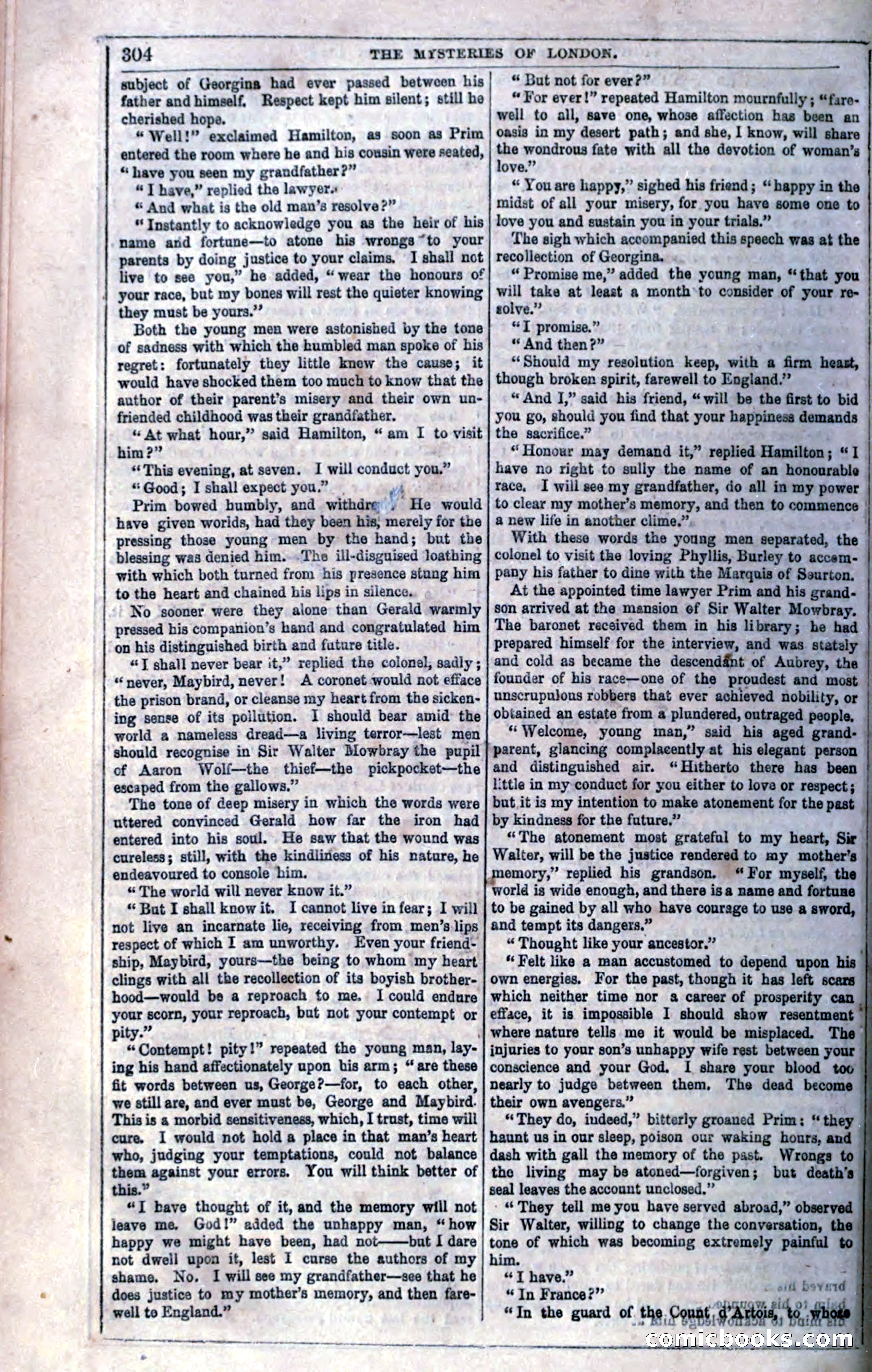
A restored page from Penny Dreadfuls, 1850. Page through the whole issue in the reader above.
📄 Transcribed text from this page (OCR, searchable)
Machine-transcribed from the original scan — historical spelling and the odd misread are preserved.
i ee ee 8 a a —_ i ie a —— Daal i a ' ———— > 304 THE MYSTERIES OF LONDON. subject of Georgina had ever passed between his father and himself, Respect kept him silent; still he cherished hope. “Well!” exclaimed Hamilton, as soon as Prim entered the room where he and his cousin were seated, “ have you seen my grandfather?” “T have,” replied the lawyers “ And what is the old man’s resolve?” “Instantly to acknowledge you as the heir of his name and fortune—to atone his wrongs “to your parents by doing justice to your claims, I shall not live to see you,” he added, “wear the honours of | your race, but my bones will rest the quieter knowing they must be yours.” Both the young men were astonished by the tone of sadness with which the humbled man spoke of his fortunately they little knew the cause; it would have shocked them too much to know that the author of their parent’s misery and their own un- regret: friended childhood was their grandfather. ‘At what hour,” said Hamilton, “am I to visit him?” * This evening, at seven. I will ir you,” “Good; I shall expect you.” Prim bowed bumbly, and withdre’’' * He would have given worlds, had they been his, merely for the pressing those young men by the hand; but the blessing was denied him...The ill-disguised loathing with which both turned from his presence stung him to the heart and chained his lips in silence. No sooner were they alone than Gerald warmly pressed his companion’s hand and congratulated him on his distinguished birth and future title. “J shall never bear it,” replied the colonel, sadly ; “ never, Maybird, never! A coronet would not efiace the prison brand, or cleanse my heart from the sicken- ing sense of its pollution. I should bear amid the world a nameless dread—a living terror—lest men should recognise in Sir Walter Mowbray the pupil of Aaron Wolf—the thief—the pickpockst—the escaped from the gallows.” The tone of deep misery in which the words were uttered convinced Gerald how far the iron had entered into his soul. He saw that the wound was cureless; still, with the kindliness of his nature, he endeavoured to console him. “ The world will never know it.” “ But I shall knowit. I cannot live in fear; I will not live an incarnate lie, receiving from men’s.lips respect of which I am unworthy. Even your friend- ship, Maybird, yours—the being to whom my heart clings with all the recollection of its boyish brother- hood—would be a reproach to me. I could endure your scorn, your reproach, but not your contempt or pity.” “Contempt! pity!” repeated the young man, lay- ing his hand affectionately upon his arm; “ are these fit words between us, George?—for, to each other, we still are, and ever must be, George and Maybird. This is a morbid sensitiveness, which, I trust, time will cure. I would not hold a place in that man’s heart who, judging your temptations, could not balance them against your errors. You will think better of this.” “J bave thought of it, and the memory will not leave me. God!” added the unhappy man, “how happy we might have been, had not——but I dare not dwell upon it, lest 1 curse the authors of my shame. No. I will see my grandfather—see that he does justice to my mother’s memory, and then fare- well to England.” nC OmicI{OOKS.cOmM “ But not for ever?” “For ever!” repeated Hamilton mournfully; “fare- well to all, save one, whose affection has been an oasis in my desert path; and she, I know, will share me wondrous fate with all the devotion of woman’s ove.” “ You are happy,” sighed his friend; “happy in the midst of all your misery, for you have some one to love you and sustain you in your trials.” The sigh which accompanied this speech was at the recollection of Georgina. . “ Promise me,” added the young man, “that you will take at least a month to consider of 42 re- solve.” “JT promise,” * And then?” | “Should my resolution keep, with a , firm heast, | though broken spirit, farewell to England.” | “And I,” said his friend, “will be the first to bid | you go, should you find that your happiness demands the sacrifice.” “ Honowr may demand it,” replied- Hamilton ; “T% have no right to sully the name of an honourable | race, I will see my grandfather, do all in my power | to clear my mother’s memory, and then to commence | a new life in another clime.”, With these words the young men separated, the colonel to visit the loving Phyllis, Burley to accem- pany his father to dine with the Marquis of Ssurton. At the appointed time lawyer Prim and his grand- son arrived at the mansion of Sir Walter Mowbray. | The baronet received them in his library; he had | prepared himself for the interview, and was stately and cold as became the descendnt of ee the founder of his race—one of the proudest and most unscrupulous robbers that ever achieved nobility, or obtained an estate from a plundered, outraged people, “Welcome, young man,” said his aged grand- parent, glancing complacently at his elegant person little in my conduct for you either to love or respect; but it is my intention to make atonement for the past by kindness for the fu to be gained by all who have courage to use a sword, and tempt its dangers.” “ Thought like your ancestor.” “Felt like a man accustomed to depend upon his own energies. For the past, though it has left SCARS which neither time nor a career of prosperity c efface, it is impossible I should show resentment | where nature tells me it would be misplaced. The | jnjuries to your son’s unhappy wife rest between you conscience and your God. I share your blood 00) nearly to judge between them, The dead become: their own avengers.” “They do, indeed,” bitterly groaned Prim; “they, haunt us in our sleep, poison our waking hours, and dash with gall the memory of the past. Wrongs t the living may be atoned—forgiven; but dea * seal leaves the account unclosed,” - “They tell me you have served abroad,” vray <> Sir Walter, willing to change the conversation, t tone of which was becoming extremely painful t him. - “T have.” 34 iq ~ sale - olf vail “In the guard of the Count ¢ A rtoi 7 0, Whoke he