
Penny Dreadfuls, 1850 · page 305 of 394
The Mysteries of London; or, Lights and Shadows of London Life — page 305: what you’re looking at
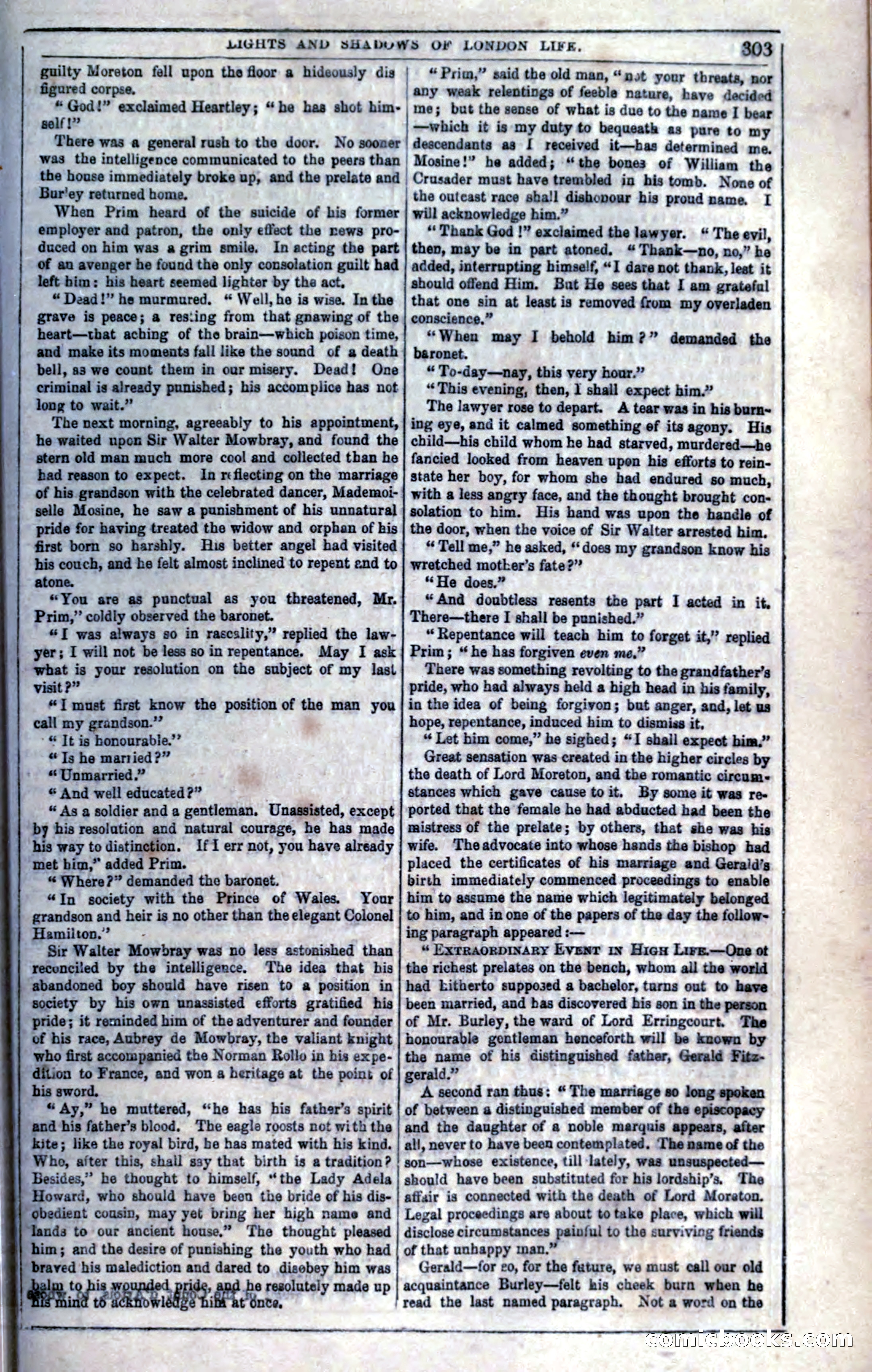
A restored page from Penny Dreadfuls, 1850. Page through the whole issue in the reader above.
📄 Transcribed text from this page (OCR, searchable)
Machine-transcribed from the original scan — historical spelling and the odd misread are preserved.
guilty Moreton fell upon the floor a hideously dis d co “God!” exclaimed Heartley; “be has shot him- self!” There was a general rush to the door. No sooner Bur'ey returned home. When Prim heard of the suicide of his former employer and patron, the only effect the news pro- | duced on him was a grim smile. In acting the part | Of an avenger he found the only consolation guilt had | left him: his heart seemed lighter by the act, i “Dead!” he murmured. “ Well, he is wise. In the | grave is peace; a res:ing from that gnawing of the heart—that aching of the brain—which poison time, and make its moments fall like the sound of a death bell, as we count them in our misery. Dead! One criminal is already punished; his accomplice has not | long to wait.” fe _ The next morning, agreeably to his appointment, | he waited npon Sir Walter Mowbray, and found the stern old man much more cool and collected than he bad reason to expect. In reflecting on the marriage of his grandson with the celebrated dancer, Mademoi- selle Mosine, he saw a punishment of his unnatural pride for having treated the widow and orphan of bis first born so harshly. His better angel had visited his couch, and he felt almost inclined to repent and to atone. “You are as punctual as you threatened, Mr. Prim,” coldly observed the baronet. “TI was always so in rascslity,” replied the law- yer; I will not be less so in repentance. May I ask what is your resolution on the subject of my last visit ?” “T must first know the position of the man you call my grandson.” ’* Tt is honourablie.”’ “Ts he married ?” “ Unmarried.” . “ And well educated?” | “ As a soldier and a gentleman. Unassisted, except by his resolation and natural courage, he has made his way to distinction. If 1 err not, you have already met him,” added Prim. “ Where?” demanded the baronet. “In society with the Prince of Wales. Your | grandson and heir is no other than the elegant Colonel Sir Walter Mowbray was no less astonished than | reconciled by the intelligence. The idea that bis } abandoned boy should have risen to a position in society by his own unassisted efforts gratified his pride; it reminded him of the adventurer and founder of his race, Aubrey de Mowbray, the valiant knight who first accompanied the Norman Rollo in his expe- dition to France, and won a heritage at the point of his sword. “ Ay,” he muttered, “he has his father’s spirit pnd his father’s blood. The eagle roosts not with the _ kite; like the royal bird, be has mated with his kind. "Who, after this, shall ssy that birth is a tradition? | Besides,” he thought to himself, “the Lady Adela 1 oward, who should have been the bride of his dis- “Obedient cousin, may yet bring her high name and Tands to our ancient house.” The thought pleased } bim; and the desire of punishing the youth who had ved his malediction and dared to disebey him was ». i y ’ a ‘ L ridé Ane he resolutely made up ‘ abbete " Rd ala Wied li ae Aas ay. ‘7 ' Ais 7 LIGHTS AND SHADUWS OF LONDON LIFE, 303 “Prim,” said the old man, “not your threats, nor any weak relentings of feeble nature, have decided me; but the sense of what is due to the name I bear —which it is my duty to bequeath as pure to my descendants as I received it—hbas determined me. was the intelligence communicated to the peers than | Mosine!” he added; “the bones of William the the house immediately broke up, and the prelate and | Crusader must have trembled in his tomb. None of the outeast race sha!l dishopour his proud name. I will acknowledge him.” Thank God !” exclaimed the lawyer. “ The evil, then, may be in part atoned. “Thank—no, no,” he added, interrupting himse!f, “I dare not thank, lest it should offend Him. But He sees that I am gratefal that one sin at least is removed from my overladen conscience,” “When may I behold him?” demanded the baronet. “ To-day—nay, this very hour.” “This evening, then, I shall expect him.” The lawyer rose to depart. A tear was in his burn~ ing eye, and it calmed something ef its agony. His child—his child whom he had starved, murdered—he fancied looked from heaven upon his efforts to rein- state her boy, for whom she bad endured so much, with a less angry face, and the thought brought con- solation to him. His hand was upon the handle of the door, when the voice of Sir Walter arrested him. “ Tell me,” he asked, *‘ does my grandson know his wretched mother’s fate?” “He does,” “And doubtless resents the part I acted in it, There—there I shall be punished.” “ Repentance will teach him to forget it,” replied Prim; “ he has forgiven even me.” There was something revolting to the grandfather’s pride, who had always held a high head in his family, in the idea of being forgivon; but anger, and, let us hope, repentance, induced him to dismiss it, “ Let him come,” he sighed; “I shail expect bim,’ Great sensation was created in the higher circles by the death of Lord Moreton, and the romantic circum. stances which gave cause toit. By some it was re- ported that the female he had abducted had been the mistress of the prelate; by others, that she was his wife. Theadvocate into whose hands the bishop had placed the certificates of his marriage and Gerald’s birth immediately commenced proceedings to enable him to assume the name which legitimately belonged to him, and in one of the papers of the day the follow- ing paragraph appeared :-— “ EXTRAORDINARY Event in Hicu Lirs.—One ot the richest prelates on the bench, whom ail the world had Litherto supposed a bachelor, turns out to have been married, and bas discovered bis son in the person of Mr. Burley, the ward of Lord Erringcourt. The honourable gentleman henceforth will be known by the name of his distinguished father, Gerald Fitz- gerald.” all, never to have been contemplated. The name of the son—whose existence, till lately, was should have been substituted for his lordship’s. The affair is connected with the death of Lord Moreton. Legal proceedings are about to take place, which will disclose circumstances peinful to the surviving friends of that unhappy man. Gerald—for eo, for the fature, we must call our old acquaintance Burley—felt his cheek burn when he read the last named paragraph. Not a word on the MLCLOOOLS (SO) i) (E©) mM