
Penny Dreadfuls, 1850 · page 286 of 394
The Mysteries of London; or, Lights and Shadows of London Life — page 286: what you’re looking at
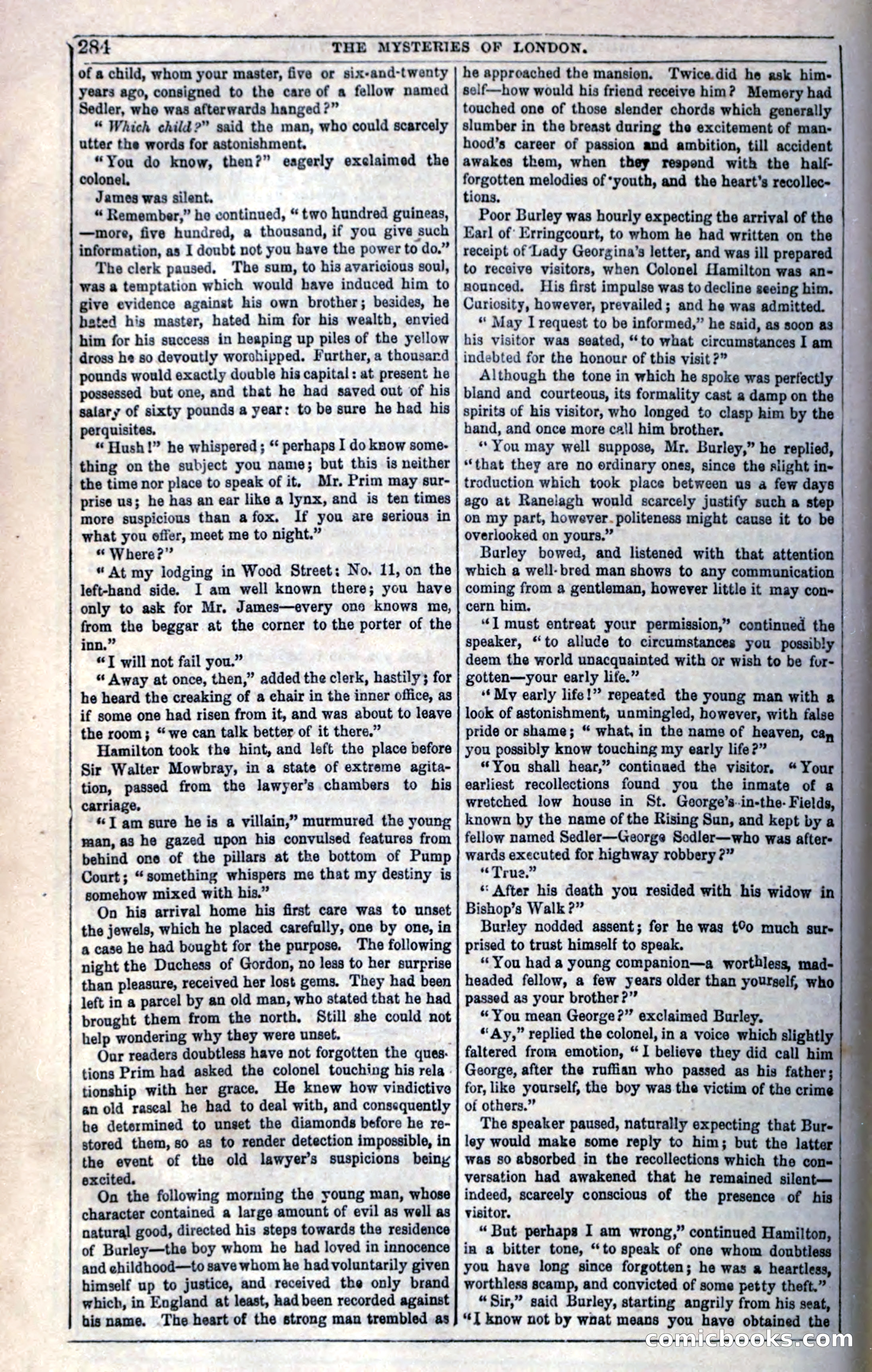
A restored page from Penny Dreadfuls, 1850. Page through the whole issue in the reader above.
📄 Transcribed text from this page (OCR, searchable)
Machine-transcribed from the original scan — historical spelling and the odd misread are preserved.
284 of a child, whom your master, five or six-and-twenty years ago, consigned to the care of a fellow named Sedler, who was afterwards hanged?” “ Which child?” said the man, who could scarcely utter the words for astonishment. “You do know, then?” eagerly exclaimed the colonel, James was silent. «“ Remember,” he continued, “two hundred guineas, —more, five hundred, a thousand, if you give such information, as I doubt not you have the power to do,” The clerk paused. The sum, to his avaricious soul, was a temptation which would have induced him to give evidence against his own brother; besides, he bated his master, hated him for his wealth, envied him for his success in heaping up piles of the yellow dross he so devoutly worshipped. Further, a thousard pounds would exactly double his capital: at present he but one, and that he had saved out of his salary of sixty pounds a year: to be sure he had his perquisites, “ Hush!” he whispered ; ** perhaps I do know some- thing on the subject you name; but this is neither the time nor place to speak of it, Mr. Prim may sur- prise us; he has an ear like a lynx, and is ten times more suspicious than a fox. If you are serious in what you offer, meet me to night.” * Where?” “At my lodging in Wood Street; No. 11, on the left-hand side. I am well known there; you have only to ask for Mr. James—every one knows me, from the beggar at the corner to the porter of the inn.” “T will not fail you.” “ Away at once, then,” added the clerk, hastily} for he heard the creaking of a chair in the inner office, as if some one had risen from it, and was about to leave the room; “we can talk better of it there.” Hamilton took the hint, and left the place before Sir Walter Mowbray, in a state of extreme agita- tion, passed from the lawyer’s chambers to his e, ‘T am sure he is a villain,” murmured the young yaan, as he gazed upon his convulsed features from behind one of the pillars at the bottom of Pump Court; “something whispers me that my destiny is somehow mixed with his.” On his arrival home his first care was to unset the jewels, which he placed carefully, one by one, in a case he had bought for the purpose. The following night the Duchess of Gordon, no less to her surprise than pleasure, received her lost gems. They had been left in a parcel by an old man, who stated that he had brought them from the north. Still she could not help wondering why they were unset. . Our readers doubtless have not forgotten the ques. tions Prim had asked the colonel touching his rela - tionship with her grace. He knew how vindictive an old raseal he had to deal with, and consequently he determined to unset the diamonds before he re- stored them, so as to render detection impossible, in the event of the old lawyer’s suspicions beiny excited. On the following morning the young man, whose character contained a large amount of evil as well as natural good, directed his steps towards the residence of Burley—the boy whom he had loved in innocence and ehildhood—to save whom he had voluntarily given himself up to justice, and received the only brand which, in England at least, had been recorded against bis name. The heart of the strong man trembled as i a Ee CQMicboo THE MYSTERIES OF LONDON. he approached the mansion. Twice.did he ask him- self—how would his friend receive him? Memery had touched one of those slender chords which generally slumber in the breast during the excitement of man- hood’s career of passion and ambition, till accident awakes them, when they respond with the half- forgotten melodies of ‘youth, and the heart's recollec- tions. Poor Burley was hourly expecting the arrival of the Earl of Erringcourt, to whom he had written on the receipt of Lady Georgina’s letter, and was ill prepared to receive visitors, when Colonel Hamilton was an- nounced. His first impulse was to decline seeing him. Curiosity, however, prevailed; and he was admitted. “ May I request to be informed,” he said, as soon a3 his visitor was seated, “to what circumstances I am indebted for the honour of this visit ?” Although the tone in which he spoke was perfectly bland and courteous, its formality cast a damp on the spirits of his visitor, who longed to clasp him by the | hand, and once more call him brother, “You may well suppose, Mr. Burley,” he replied, | “that they are no erdinary ones, since the slight in- | — troduction which took place between us a few ago at Ranelagh would scarcely justify such a step on my part, however. politeness might cause it to be overlooked on yours.” Burley bowed, and listened with that attention which a well-bred man shows to any communication coming from a gentleman, however little it may con~ | cern him. 4 “I must entreat your permission,” continued the | speaker, “to allude to circumstances you possibly | deem the world unacquainted with or wish to be fur- | gotten—your early life.” ‘My early life!” repeated the young man with a look of astonishment, unmingled, however, with false pride or shame; “ what, in the name of heaven, cay | you possibly know touching my early life?” | “You shall hear,” contiaued the visitor, “Your | earliest recollections found you the inmate of a wretched low house in St. George’s.in-the- Fields, | known by the name of the Rising Sun, and kept by a | fellow named Sedler—George Sodler—who was after- | wards executed for highway robbery 2?” | “Trae. i ; ‘After his death you resided with his widow in| Bishop’s Walk ?” | Burley nodded assent; fer he was t°0 much sur- prised to trust himself to speak. b “You had a young companion—a worthless, mad- | headed fellow, a few years older than yourself, who | passed as your brother?” | “You mean George?” exclaimed Burley, “Ay,” replied the colonel, in a voice which slightly | faltered from emotion, “I believe they did call him | George, after the ruffian who passed as his father ; | for, like yourself, the boy was the victim of the crime | of others.” ’ The speaker paused, naturally expecting that Bure h ley would make some reply to him; but the latter | was so absorbed in the recollections which the con= | versation had awakened that he remained silent— | indeed, scareely conscious of the presence of his | visitor. “But perhaps 1 am wrong,” continued Hamil in a bitter tone, “to speak of one whom dc yy you have long since forgotten; he was a heartless, | worthless scamp, and convicted of some petty theft.” “Sir,” said Burley, starting angrily from his seat, | “I know not by wnat means you have obtained the | i