
Penny Dreadfuls, 1850 · page 285 of 394
The Mysteries of London; or, Lights and Shadows of London Life — page 285: what you’re looking at
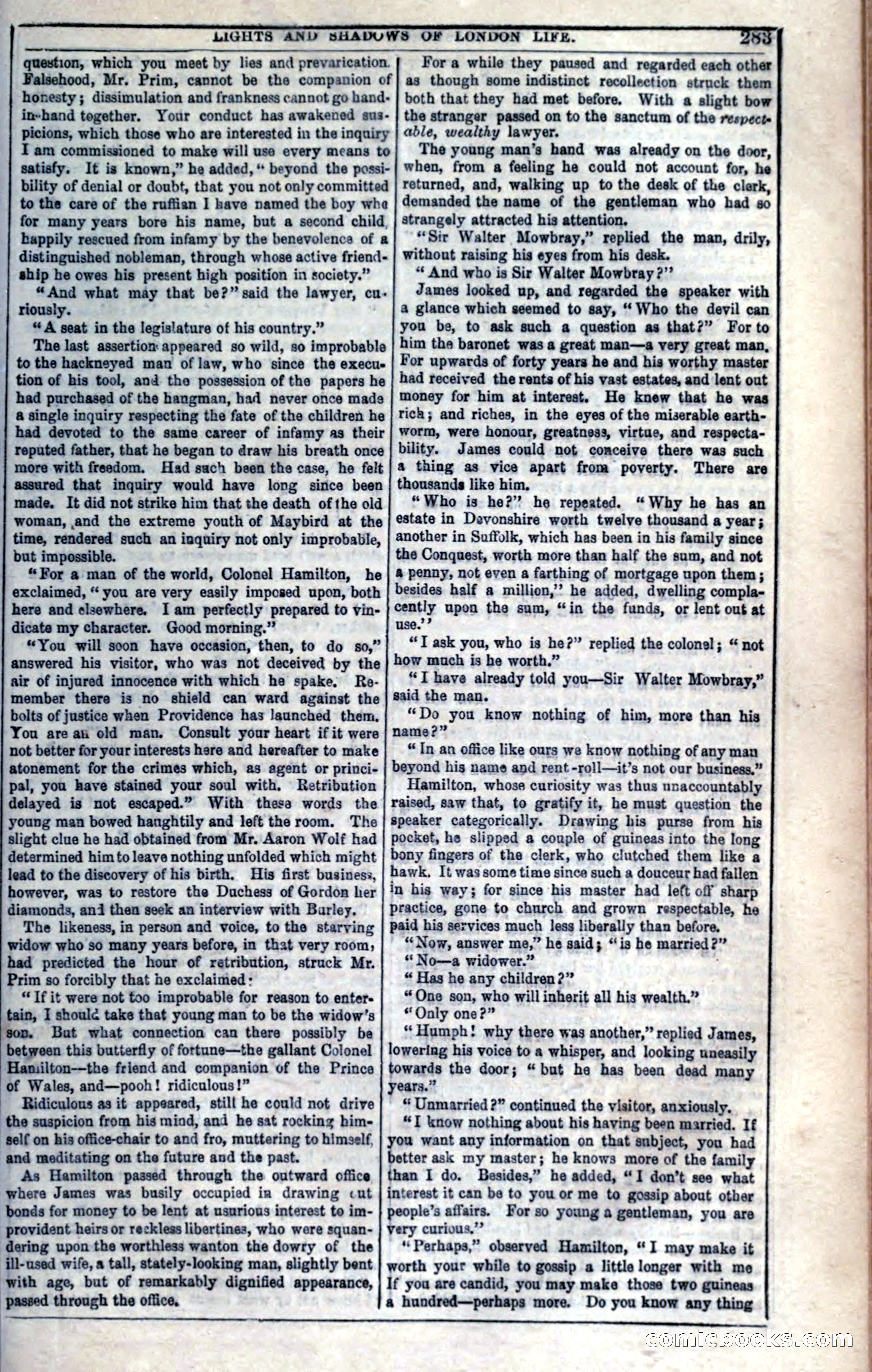
A restored page from Penny Dreadfuls, 1850. Page through the whole issue in the reader above.
📄 Transcribed text from this page (OCR, searchable)
Machine-transcribed from the original scan — historical spelling and the odd misread are preserved.
for many years bore his name, but a second child, distinguished ship he owes his present high position in society.” “A seat in the legislature of his country.” that did woman, and rendered such an inquiry not only improbable, but im exclaimed, “ you are very easily imposed upon, both here and elsewhere. Iam perfectly prepared to vin- dicate my character. Good morning.” “You will soon have occasion, then, to do s0, Re- bolts of justice when Providence has Iaunched them. You are ai old man. Consult your heart if it were not better for your interests here and hereafter to make atonement for the crimes which, as agent or princi- pal, you have stained your soul with. Retribution delayed is not escaped.” With thesa words the young man bowed hanghtily and left the room. The slight clue he had obtained from Mr. Aaron Wolf had determined him to leave nothing unfolded which might lead to the discovery of his birth. His first business, however, was to restore the Duchess of Gordon her diamonds, ani then seek an interview with Burley. The likeness, in person and voice, to the starving widow who so many years before, in that very room, had predicted the hour of retribution, struck Mr. Prim so forcibly that he exclaimed: “If it were not too improbable for reason to enter- tain, I shoulc take that young man to be the widow’s , Bat what connection can there possibly be this butterfly of fortune—the gallant Colonel Haniilton—the friend and companion of the Prince of Wales, and—pooh! ridiculous!” Ridiculous as it appeared, still he could not drive the suspicion from his miad, and he sat rocking him- self on his office-chair to and fro, muttering to himself, and meditating on the future and the past. As Hamilton passed through the outward office where James was busily occupied in drawing cut bonds for money to be lent at usurious interest to im- provident heirs or reckless libertines, who were squan- upon the worthless wanton the dowry of the i used wife, a tall, stately-looking man, slightly bent th age, but of remarkably dignified appearance, passed through the office, LIGHTS AND SHADUWS OF question, which you meet by lies and prevarication. Falsehood, Mr. Prim, cannot be the companion of honesty; dissimulation and frankness cannot go hand- in-band tegether. Your conduct has awakened sus- | the picions, which those who are interested in the inquiry I am commissioned to make will use every means to satisfy. It is known,” he added,“ beyond the possi- bility of denial or doubt, that you not only committed to the care of the ruffian I have named the boy whe bappily rescued from infamy by the benevolence of a nobleman, through whose active friend- “And what may that be?” said the lawyer, cu- The last assertion appeared so wild, so improbable to the hackneyed man of law, who since the execu- tion of his tool, and the possession of the papers he Had sach edits cone he felt inquiry would have long since been not strike him that the death ofthe old the extreme youth of Maybird at the possible. “For a man of the world, Colonel Hamilton, he answered his visitor, who was not deceived by the wT LONDON LIFE. 25% For a while they paused and regarded each other as though some indistinct recollection struck them both that they had met before. With a slight bow stranger passed on to the sanctum of the respecte able, wealthy lawyer. The young man’s hand was already on the door, when, from a feeling he could not account for, he returned, and, walking up to the desk of the clerk, demanded the name of the gentleman who had go strangely attracted his attention, “Sir Walter Mowbray,” replied the man, drily, without raising his eyes from his desk. “ And who is Sir Walter Mowbray ?’’ James looked up, and regarded the speaker with a glance which seemed to say, “Who the devil can you be, to ask such a question as that?” For to him the baronet was a great man—a very great man, For upwards of forty years he and his worthy master had received the rents of his vast estates, and lent out money for him at interest. He knew that he was rick; and riches, in the eyes of the miserable earth- worm, were honour, greatness, virtue, and respecta- bility. James could not conceive there was such a thing as vice apart from poverty. There are thousands like him, “Who is he?” he repeated. “Why he has an estate in Devonshire worth twelve thousand a year; another in Suffolk, which has been in his family since the Conquest, worth more than half the sum, and not & penny, not even a farthing of mortgage upon them; besides half a million,’ he added, dwelling compla- cently upon the sum, “in the funds, or lent out at use.’ “T ask you, who is he?” replied the colonel; “ not how much is he worth,” “I have already told you—Sir Walter Mowbray,” said the man. “Do you know nothing of him, more than his name?” “In an office like ours we know nothing of any man beyond his name and rent -roll—it’s not our business,” Hamilton, whose curiosity was thus unaccountably raised, saw that, to gratify it, he must question the speaker categorically. Drawing his purse from his pocket, he slipped a couple of guineas into the long bony fingers of the clerk, who clutched them like a hawk. It was some time since such a douceur had fallen in his way; for since his master had left off sharp practice, gone to church and grown respectable, he paid his services much less liberally than before. ‘Now, answer me,” he said; “is he married a “ No—a widower.” “ Has he any children?” “One son, who will inherit all his wealth.” * Only one?” “ Humph! why there was another,” replied James, lowering his voice to a whisper, and looking uneasily fowards the door; “but he has been dead many years.” “ Unmarried 2” continued the visitor, anxiously, “T know nothing about his having been married. If bat want any information on that subject, you had tter ask my master; he knows more of the family than I do. Besides,” he added, “I don’t see what interest it can be to you or me to gossip about other people’s affairs. For so young a gentleman, you are very curious,” “Perhaps,” observed Hamilton, “I may make it worth your while to gossip a little longer with me If you are candid, you may make those two guineas a hundred—perhaps more. Do you know any thing CORNICLOO S (EO)