
Penny Dreadfuls, 1850 · page 263 of 394
The Mysteries of London; or, Lights and Shadows of London Life — page 263: what you’re looking at
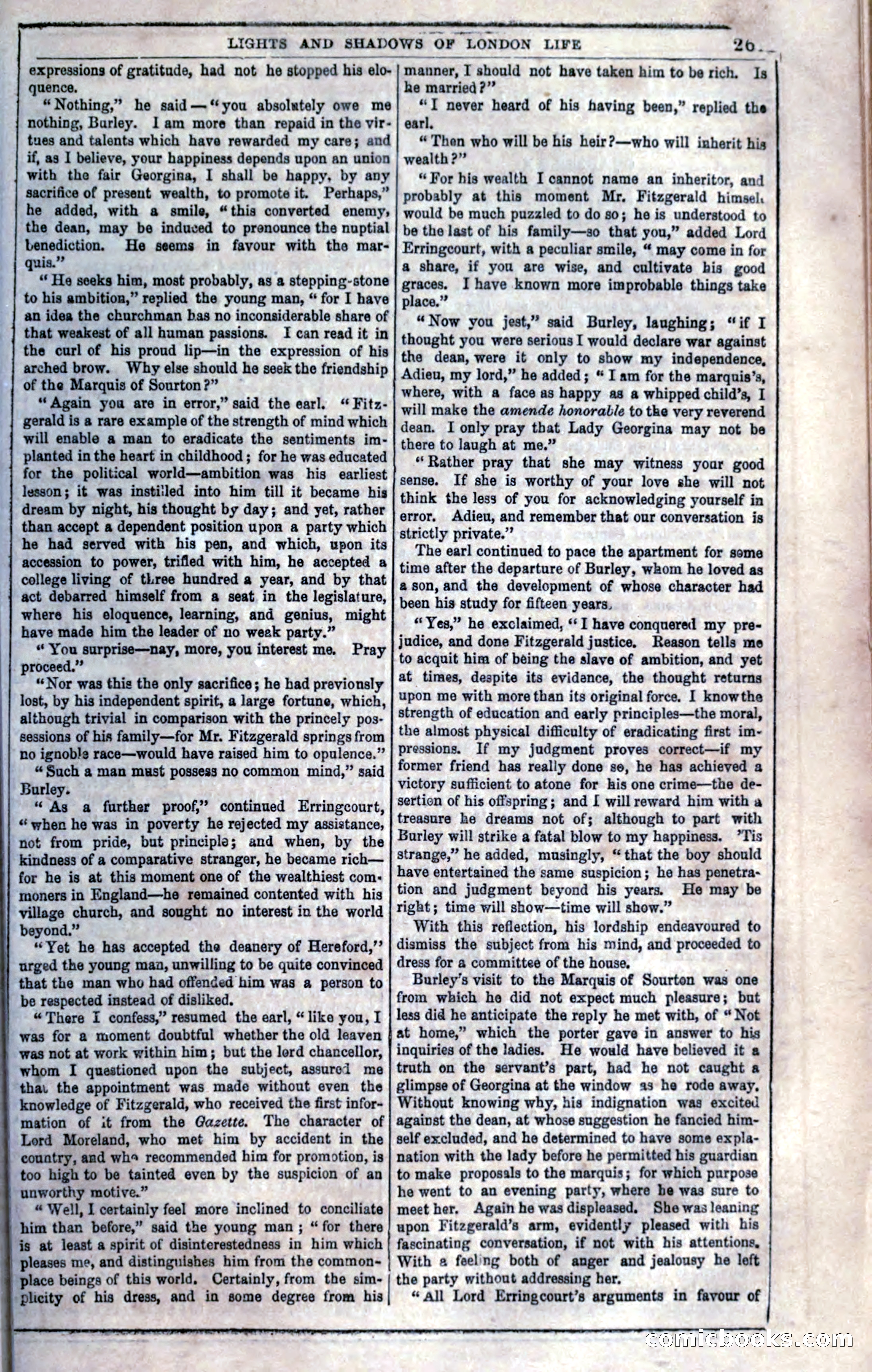
A restored page from Penny Dreadfuls, 1850. Page through the whole issue in the reader above.
📄 Transcribed text from this page (OCR, searchable)
Machine-transcribed from the original scan — historical spelling and the odd misread are preserved.
LIGHTS AND SHADOWS OF I LONDON | LIFE 20._ } ec expressions of gratitude, had not ot he stopped his elo- manner, T should not not have t taken him to be rich, Is quence, “Nothing,” he said—‘‘you absolutely owe me nothing, Burley. I am more than repaid in the vir- tues and talents which have rewarded my care; and if, as I believe, your happiness depends upon an union with the fair Georgina, I shall be happy, by any sacrifice of present wealth, to promote it. Perhaps,” he added, with a smile, “this converted enemy, the dean, may be induced to pronounce the nuptial benediction. He seems in favour with the mar- ” “‘ He seeks him, most probably, as a stepping-stone to his ambition,” replied the young man, “ for I have an idea the churchman bas no inconsiderable share of that weakest of all human passions. I can read it in the curl of his proud lip—in the expression of his arched brow. Why else should he seek the friendship of the Marquis of Sourton?” _— “Again you are in error,” said the earl, “ Fitz- gerald is a rare example of the strength of mind which will enable a man to eradicate the sentiments im- planted in the heart in childhood; for he was educated for the political world—ambition was his earliest lesson; it was instilled into him till it became his dream by night, his thought by day; and yet, rather than accept a dependent position upon a party which he had served with his pen, and which, upon its accession to power, trifled with him, he accepted a college living of three hundred a year, and by that act debarred himself from a seat in the legislature, where his eloquence, learning, and genius, might have made him the leader of no week party.” “ You surprise—nay, more, you interest me. Pray ” “Nor was this the only sacrifice; he had previonsly lost, by his independent spirit, a large fortune, which, although trivial in comparison with the princely pos- sessions of his family—for Mr. Fitzgerald springs from no ignoble race—would have raised him to opulence.” “Such a man must possess no common mind,” said Burley. “As a further proof,’ continued Erringcourt, “when he was in poverty he rejected my assistance, not from pride, but principle; and when, by the kindness of a comparative stranger, he became rich— for he is at this moment one of the wealthiest com. moners in England—he remained contented with his | village church, and sought no interest in the world beyond.” “Yet he has accepted the deanery of Hereford,’’ urged the young maa, unwilling to be quite convinced that the man who had offended him was a person to be respected instead of disliked. “There I confess,” resumed the earl, “like you, I was for a moment doubtful whether the old leaven was not at work within him; but the lerd chancellor, I questioned upon the subject, assured me ‘that the appointment was made without even the knowledge of Fitzgerald, who received the first infor- ‘mation of it from the Gazette. The character of Lord Moreland, who met him by accident in the country, and whe recommended him for promotion, is too high to be tainted even by the suspicion of an unworthy motive.” _ “Well, I certainly feel more inclined to conciliate him than before,” said the young man ; “for there is at least a spirit of disinterestedness in him which pleases me, and distinguishes him from the common- place beings of this world. Certainly, from the sim- plicity of his dress, and in some degree from his he married ?” “T never heard of his having been,” replied the earl, “Then who will be his heir?—who will inherit his wealth ?” “ For his wealth I cannot name an inheritor, and probably at this moment Mr, Fitzgerald himsel, would be much puzzled to do so; he is understood to be the last of his family—so that you,” added Lord Erringcourt, with a peculiar smile, “ may come in for a share, if you are wise, and cultivate his good graces. I have known more improbable things take place.” “Now you jest,” said Burley, laughing; “if I thought you were serious I would declare war against the dean, were it only to show my independence, Adieu, my lord,” he added; “ I am for the marquis’s, where, with a face as happy as a whipped child’s, I will make the amende honorable to the very reverend dean. I only pray that Lady Georgina may not be there to laugh at me,” “Rather pray that she may witness your good sense. If she is worthy of your love she will not think the less of you for acknowledging yourself in error. Adieu, and remember that our conversation is strictly private.” The earl continued to pace the apartment for some time after the departure of Burley, whom he loved as ason, and the development of whose character had been his study for fifteen years, “Yes,” he exclaimed, “I have conquered my pre- judice, and done Fitzgerald justice, Reason tells me to acquit him of being the slave of ambition, and yet at times, despite its evidence, the thought returns upon me with more than its original force. I knowthe strength of education and early principles—the moral, the almost physical difficulty of eradicating first im- pressions. If my judgment proves correct—if my former friend has really done se, he has achieved a victory sufficient to atone for his one crime—the de- sertion of his offspring; and [ will reward him with a treasure he dreams not of; although to part with Burley will strike a fatal blow to my happiness. *Tis strange,” he added, musingly, “that the boy should have entertained the same suspicion; he has penetra- tion and judgment beyond his years. He may be right; time will show—time will show.” With this reflection, his lordship endeavoured to dismiss the subject from his mind, and proceeded to dress for a committee of the house. Burley’s visit to the Marquis of Sourten was one from which he did not expect much pleasure; but less did he anticipate the reply he met with, of “* Not at home,” which the porter gave in answer to his inquiries of the ladies. He would have believed it a truth on the servant’s part, had he not caught a glimpse of Georgina at the window a3 he rode away, Without knowing why, his indignation was excited against the dean, at whose suggestion he fancied him- self excluded, and he determined to have some expla- nation with the lady before he permitted his guardian to make proposals to the marquis; for which purpose he went to an evening party, where he was sure to meet her, Again he was displeased. She was leaning upon Fitzgerald’s arm, evidently pleased with his fascinating conversation, if not with his attentions, With a feeling both of anger and jealousy he left the party without addressing her. “ All Lord Erringcourt’s arguments in favour of mM eLo@e) S (C() im (CO)