
Penny Dreadfuls, 1850 · page 262 of 394
The Mysteries of London; or, Lights and Shadows of London Life — page 262: what you’re looking at
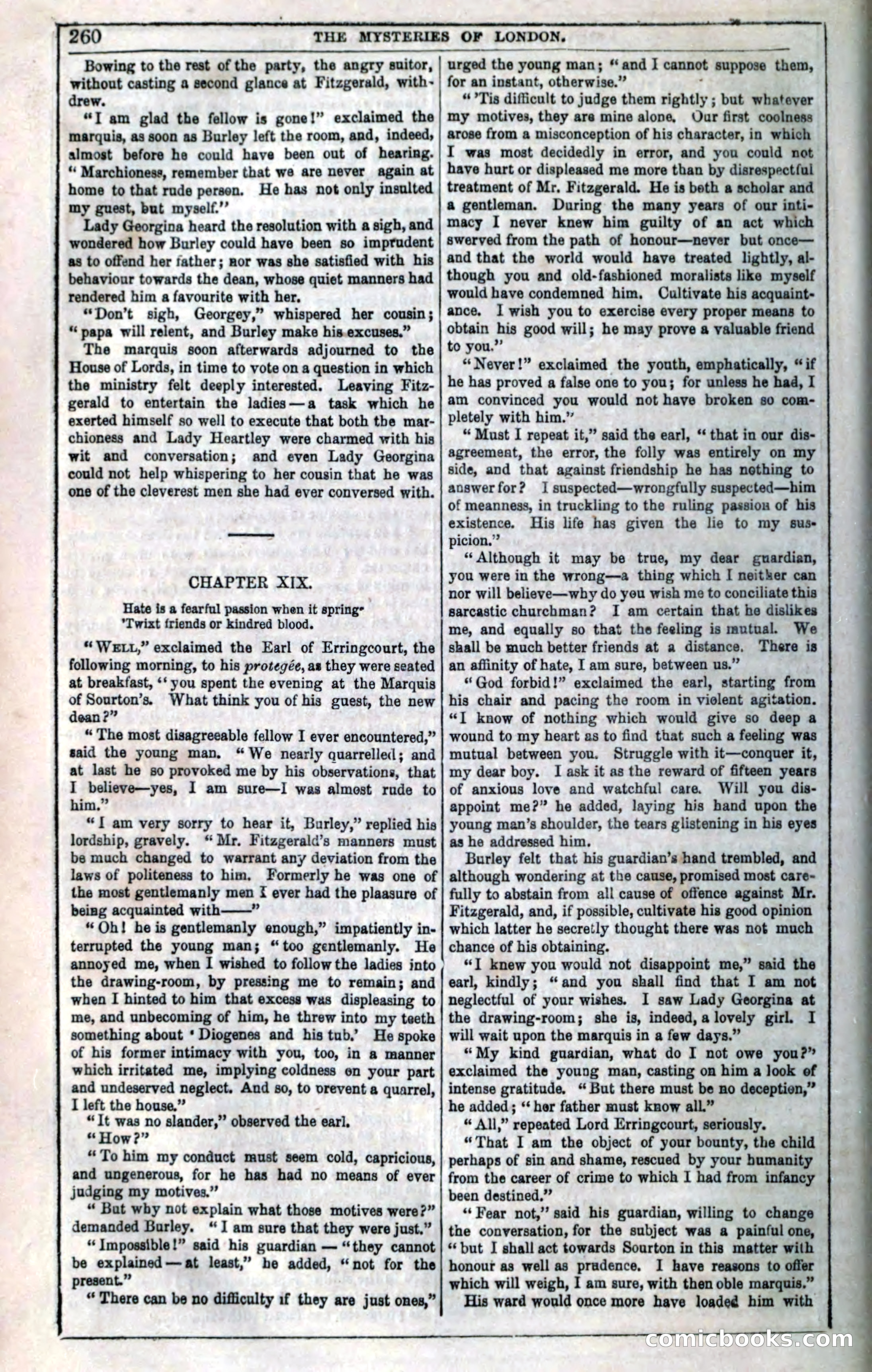
A restored page from Penny Dreadfuls, 1850. Page through the whole issue in the reader above.
📄 Transcribed text from this page (OCR, searchable)
Machine-transcribed from the original scan — historical spelling and the odd misread are preserved.
260 Bowing to the rest of the party, the angry suitor, without casting a second glance at Fitzgerald, with- drew. “T am glad the fellow is gone!” exclaimed the marquis, as soon as Burley left the room, and, indeed, almost before he could have been out of hearing. “ Marchioness, remember that we are never again at home to that rude person. He has not only insulted my guest, but myself.”’ Lady Georgina heard the resolution with a sigh, and wondered how Burley could have been so imprudent as to offend her father; nor was she satisfied with his behaviour towards the dean, whose quiet manners had rendered him a favourite with her, “Don’t sigh, Georgey,” whispered her cousin; “papa will relent, and Burley make his.excuses,” The marquis soon afterwards adjourned to the House of Lords, in time to vote on a question in which the ministry felt deeply interested. Leaving Fitz- gerald to entertain the ladies—a task which he exerted himself so well to execute that both the mar- chioness and Lady Heartley were charmed with his wit and conversation; and even Lady Georgina could not help whispering to her cousin that he was one of the cleverest men she had ever conversed with. CHAPTER XIX. Hate is a fearful passion when it springs *Twixt friends or kindred blood. “WELL,” exclaimed the Earl of Erringcourt, the following morning, to his protegée, as they were seated at breakfast, ‘*‘ you spent the evening at the Marquis of Sourton’s. What think you of his guest, the new dean?” “The most disagreeable fellow I ever encountered,” said the young man, “ We nearly quarrelled; and at last he so provoked me by his observations, that I believe—yes, I am sure—I was almost rude to him.” “fam very sorry to hear it, Burley,” replied his lordship, gravely. “ Mr. Fitzgerald’s manners must be much changed to warrant any deviation from the laws of politeness to him, Formerly he was one of the most gentlemanly men £ ever had the plaasure of being acquainted with—— “Oh! he is gentlemanly enough,” impatiently in- terrupted the young man; “too gentlemanly. He annoyed me, when I wished to follow the ladies into the drawing-room, by pressing me to remain; and when I hinted to him that excess was displeasing to me, and unbecoming of him, he threw into my teeth something about * Diogenes and his tub.’ He spoke of his former intimacy with you, too, in a manner which irritated me, implying coldness en your part and undeserved neglect. And so, to vrevent a quarrel, I left the house,” “Tt was no slander,” observed the earl, “ How?” “To him my conduct must seem cold, capricious, and ungenerous, for he has had no means of ever judging my motives.” “ Bat why not explain what those motives were?” demanded Burley. “I am sure that they were just.” “ Impossible!” said his guardian — “they cannot be explained —at least,” he added, “not for the present.” “ There can be no difficulty if they are just ones,” THE MYSTERIES OF LONDON, urged the young man; “and I cannot suppose eo them, for an instant, otherwise.” “Tis difficult to judge them rightly ; but whatever my motives, they are mine alone, dur first coolness arose from a misconception of his character, in which I was most decidedly in error, and you could not have hurt or displeased me more than by disrespectful treatment of Mr. Fitzgerald. He is beth a scholar and a gentleman. During the many years of our inti- macy I never knew him guilty of an act which swerved from the path of honour—never but once— and that the world would have treated lightly, al- though you and old-fashioned moralists like myself would have condemned him, Cultivate his acquaint- ance. J wish you to exercise every proper means to obtain his good will; he may prove a valuable friend to you.” “Never!” exclaimed the youth, emphatically, “if he has proved a false one to you; for unless he had, I am convinced you would not have broken so com- pletely with him.” “ Must I repeat it,” said the earl, “‘ that in our dis- agreement, the error, the folly was entirely on my side, and that against friendship he has nothing to answerfor? JI suspected—wrongfully suspected—him of meanness, in truckling to the ruling passion of his existence. His life has given the lie to my sus- picion.” ‘‘ Although it may be true, my dear guardian, you were in the wrong—a thing which I neither can nor will believe—why do yeu wish me to conciliate this sarcastic churchman? I am certain that he dislikes me, and equally so that the feeling is mutual. We shall be much better friends at a distance, There is an affinity of hate, I am sure, between us.” “God forbid!” exclaimed the earl, starting from his chair and pacing the room in violent agitation. “T know of nothing which would give so deep a wound to my heart as to find that such a feeling was mutual between you. Struggle with it—conquer it, my dear boy. I ask it as the reward of fifteen years of anxious love and watchful care. Will you dis- appoint me?” he added, laying his hand upon the young man’s shoulder, the tears glistening in his eyes as he addressed him, Burley felt that his guardian’s hand trembled, and although wondering at the cause, promised most care- fully to abstain from all cause of offence against Mr. Fitzgerald, and, if possible, cultivate his good opinion which latter he secretly thought there was not much chance of his obtaining. “T knew you would not disappoint me,” said the earl, kindly; “and you shall find that I am not neglectful of your wishes. I saw Lady Georgina at the drawing-room; she is, indeed, a lovely girl. I will wait upon the marquis in a few days.” “My kind guardian, what do I not owe you?” exclaimed the young man, casting on him a look of intense gratitude, “But there must be no deception,” he added; ‘‘ her father must know all.” “ All,” repeated Lord Erringcourt, seriously. “That I am the object of your bounty, the child perhaps of sin and shame, rescued by your humanity from the career of crime to which I had from infancy been destined,” ‘Fear not,” said his guardian, willing to change the conversation, for the subject was a painful one, ‘but I shall act towards Sourton in this matter with honour as well as prudence. I have reasons to offer which will weigh, I am sure, with then oble marquis.” His ward would once more have loaded him with mann ONG IO OOKSICO