
Penny Dreadfuls, 1850 · page 197 of 394
The Mysteries of London; or, Lights and Shadows of London Life — page 197: what you’re looking at
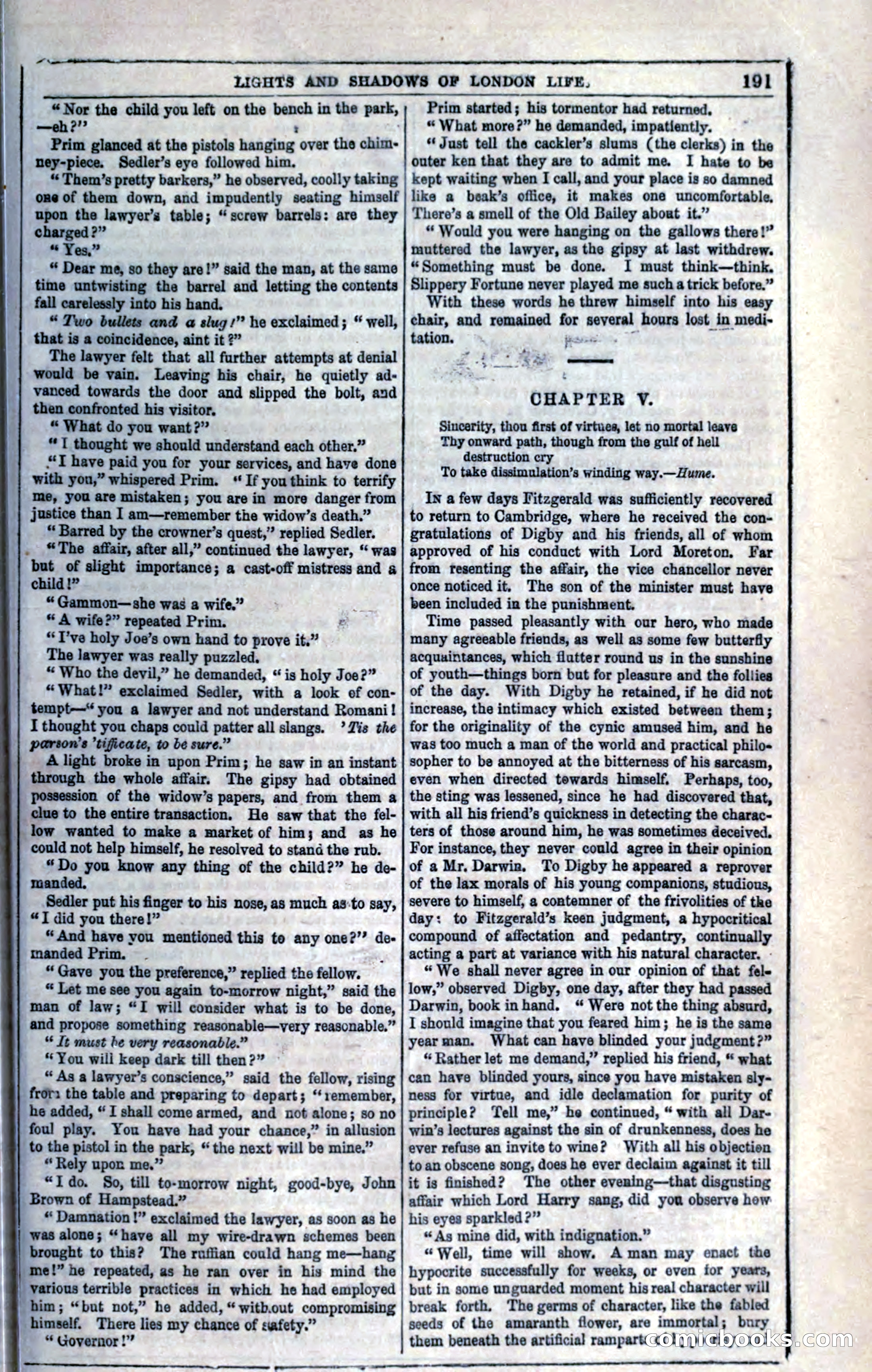
A restored page from Penny Dreadfuls, 1850. Page through the whole issue in the reader above.
📄 Transcribed text from this page (OCR, searchable)
Machine-transcribed from the original scan — historical spelling and the odd misread are preserved.
arn “ Nor the child you left on the — park, —eh ?’? Prim glanced at the pistols hanging over the chim- ney-piece. Sedler’s eye followed him. “ Them’s pretty barkers,” he observed, coolly taking one of them down, and impudently seating himself upon the lawyer's table; “screw barrels: are they ? * Yes,” “ Dear me, so they are!” said the man, at the same time untwisting the barrel and letting the contents fall carelessly into his hand. “ Two bullets and a slug!’ he exclaimed; “ well, that is a coincidence, aint it ?” The lawyer felt that all further attempts at denial would be vain. Leaving his chair, he quietly ad- vanced towards the door and slipped the bolt, and then confronted his visitor. | “I thought we should understand each other.” | SI have paid you for your services, and have done | with you,” whispered Prim. “ If you think to terrify S} ay, You ere mistaken 5 ‘you are in more danger from | justice than I am—remember the widow’s dea é “ Barred by the crowner’s quest,” replied Sedler. |. The affair, after all,” continued the lawyer, “was . ae oe importance; a cast-off mistress and a | “Gammon—she was a wife.” i" : : “ A wife?” repeated Prim. re “I’ve holy Joe’s own hand to prove it.” The lawyer was really puzzled. “ Who the devil,” he demanded, “ is holy Joe?” “What!” exclaimed Sedler, with a look of con- broke in upon Prim; he saw in an instant the whole affair. The gipsy had obtained of the widow’s papers, and from them a to the entire transaction. He saw that the fel- » wanted to make a market of him; and as he could not help himself, he resolved to stand the rub. “Do you know any thing of the child?” he de- manded. | Sedler put his finger to his nose, as much as-to say, “I did you there!” “And have you mentioned this te any one?’’ de- Prim. . “ Gave you the preference,” replied the fellow. _ © Let me see you again to-morrow night,” said the man of law; “I will consider what is to be done, il “You wili keep dark till then?” ~ “ As a lawyer’s conscience,” said the fellow, rising 'frdra the table and preparing to depart; “1emember, _he added, “I shall come armed, and not alone; so no foal play. You have had your chance,” in allusion pe the Park; “the next will be mine.” me,” “Ido. So, till to-morrow night, good-bye, John Brown of Hampstead.” “ Damnation !” exclaimed the lawyer, as soon as he was alone; “have all my wire-drawn schemes been prong to this? The ruffian could hang me—hang me!” he repeated, as he ran over in his mind the Various terrible practices in which he had employed im; “but not,” he added, “ witb.out Se himself. There lies my chance of safi * Governor !’” ——_—_—_—_————— LIGHTS AND SHADOWS OF LONDON LIFE. ee 191 Prim started; his tormentor had returned, “ What more?” he demanded, impatiently, ~ “ Just tell the cackler’s slums (the clerks) in the outer ken that they are to admit me. I hate to be kept waiting when I call, and your place is so damned like a beak’s office, it makes one uncomfortable, There’s a smell of the Old Bailey about it.” “ Would you were hanging on the gallows there!” muttered the lawyer, as the gipsy at last withdrew. “Something must be done. I must think—think,. Slippery Fortune never played me sucha trick before.” With these words he threw himself into his easy chair, and remained for several hours lost in medi- CHAPTER V. Sincerity, thou first of virtuea, let no mortal leave Thy onward path, though from the gulf of hell destruction cry To take dissimulation’s winding way.—Hume. In a few days T'itzgerald was sufficiently recovered to return to Cambridge, where he received the con- gratulations of Digby and his friends, all of whom approved of his conduct with Lord Moreton, Far from resenting the affair, the vice chancellor never once noticed it, The son of the minister must have been included in the punishment. Time passed pleasantly with our hero, who made many agreeable friends, as well as some few butterfly acquuintances, which flutter round us in the sunshine of youth—things born but for pleasure and the follies of the day. With Digby he retained, if he did not increase, the intimacy which existed between them; for the originality of the cynic amused him, and he was too much a man of the world and practical philo- sopher to be annoyed at the bitterness of his sarcasm, even when directed tewards himself. Perhaps, too, the sting was lessened, since he had discovered that, with all his friend’s quickness in detecting the charac- ters of those around him, he was sometimes deceived, For instance, they never could agree in their opinion of a Mr, Darwin. To Digby he appeared a reprover of the lax morals of his young companions, studious, severe to himself, a contemner of the frivolities of the day: to Fitzgerald’s keen judgment, a hypocritical compound of affectation and pedantry, conSiually acting a part at variance with his natural character. “ We shall never agree in our opinion of that fel- low,” observed Digby, one day, after they had passed Darwin, book inhand. “ Were not the thing absurd, I should imagine that you feared him; he is the same year man. What can have blinded your judgment?” “ Rather let me demand,” replied his friend, * what can have blinded yours, since you have mistaken sly- ness for virtue, and idle declamation for purity of principle? Tell me,” be continued, “ with all Dar- win’s lectures against the sin of drunkenness, does he ever refuse an inviteto wine? With all his objection to an obscene song, does he ever declaim against it till it is finished? The other evening—that disgusting affair which Lord Harry sang, did you observe how his eyes sparkled ?” “As mine did, with indignation.” “ Well, time will show. A man may enact the hypocrite successfully for weeks, or even for years, but in some unguarded moment his real character will break forth. The germs of character, like the fabled seeds of the amaranth flower, are immortal; bury them beneath the artificial rampart(Qol j 4) el ¢o10) (CO) im