
Penny Dreadfuls, 1850 · page 196 of 394
The Mysteries of London; or, Lights and Shadows of London Life — page 196: what you’re looking at
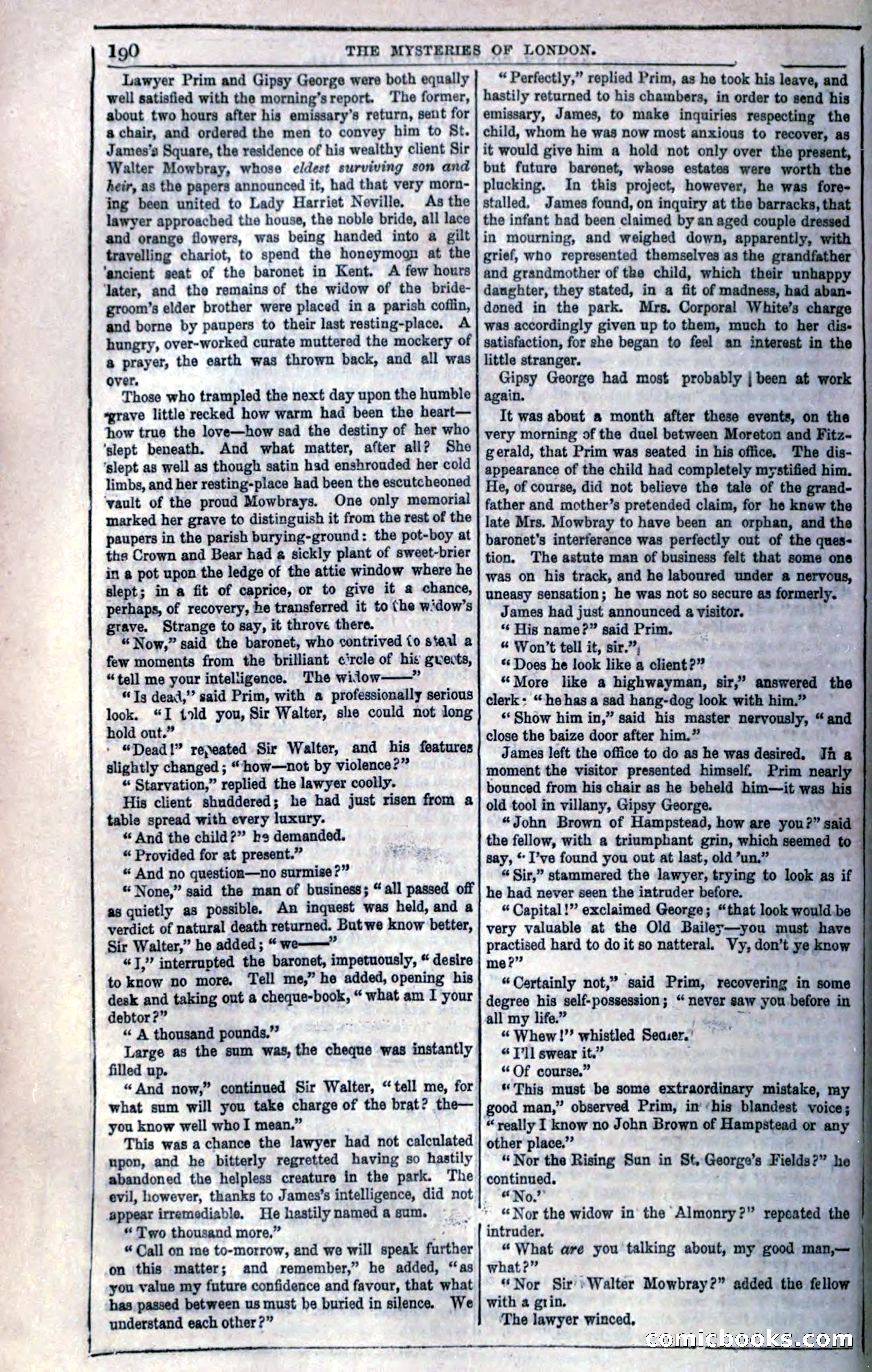
A restored page from Penny Dreadfuls, 1850. Page through the whole issue in the reader above.
📄 Transcribed text from this page (OCR, searchable)
Machine-transcribed from the original scan — historical spelling and the odd misread are preserved.
190 Lawyer Prim and Gipsy George were both equally well satisfied with the morning’sreport. The former, about two hours after his emissary’s return, sent for a chair, and ordered the men to convey him to St. James's Square, the residence of his wealthy client Sir Walter Mowbray, whose eldest surviving son and heir, as the papers announced it, had that very morn- ing been united to Lady Harriet Neville. As the lawyer approached the house, the noble bride, all lace and orange flowers, was being handed into a gilt travelling chariot, to spend the honeymoon at the ‘ancient seat of the baronet in Kent. A few hours ‘later, and the remains of the widow of the bride- groom’s elder brother were placed in a parish coffin, and borne by paupers to their last resting-place. A hungry, over-worked curate muttered the mockery of @ prayer, the earth was thrown back, and all was over. Those who trampled the next day upon the humble ‘grave little recked how warm had been the heart— how true the love—how sad the destiny of her who ‘slept beneath. And what matter, after all? She ‘slept as well as though satin had enshrouded her cold limbs, and her resting-place had been the escutcheoned ‘vault of the proud Mowbrays. One only memorial marked her grave to distinguish it from the rest of the paupers in the parish burying-ground : the pot-boy at the Crown and Bear had a sickly plant of sweet-brier in a pot upon the ledge of the attie window where he slept; in a fit of caprice, or to give it a chance, perhaps, of recovery, he transferred it to (he widow’s gtave. Strange to say, it throve there. “Now,” said the baronet, who contrived fo steal a few moments from the brilliant c'rcle of his gwevts, “tell me your intelligence. The wilow——” “Ts dead,” said Prim, with a professionally serious look. “I told you, Sir Walter, she could not long hold out.” : “Dead!” reneated Sir Walter, and his features slightly changed ; “‘how—not by violence?” “ Starvation,” replied the lawyer coolly. His client shuddered; he had just risen from a table spread with every luxury. “ And the child?” ho demanded. “ Provided for at present.” “ And no question—no surmise?” “ None,” said the man of business; “all passed off as quietly as possible. An inquest was held, and a verdict of natural death returned. But we know better, Sir Walter,” he added; “we——” “J,” interrupted the baronet, impetuously, “ desire to know no more. Tell me,” he added, opening his desk and taking ont a cheque-book, “ what am I your debtor ?” “ A thousand pounds.” Large as the sum was, the cheque was instantly filled up. “And now,” continued Sir Walter, “tell me, for what sum will you take charge of the brat? the— you know well who I mean.” This was a chance the lawyer had not calculated npon, and he bitterly regretted having so hastily abandoned the helpless creature in the park. The evil, however, thanks to James’s intelligence, did not | appear irremediable. He hastily named 4 sum. * Teo thousand more,” San “ Call on me to-morrow, and we will speak further on this matter; and remember,” he added, “as you value my future confidence and favour, that what has passed between us must be buried in silence. We understand each other?” THE MYSTERIES OF LONDON, “ Perfectly,” replied Prim, as he took his leave, and hastily returned to his chambers, in order to send his emissary, James, to make inquiries respecting the child, whom he was now most anxious to recover, as it would give him a hold not only over the present, but future baronet, whose estates were worth the plucking. In this project, however, he was fore- stalled, James found, on inquiry at the barracks, that the infant had been claimed by an aged couple dressed in mourning, and weighed down, apparently, with grief, who represented themselves as the grandfather and grandmother of the child, which their A danghter, they stated, in a fit of madness, doned in the park. Mrs. Corporal White’s was accordingly given up to them, much to satisfaction, for she began to feel an interest little stranger. Gipsy George had most probably | been at again. | It was about a month after these events, on the | very morning of the duel between Moreton and Fitz- | gerald, that Prim was seated in his office, The dis- | appearance of the child had completely mystified him. } He, of course, did not believe the tale of the grand- | father and mother’s pretended claim, for he knew the late Mrs. Mowbray to have been an orphan, and the © baronet's interference was perfectly out of the ques- tion. The astute man of business felt that some one was on his track, and he laboured under a nervous, uneasy sensation; he was not so secure as formerly. James had just announced a visitor. ti ‘“‘ His name?” said Prim. “ Won't tell it, sir.”; “ Does he look like a client?” | “More like a highwayman, sir,’ answered the clerk: “he has a sad hang-dog look with him.” ‘Show him in,” said his master nervously, “ close the baize door after him.” Sr iaetd James left the office to do as he was desired. Th a moment the visitor presented himself. Prim : bounced from his chair as he beheld him—it was his old tool in villany, Gipsy George. OMS “John Brown of Hampstead, how are you?” said the fellow, with a triumphant grin, which seemed to — say, * I’ve found you out at last, old ’un.” ] “ Sir,” stammered the lawyer, trying to look as he had never seen the intruder before. 8 “ Capital!” exclaimed George; “that look would.be very valuable at the Old Bailey—you must have practised hard to do it so natteral. Vy, don’t ye kno me?” ~~, “Certainly not,” said Prim, recovering in some degree his self-possession; “never saw you before in all my life.” ). dhe “ Whew!’ whistled Sear.’ « T’ll swear it.” “Of course.” “This must be some extraordinary mistake, my good man,” observed Prim, in’ ‘his blandest voice; “really I know no John Brown of Hampstead or any other place.” e333 “Nor the Rising Sun in St, George’s Fields?” he continued. “No.” ' “Nor the widow in the Almonry?” repeated the intruder. 7 a “ What are you talking about, my good . what?” “oF oa “Nor Sir» Walter Mowbray?” added the fe with a grin. The lawyer winced, er * = , nf g F 5 g 5 ~- » . ?. és * com i ooo) cS