
Penny Dreadfuls, 1850 · page 187 of 394
The Mysteries of London; or, Lights and Shadows of London Life — page 187: what you’re looking at
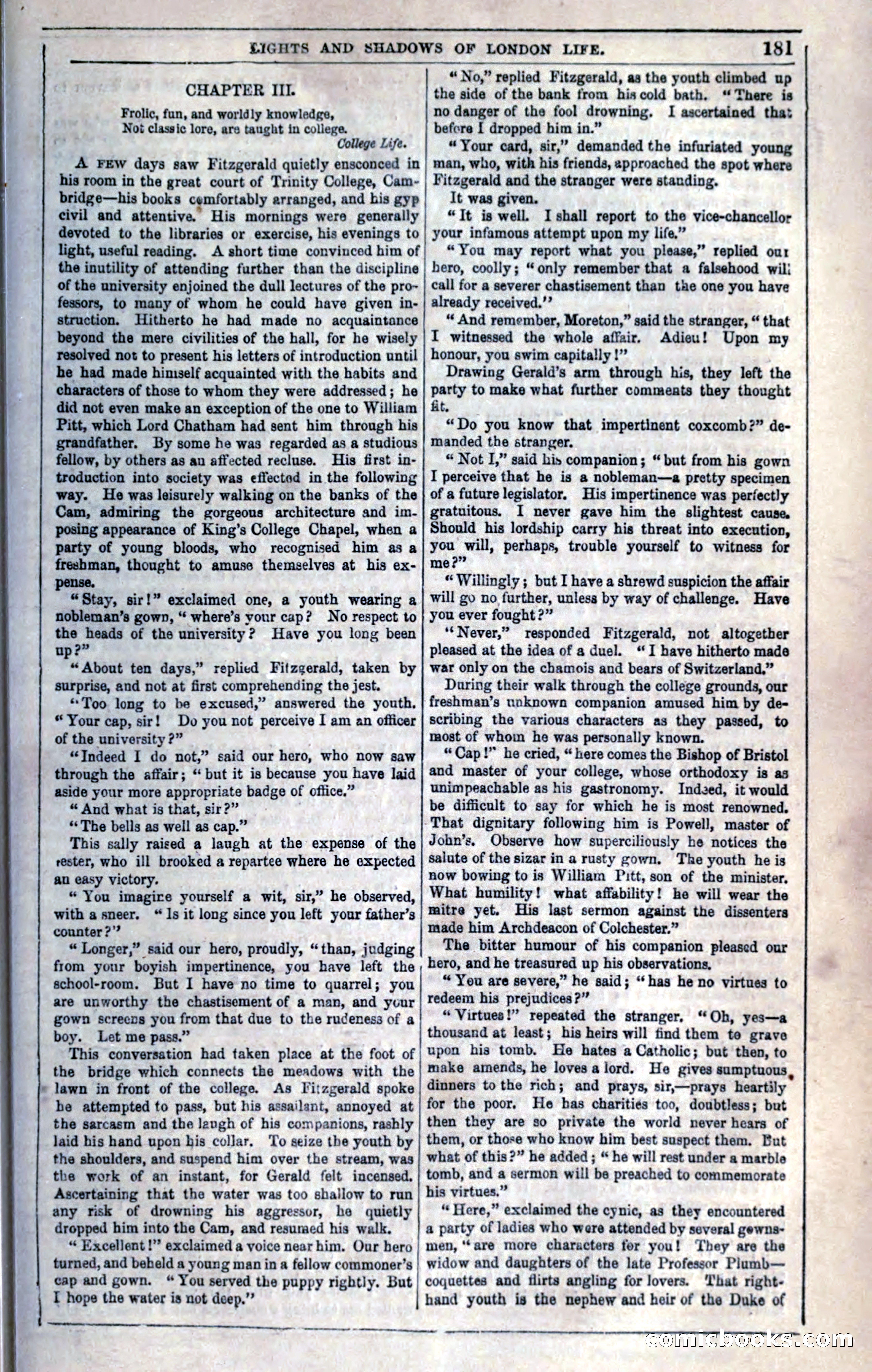
A restored page from Penny Dreadfuls, 1850. Page through the whole issue in the reader above.
📄 Transcribed text from this page (OCR, searchable)
Machine-transcribed from the original scan — historical spelling and the odd misread are preserved.
LIGHTS AND SHADOWS OF LONDON LIFE. 181 CHAPTER III. Frolic, fun, and worldly knowledge, Noi classic lore, are taught in college. College Life. A ¥FEw days saw Fitzgerald quietly ensconced in his room in the great court of Trinity College, Cam- bridge—his books cemfortably arranged, and his gyp civil and attentive. His mornings were generally devoted to the libraries or exercise, his evenings to light, useful reading. A short time convinced him of the inutility of attending further than the discipline of the university enjoined the dull lectures of the pro- fessors, to many of whom he could have given in- struction. Hitherto he had made no acquaintance beyond the mere civilities of the hall, for he wisely resolved not to present his letters of introduction until he had made himself acquainted with the habits and characters of those to whom they were addressed; he did not even make an exception of the one to William Pitt, which Lord Chatham had sent him through his grandfather. By some he was regarded as a studious fellow, by others as an affected recluse. His first in- troduction into society was effected in the following way. He was leisurely walking on the banks of the Cam, admiring the gorgeous architecture and im- posing appearance of King’s College Chapel, when a party of young bloods, who recognised him as a freshman, thought to amuse themselves at his ex- “Stay, sir!” exclaimed one, a youth wearing a nobleman’s gown, “ where’s your cap? No respect to the heads of the university? Have you long been 2?” A About ten days,” replied Fitzgerald, taken by surprise, and not at first comprehending the jest. “Too long to be excused,” answered the youth, * Your cap, sir! Do you not perceive I am an officer of the university ?” “Indeed I do not,” said our hero, who now saw through the affair; “ but it is because you have laid aside your more appropriate badge of office.” “ And what is that, sire” ** The bells as well as cap.” This sally raised a laugh at the expense of the rester, who ill brooked a repartee where he expected an easy victory. “ You imagire yourself a wit, sir,” he observed, with asneer. “Is it long since you left your father’s counter?” “ Longer,” said our hero, proudly, “than, judging from your boyish impertinence, you have left the school-room. But I have no time to quarrel; you are unworthy the chastisement of a man, and your gown screens you from that due to the rudeness of a boy. Let me pass.” This conversation had taken place at the foot of the bridge which connects the meadows with the lawn in front of the college. As litzgerald spoke be attempted to pass, but his assailant, annoyed at the sarcasm and the Jaugh of his companions, rashly Jaid his hand upon his collar. To seize the youth by the shoulders, and suspend him over the stream, was the work of an instant, for Gerald felt incensed. Ascertaining that the water was too shallow to run any risk of drowning his aggressor, he quietly dropped him into the Cam, and resummed his walk. “ Excellent!” exclaimed a voice near him. Our hero turned, and beheld a young man in a fellow commoner’s cap and gown. “ You served the puppy rightly. But I hope the water is not deep.”’ “No,” replied Fitzgerald, as the youth climbed up the side of the bank from his cold bath. “ There is no danger of the fool drowning. I ascertained tha: before | dropped him in.” “Your card, sir,” demanded the infuriated young man, who, with his friends, approached the spot where Fitzgerald and the stranger were standing. It was given. “It is well. Ishall report to the vice-chancellor your infamous attempt upon my life,” “You may report what you please,” replied our hero, coolly; “only remember that a falsehood wil; call for a severer chastisement than the one you have already received,’’ “And remember, Moreton,” said the stranger, “ that I witnessed the whole affair. Adieu! Upon my honour, you swim capitally |” Drawing Gerald’s arm through his, they left the party to make what further commeats they thought fit. “Do you know that impertinent coxcomb?” de- manded the stranger. “ Not I,” said his companion; “ but from his gown I perceive that he is a nobleman—a pretty specimen of a future legislator. His impertinence was perfectly gratuitous. I never gave him the slightest cause, Should his lordship carry his threat into execution, you will, perhaps, trouble yourself to witness for me?” “Willingly ; but I have a shrewd suspicion the affair will go no further, unless by way of challenge. Have you ever fought ?” ‘* Never,” responded Fitzgerald, not altogether pleased at the idea of a duel. “I have hitherto made war only on the chamois and bears of Switzerland.” During their walk through the college grounds, our freshman’s unknown companion amused him by de- scribing the various characters as they passed, to most of whom he was personally known. “Cap!” he cried, “here comes the Bishop of Bristol and master of your college, whose orthodoxy is as unimpeachable as his gastronomy. Ind2ed, it would be difficult to say for which he is most renowned. ‘That dignitary following him is Powell, master of John’s. Observe how superciliously he notices the salute of the sizar in a rusty gown. The youth he is now bowing to is William Pitt, son of the minister, What humility! what affability! he will wear the mitre yet. His last sermon against the dissenters made him Archdeacon of Colchester.” The bitter humour of his companion pleased our hero, and he treasured up his observations, “ You are severe,” he said; “has he no virtues to redeem his prejudices?” “ Virtues!” repeated the stranger. “Oh, yes—a thousand at least; his heirs will find them te grave upon his tomb. He hates a Catholic; but then, to make amends, he lovesalord. He gives sumptuous, dinners to the rich; and prays, sir,—prays heartily for the poor, He has charities too, doubtless; but then they are so private the world never hears of them, or those who know him best suspect them. Put what of this?” he added; “ he will rest under a marble tomb, and a sermon will be preached to commemorate his virtues.” “ Here,” exclaimed the cynic, as they encountered a party of ladies who were attended by several gewns- men, “are more characters for you! They are the widow and daughters of the late Professor Pluamb— coquettes and flirts angling for lovers. That right- hand youth is the nephew and heir of the Duke of Jc a Ninh epee OM CIOOKS: GO