
Penny Dreadfuls, 1850 · page 186 of 394
The Mysteries of London; or, Lights and Shadows of London Life — page 186: what you’re looking at
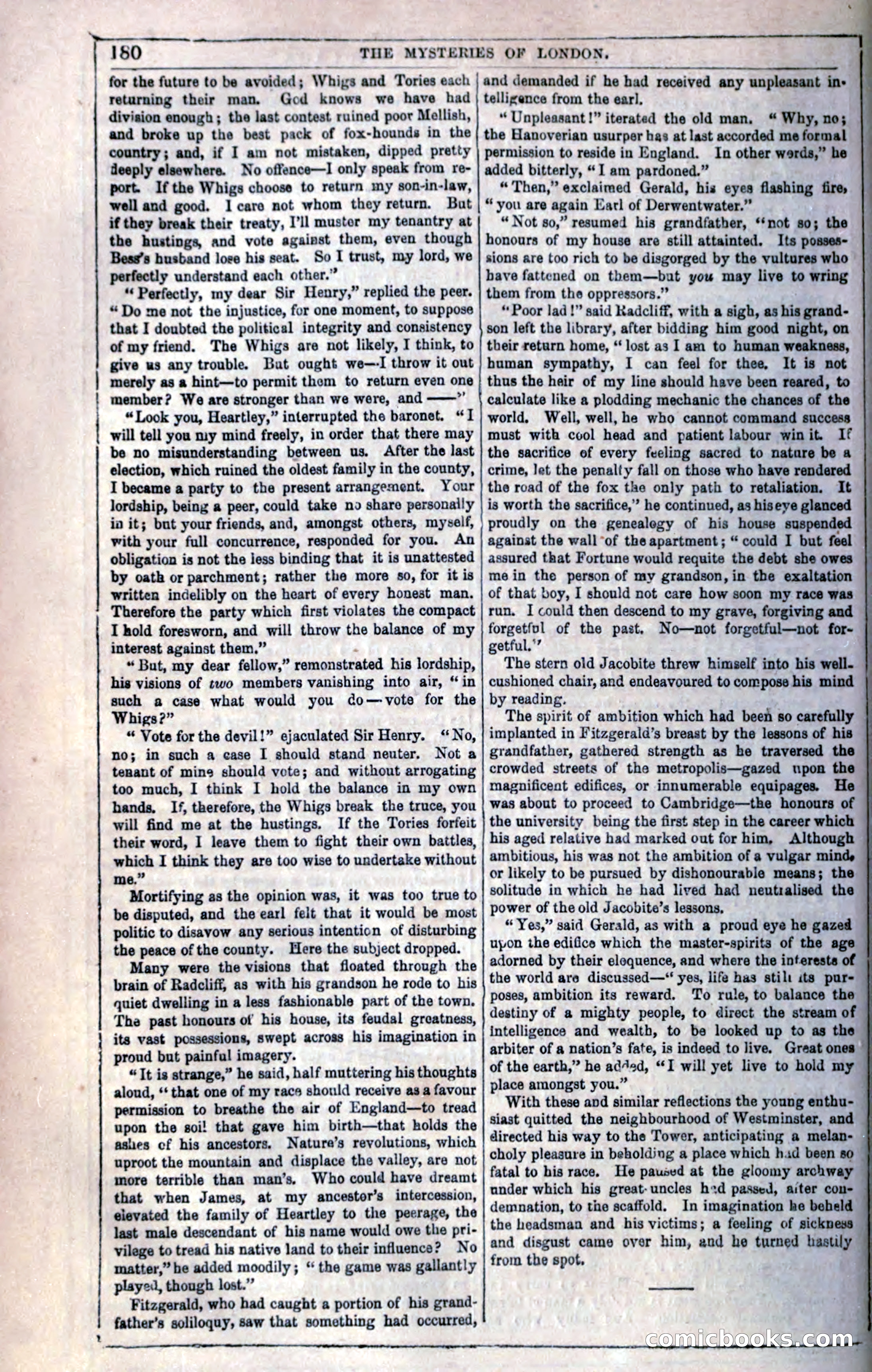
A restored page from Penny Dreadfuls, 1850. Page through the whole issue in the reader above.
📄 Transcribed text from this page (OCR, searchable)
Machine-transcribed from the original scan — historical spelling and the odd misread are preserved.
oe tnt a Al A Al A i 180 Baa for the future to be avoided; Whigs and Tories each returning their man. God knows we have had division enough; the last contest ruined poor Mellish, and broke up the best pack of fox-hounds in the country; and, if I am not mistaken, dipped pretty deeply elsewhere. No offence—I only speak from re- port. Ifthe Whigs choose to return my son-in-law, well and good. I care not whom they return. But if they break their treaty, Ill muster my tenantry at the hustings, and vote against them, even though Bess’s husband lose his seat. So I trust, my lord, we perfectly understand each other.” “Perfectly, my dear Sir Henry,” replied the peer. “Do me not the injustice, for one moment, to suppose that I doubted the political integrity and consistency of my friend. The Whigs are not likely, I think, to give us any trouble. But ought we—-I throw it out merely as a hint—to permit them to return even one member? We are stronger than we were, and ——”’ “Look you, Heartley,” interrupted the baronet. “I will tell you my mind freely, in order that there may be no misunderstanding between us. After the last election, which ruined the oldest family in the county, I became a party to the present arrangement. Your lordship, being a peer, could take no share personally in it; but your friends, and, amongst others, myself, with your full concurrence, responded for you. An obligation is not the less binding that it is unattested by oath or parchment; rather the more s0, for it is written indelibly on the heart of every honest man. Therefore the party which first violates the compact I hold foresworn, and will throw the balance of my interest against them,” ‘ “ But, my dear fellow,” remonstrated his lordship, his visions of two members vanishing into air, “in such a case what would you dco—vote for the Whigs?” “ Vote for the devil!” ejaculated Sir Henry. ‘No, no; in such a case I should stand neuter. Not a tenant of mine should vote; and without arrogating too much, I think I hold the balance in my own hands, If, therefore, the Whigs break the truce, you will find me at the hustings. If the Tories forfeit their word, I leave them to fight their own battles, which I think they are too wise to undertake without me.” Mortifying as the opinion was, it was too true to be disputed, and the earl felt that it would be most politic to disavow any serious intention of disturbing the peace ofthe county. Tere the subject dropped. Many were the visions that floated through the brain of Radcliff, as with his grandson he rode to his quiet dwelling in a less fashionable part of the town. The past honours of his house, its feudal greatness, its vast possessions, swept across his imagination in proud but painful imagery. “It is strange,” he said, half muttering his thoughts aloud, *‘ that one of my racs should receive asa favour permission to breathe the air of England—to tread upon the soi! that gave him birth—that holds the ashes cf his ancestors. Nature’s revolutions, which uproot the mountain and displace the valley, are not more terrible than man’s. Who could have dreamt that when James, at my ancestor’s intercession, elevated the family of Heartley to the peerage, the last male descendant of his name would owe the pri- vilege to tread his native land to their influence? No matter,” he added moodily; “ the game was gallantly played, though lost.” Fitzgerald, who had caught a portion of his grand- father’s soliloquy, Saw that something had occurred, er a ee THE MYSTERIES OF LONDON, He _- and demanded if he had received any unpleasant ins tellizence from the earl, “ Unpleasant!” iterated the old man. “ Why, no; the Hanoverian usurper has at last accorded me formal — permission to reside in England. In other words,” he | added bitterly, “1 am pardoned.” “Then,” exclaimed Gerald, his eyes flashing fire “you are again Earl of Derwentwater.” “ Not so,” resumed his grandfather, “*not so; the honours of my house are still attainted. Its posses- | sions are too rich to be disgorged by the vultures who | have fattened on them—but you may live to wring them from the oppressors.” | “Poor lad!” said Radcliff, with a sigh, as his grand- son left the library, after bidding him good night, on their return home, “lost as I am to human weakness, human sympathy, I can feel for thee, It is not thus the heir of my line should have been reared, to | calculate like a plodding mechanic the chances of the | world, Well, well, he who cannot command success | must with cool head and patient labour winit. If the sacrifice of every feeling sacred to natare be a — crime, let the penalty fall on those who have rendered — the road of the fox the only path to retaliation. It is worth the sacrifice,” he continued, as hiseye glanced proudly on the genealegy of his house suspended — against the wall of the apartment; “could I but feel assured that Fortune would requite the debt she owes mein the person of my grandson,in the exaltation of that boy, I should not care how soon my race was > run. I could then descend to my grave, forgiving and — forgetfol of the past, No—not forgetful—not for- getful.’” The stern old Jacobite threw himself into his well- cushioned chair, and endeavoured to compose his mind — by reading. The spirit of ambition which had been so carefully — implanted in Fitzgerald’s breast by the lessons of his grandfather, gathered strength as he traversed the crowded streets of the metropolis—gazed upon the magnificent edifices, or innumerable equipages. He was about to proceed to Cambridge—the honours of the university being the first step in the career which — his aged relative had marked out for him, Although © ambitious, his was not the ambition of a vulgar minds © or likely to be pursued by dishonourable means; the solitude in which he had lived had neutralised the power of the old Jacobite’s lessons, “Yes,” said Gerald, as with a proud eye he gazed upon the edifice which the master-spirits of the age adorned by their eloquence, and where the interests of the world are discussed—* yes, life has stil: its pur- poses, ambition its reward. To rule, to balance the destiny of a mighty people, to direct the stream of intelligence and wealth, to be looked up to as the arbiter of a nation’s fate, is indeed to live. Great ones of the earth,” he added, “I will yet live to hold my place amongst you.” q With these and similar reflections the young enthu- siast quitted the neighbourhood of Westminster, and — directed his way to the Tower, anticipating a melan- — choly pleasure in beholding a place which had been 80 fatal to his race. He paused at the gloomy archway under which his great-uncles hed passed, a:ter con- demnation, to the scaffold. In imagination he beheld the headsman and his victims; a feeling of sickness and disgust came over him, and he turned hastily from the spot, 4 books:com