
Penny Dreadfuls, 1850 · page 181 of 394
The Mysteries of London; or, Lights and Shadows of London Life — page 181: what you’re looking at
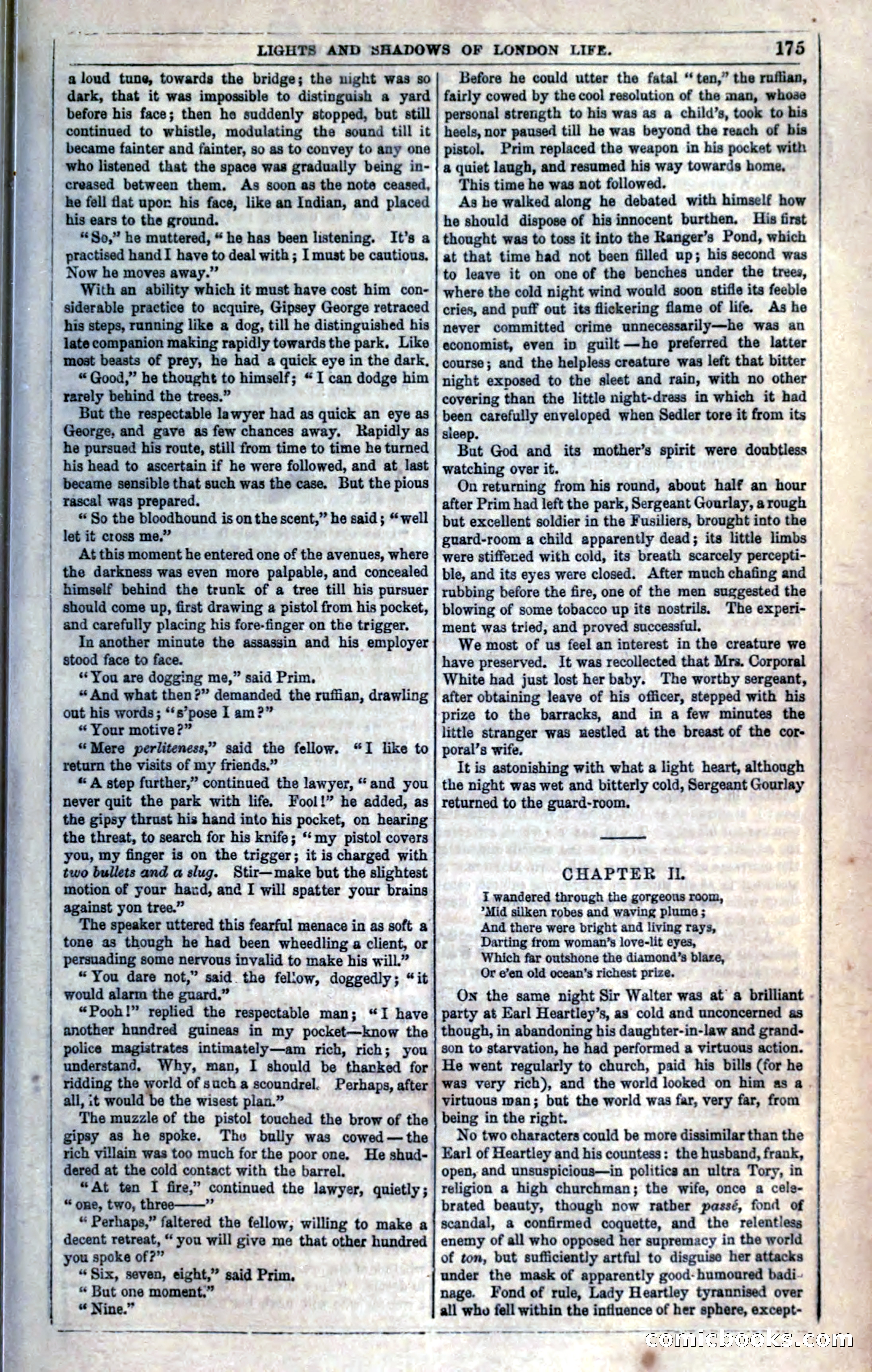
A restored page from Penny Dreadfuls, 1850. Page through the whole issue in the reader above.
📄 Transcribed text from this page (OCR, searchable)
Machine-transcribed from the original scan — historical spelling and the odd misread are preserved.
— ee em rr ee, ee ee ee —_—_ ee LIGHTS AND SHADOWS oF LONDON LIF FE. aloud tune, towards the bridge; the night was so dark, that it was impossible to distinguish a yard before his face; then he suddenly stopped, but still continued to whistle, modulating the sound till it became fainter and fainter, so as to convey to any one who listened that the space was gradually being in- creased between them. As soon as the note ceased, he fell flat upor his face, like an Indian, and placed his ears to the ground. *So,” he muttered, “ he has been listening. It’s a practised hand I have to deal with ; I must be cautious. Now he moves away.” With an ability which it must have cost him con- siderable practice to acquire, Gipsey George retraced his steps, running like a dog, till he distinguished his late companion making rapidly towards the park. Like most beasts of prey, he had a quick eye in the dark, “Good,” he thought to himself; “I can dodge him rarely behind the trees.” But the respectable lawyer had as quick an eye as George, and gave as few chances away. Rapidly as he pursued his route, still from time to time he turned his head to ascertain if he were followed, and at last became sensible that such was the case. But the pious rascal was prepared. “ So the bloodhound is on the scent,” he said; “well let it cross me.” At this moment he entered one of the avenues, where the darkness was even more palpable, and concealed himself behind the trunk of a tree till his pursuer should come up, first drawing a pistol from his pocket, and carefully placing his fore-finger on the trigger. In another minute the assassin and his employer stood face to face. “You are dogging me,” said Prim. “ And what then?” demanded the ruffian, drawling out his words; *‘s’pose I am?” * Your motive?” “Mere perliteness,” said the fellow. return the visits of my friends.” “ A step further,” continued the lawyer, “and you never quit the park with life. Fool!” he added, as the gipsy thrust his hand into his pocket, on hearing the threat, to search for his knife; “my pistol covers you, my finger is on the trigger; it is charged with two bullets and a slug. Stir—make but the slightest motion of your hard, and I will spatter your brains against yon tree.” “TI like to The speaker uttered this fearful menace in as soft a tone as though he had been wheedling a client, or some nervous invalid to make his will.” “You dare not,” said the fellow, doggedly; “it would alarm the guard.” “Pooh!” replied the respectable man; “I have another hundred guineas in my pocket—know the police magistrates intimately—am rich, rich; you patie ie Why, man, I should be tharked for all, it grate? the wisest plan.” gta muzzle of the pistol touched the brow of the gipsy as he spoke. The bully was cowed—the rich villain was too much for the poor one. He shud- dered at the cold contact with the barrel. “At ten I fire,” continued the lawyer, quietly ; “ one, two, three——” “ Perhaps,” faltered the fellow, willing to make a decent retreat, “ you will give me that other hundred you spoke of?” “Six, seven, eight,” said Prim. “ But one moment,” “ Nine.” orld of such a scoundrel. Perhaps, after ——— ee Before he could utter the fatal “ ten,” the raflian, fairly cowed by the cool resolution of the man, whose personal strength to his was as a child’s, took to his heels, nor paused till he was beyond the reach of bis pistol. Prim replaced the weapon in his pocket with a quiet laugh, and resumed his way towards home, This time he was not followed. As he walked along he debated with himself how he should dispose of his innocent burthen. His first thought was to toss it into the Ranger’s Pond, which at that time had not been filled up; his second was to leave it on one of the benches under the trees, where the cold night wind would soon stifle its feeble cries, and puff out its flickering flame of life. As he never committed crime unnecessarily—he was an economist, even in guilt-——he preferred the latter course; and the helpless creature was left that bitter night exposed to the sleet and rain, with no other covering than the little night-dress in which it had been carefully enveloped when Sedler tore it from its sleep. But God and its mother’s spirit were doubtless watching over it. On returning from his round, about half an hour after Prim had left the park, Sergeant Gourlay, arough but excellent soldier in the Fusiliers, brought into the guard-room a child apparently dead; its little limbs were stiffeced with cold, its breath scarcely percepti- ble, and its eyes were closed. After much chafing and rubbing before the fire, one of the men suggested the blowing of some tobacco up ite nostrils. The experi- ment was tried, and proved successful, We most of us feel an interest in the creature we have preserved. It was recollected that Mrs. Corporal White had just lost her baby. The worthy sergeant, after obtaining leave of his officer, stepped with his prize to the barracks, and in a few minutes the little stranger was uestled at the breast of the cor- poral’s wife. It is astonishing with what a light heart, although the night was wet and bitterly cold, Sergeant Gourlay returned to the guard-room. -__-—---- CHAPTER IL I wandered through the gorgeous room, *Mid silken robes and waving plume ; And there were bright and living rays, _ Darting from woman’s love-lit eyes, Which far outshone the diamond’s blaze, Or e’en old ocean’s richest prize. On the same night Sir Walter was at a brilliant . party at Earl Heartley’s, as cold and unconcerned as though, in abandoning his daughter-in-law and grand- son to starvation, he had performed a virtuous action. He went regularly to church, paid his bills (for he was very rich), and the world looked on him as a. virtuous man; but the world was far, very far, from being in the right. No two characters could be more dissimilar than the Karl of Heartley and his countess: the husband, frank, open, and unsuspicious—in politics an ultra Tory, in religion a high churchman; the wife, once a cele- brated beauty, though now rather passé, fond of scandal, a confirmed coquette, and the relentless enemy of all who opposed her supremacy in the world of ton, but sufficiently artful to disguise her attacks -{under the mask of apparently good-humoured badi- nage. Fond of rule, Lady Heartley tyrannised over all who fell within the influence of her sphere, except- (CO) —--—~ -—---—- NNICLOOOKS (E) m