
Penny Dreadfuls, 1850 · page 180 of 394
The Mysteries of London; or, Lights and Shadows of London Life — page 180: what you’re looking at
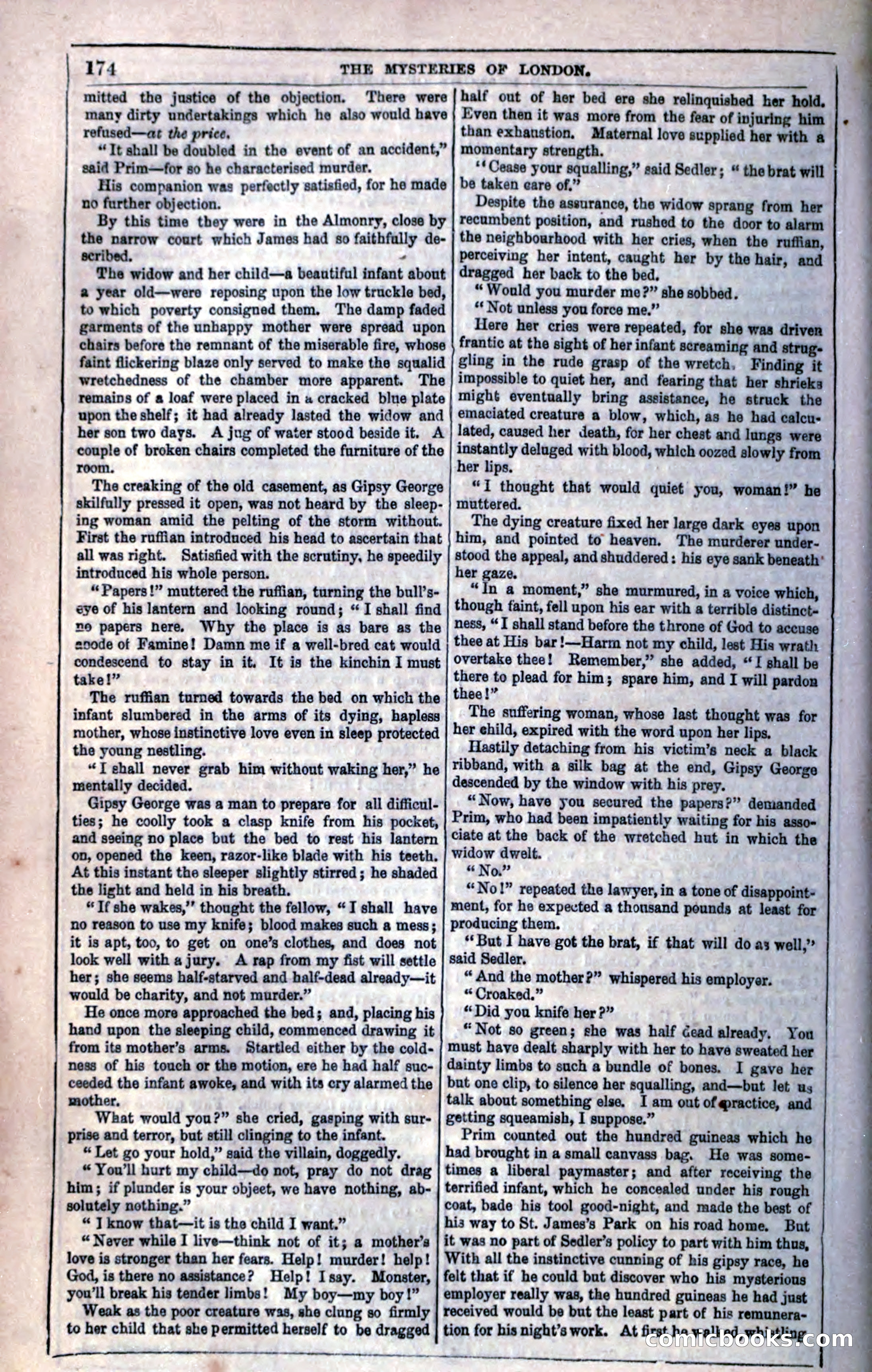
A restored page from Penny Dreadfuls, 1850. Page through the whole issue in the reader above.
📄 Transcribed text from this page (OCR, searchable)
Machine-transcribed from the original scan — historical spelling and the odd misread are preserved.
| 174 HE MY mitted the justice of the objection. There were many dirty undertakings which he also would have refused—at the price, “Tt shall be doubled in the event of an accident,” said Prim—for so he characterised murder. His companion was perfectly satisfied, for he made no further objection. By this time they were in the Almonry, close by the narrow court which James had so faithfully de- scribed. : The widow and her child—a beautiful infant about a year old—were reposing upon the low truckle bed, to which poverty consigned them. The damp faded garments of the unhappy mother were spread upon chairs before the remnant of the miserable fire, whose faint flickering blaze only served to make the squalid wretchedness of the chamber more apparent. The remains of a loaf were placed in « cracked blue plate upon the shelf; it had already lasted the widow and her son two days. <A jug of water stood beside it. A couple of broken chairs completed the furniture of the room. The creaking of the old casement, as Gipsy George skilfully pressed it open, was not heard by the sleep- ing woman amid the pelting of the storm without. First the ruffian introduced his head to ascertain that all was right. Satisfied with the scrutiny, he speedily introduced his whole person. “Papers!” muttered the ruffian, turning the bull’s- eye of his lantern and looking round; “I shall find mo papers nere. Why the place is as bare as the eoode of Famine! Damn me if a well-bred cat would condescend to stay in it. It is the kinchin I must take!” The ruffian turned towards the bed on which the infant slumbered in the arms of its dying, hapless mother, whose instinctive love even in sleep protected the young nestling. | “T shall never grab him without waking her,” he mentally decided. Gipsy George was a man to prepare for all difficul- ties; he coolly took a clasp knife from his pocket, and seeing no place but the bed to rest his lantern on, opened the keen, razor-like blade with his teeth. At this instant the sleeper slightly stirred; he shaded the light and held in his breath. “If she wakes,” thought the fellow, “I shall have no reason to use my knife; blood makes such a mess; it is apt, too, to get on one’s clothes, and does not look well with a jury. A rap from my fist will settle her; she seems half-starved and half-dead already—it would be charity, and not murder.” He once more approached the bed; and, placing his hand upon the sleeping child, commenced drawing it from its mother’s arms. Startled either by the cold- ness of his touch or the motion, ere he had half suc- ceeded the infant awoke, and with its cry alarmed the mother. What would you?” she cried, gasping with sur- prise and terror, but still clinging to the infant. * Let go your hold,” said the villain, doggedly. “ You'll hurt my child—do not, pray do not drag him; if plunder is your objeet, we have nothing, ab- solutely nothing.” “ ] know that—it is the child I want.” “ Never while I live—think not of it; a mother’s love is stronger than her fears. Help! murder! help! God, is there no assistance? Help! Isay. Monster, you'll break his tender limbs! My boy—my boy!” Weak as the poor creature was, she clung so firmly to her child that she permitted herself to be dragged salient es SSS lS sts eesiee THE MYSTERIES OF LONDON, om Ae a AR half out of her bed ere she relinquished her hold, Even then it was more from the fear of injuring him than exhaustion, Maternal love supplied her with a momentary strength. ‘* Cease your squalling,” said Sedler; “ the brat will be taken eare of,” Despite the assurance, the widow sprang from her recumbent position, and rushed to the door to alarm the neighbourhood with her cries, when the ruffian, perceiving her intent, caught her by the hair, and dtagged her beck to theta “Would you murder me?” she sobbed. ** Not unless you force me.” Here her cries were repeated, for she was driven frantic at the sight of her infant screaming and gling in the rude grasp of the wretch, Finding impossible to quiet her, and fearing that her shrieks might eventually bring assistance, he struck the emaciated creature a blow, which, as he had calcu- lated, caused her death, for her chest and lungs ° oo deluged with blood, which oozed slowly from er lips. “I thought that would quiet you, woman!” he muttered. The dying creature fixed her dark eyes him, and pointed to heaven. pees Be wae pie the appeal, and shuddered: his eye sank beneath’ er gaze. “In a moment,” she murmured, in a voice which, though faint, fell upon his ear with a terrible distinct« ness, “I shall stand before the throne of God to accuse thee at His bar!—Harm not my child, lest His wrath overtake thee! Remember,” she added, “I shall be oy to plead for him; spare him, and I will pardon thee!” The suffering woman, whose last thought was for her child, expired with the word upon her lips, Hastily detaching from his victim’s neck a black ribband, with a silk bag at the end, Gipsy George descended by the window with his prey. “Now, have you secured the papers?” demanded Prim, who had been impatiently waiting for his @sso- ciate at the back of the wretched hut in which the widow dwelt. “ No.”’ “Nol” repeated the lawyer, in a tone of di ment, for he expected a thousand pounds at least for producing them. | ‘But I have got the brat, if that will do ay well,” said Sedler, “ And the mother?” whispered his loyer. “ Croaked.” ee “Did you knife her ?” “Not so green; she was half Gead already, You must have dealt sharply with her to have sweated her dainty limbs to such a bundle of bones. I gave her but one clip, to silence her squalling, and—but let us talk about something else, I am out of @ractice, and getting squeamish, I suppose.” Prim counted out the hundred guineas which he had brought in a small canvass bag. He was some- times a liberal paymaster; and after receiving the terrified infant, which he concealed under his rough coat, bade his tool good-night, and made the best of his way to St. James’s Park on his road home. But it was no part of Sedler’s policy to part with him thus, With all the instinctive cunning of his gipsy race, he felt that if he could but discover who his mysterious employer really was, the hundred guineas he had just received would be but the least part of his remunera- tion for his night’s work. At first p<