
Penny Dreadfuls, 1849 · page 374 of 394
The Mysteries of the Court of London — page 374: what you’re looking at
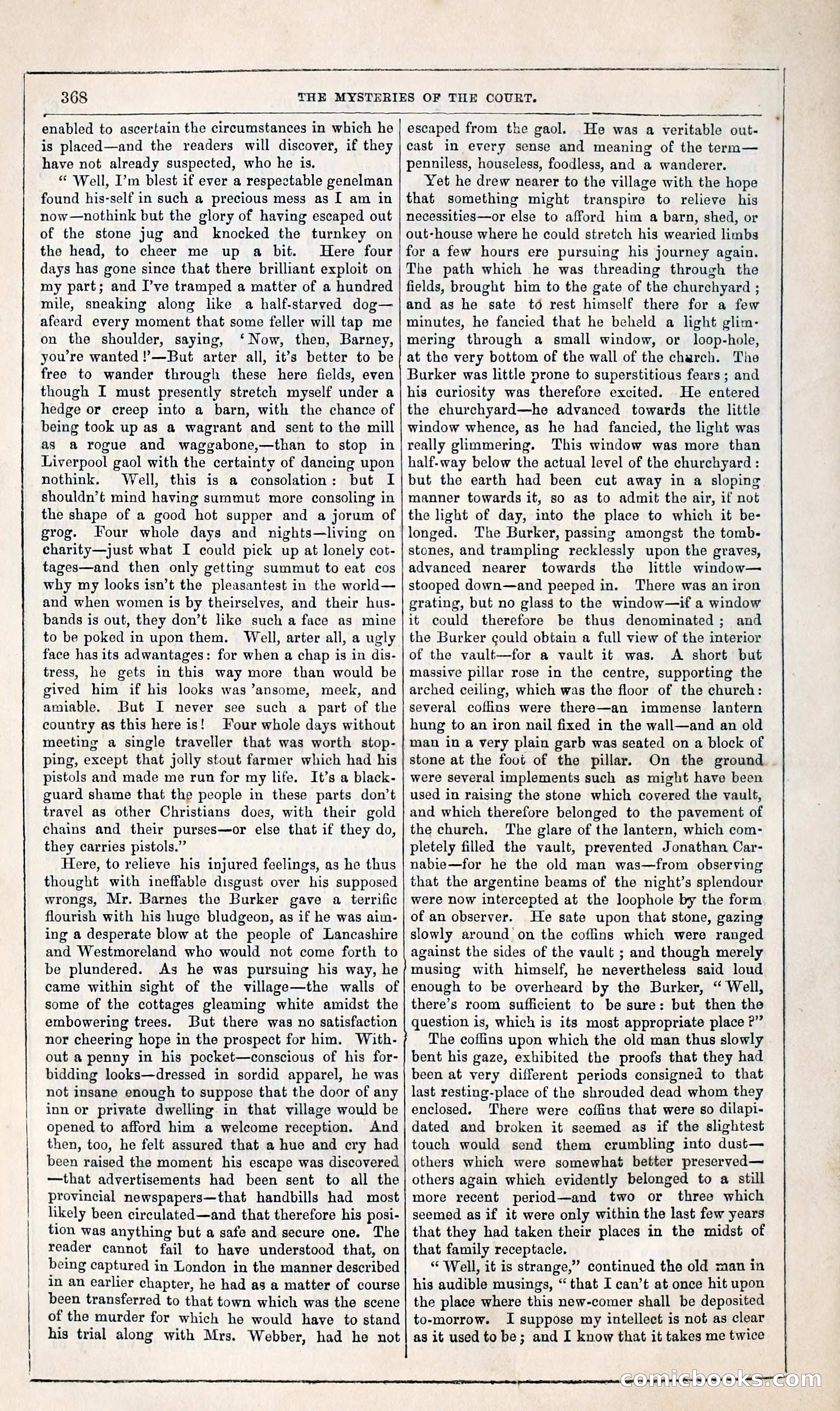
A restored page from Penny Dreadfuls, 1849. Page through the whole issue in the reader above.
📄 Transcribed text from this page (OCR, searchable)
Machine-transcribed from the original scan — historical spelling and the odd misread are preserved.
arene teen a A TE LL LA 368 enabled to ascertain the circumstances in which he is placed—and the readers will discover, if they have not already suspected, who he is. « Well, I’m blest if ever a respectable genelman found his-self in such a precious mess as I am in now—nothink but the glory of having escaped out of the stone jug and knocked the turnkey on the head, to cheer me up a bit. Here four days has gone since that there brilliant exploit on my part; and I’ve tramped a matter of a hundred mile, sneaking along like a half-starved dog— afeard every moment that some feller will tap me on the shoulder, saying, ‘Now, then, Barney, you’re wanted !’—But arter all, it’s better to be free to wander through these here fields, even though I must presently stretch myself under a hedge or creep into a barn, with the chance of being took up as a wagrant and sent to the mill as a rogue and waggabone,—than to stop in Liverpool gaol with the certainty of dancing upon nothink. Well, this is a consolation: but I shouldn’t mind having summut more consoling in the shape of a good hot supper and a jorum of grog. our whole days and nights—living on charity—just what I could pick up at lonely cot- tages—and then only getting summut to eat cos why my looks isn’t the pleasantest in the world— and when women is by theirselves, and their hus- bands is out, they don’t like such a face as mine to be poked in upon them. Well, arter all, a ugly face has its adwantages: for when a chap is in dis- tress, he gets in this way more than would be gived him if his looks was ’ansome, meek, and amiable. But I never see such a part of the country as this here is! Four whole days without meeting a single traveller that was worth stop- ping, except that jolly stout farmer which had his pistols and made me run for my life. It’s a black- guard shame that the people in these parts don’t travel as other Christians does, with their gold chains and their purses—or else that if they do, they carries pistols.” Here, to relieve his injured feelings, as he thus thought with ineffable disgust over his supposed wrongs, Mr. Barnes the Burker gave a terrific flourish with his huge bludgeon, as if he was aim- ing a desperate blow at the people of Lancashire and Westmoreland who would not come forth to be plundered. As he was pursuing his way, he came within sight of the village—the walls of some of the cottages gleaming white amidst the embowering trees. But there was no satisfaction nor cheering hope in the prospect for him. With- out a penny in his pocket—conscious of his for- bidding looks—dressed in sordid apparel, he was not insane enough to suppose that the door of any inn or private dwelling in that village would be opened to afford him a welcome reception. And then, too, he felt assured that a hue and cry had been raised the moment his escape was discovered —that advertisements had been sent to all the provincial newspapers—that handbills had most likely been circulated—and that therefore his posi- tion was anything but a safe and secure one. The reader cannot fail to have understood that, on being captured in London in the manner described in an earlier chapter, he had as a matter of course been transferred to that town which was the scene of the murder for which he would have to stand his trial along with Mrs. Webber, had he not a me re rn te ee ee THE MYSTERIES OF THE COURT. —— escaped from the gaol. cast in every sense and meaning of the term— penniless, houseless, foodless, and a wanderer. Yet he drew nearer to the village with the hope that something might transpire to relieve his necessities—or else to afford him a barn, shed, or out-house where he could stretch his wearied limbs for a few hours ere pursuing his journey again. The path which he was threading through the fields, brought him to the gate of the churchyard ; and as he sate to rest himself there for a few minutes, he fancied that he beheld a light glim- mering through a small window, or loop-hole, at the very bottom of the wall of the charch. The Burker was little prone to superstitious fears ; and his curlosity was therefore excited. He entered the churchyard—he advanced towards the little window whence, as he had fancied, the light was really glimmering. This window was more than half-way below the actual level of the churchyard : but the earth had been cut away in a sloping manner towards it, so as to admit the air, if not the light of day, into the place to which it be- longed. The Burker, passing amongst the tomb- stones, and trampling recklessly upon the graves, advanced nearer towards the little window— stooped down—and peeped in. There was an iron grating, but no glass to the window—if a window it could therefore be thus denominated; and the Burker could obtain a full view of the interior of the vault—for a vault it was. A short but massive pillar rose in the centre, supporting the arched ceiling, which was the floor of the church: several coffins were there—an immense lantern hung to an iron nail fixed in the wall—and an old man in a very plain garb was seated on a block of stone at the foot of the pillar. On the ground were several implements such as might have been used in raising the stone which covered the vault, and which therefore belonged to the pavement of the church. The glare of the lantern, which com- pletely filled the vault, prevented Jonathan Car- nabie—for he the old man was—from observing that the argentine beams of the night’s splendour were now intercepted at the loophole by the form of an observer. He sate upon that stone, gazing slowly around on the coffins which were ranged against the sides of the vault ; and though merely musing with himself, he nevertheless said loud enough to be overheard by the Burker, “ Well, there’s room sufficient to be sure: but then the question is, which is its most appropriate place ?” The coffins upon which the old man thus slowly bent his gaze, exhibited the proofs that they had been at very different periods consigned to that last resting-place of the shrouded dead whom they enclosed. There were coffins that were so dilapi- dated and broken it seemed as if the slightest touch would send them crumbling into dust— others which were somewhat better preserved— others again which evidently belonged to a still more recent period—and two or three which seemed as if it were only within the last few years that they had taken their places in the midst of that family receptacle. “ Well, it is strange,” continued the old man in his audible musings, “ that I can’t at once hit upon the place where this new-comer shall be deposited to-morrow. I suppose my intellect is not as clear as it used to be; and I know that it takes me twice He was a veritable out- COMmICDOOKS.GO