
Penny Dreadfuls, 1849 · page 373 of 394
The Mysteries of the Court of London — page 373: what you’re looking at
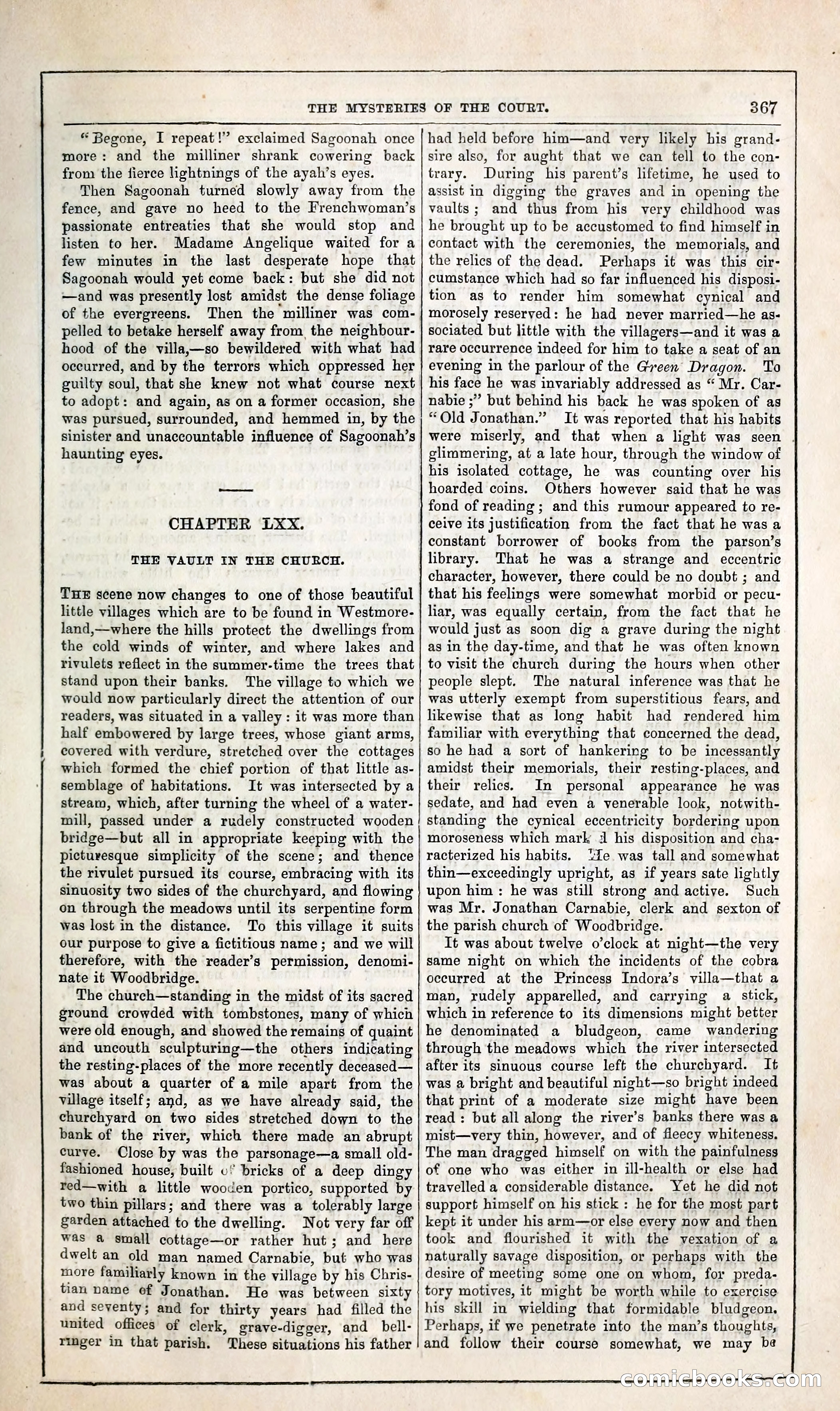
A restored page from Penny Dreadfuls, 1849. Page through the whole issue in the reader above.
📄 Transcribed text from this page (OCR, searchable)
Machine-transcribed from the original scan — historical spelling and the odd misread are preserved.
THE MYSTERIES OF THE COURT. 367 “Begone, I repeat!” exclaimed Sagoonah once more: and the milliner shrank cowering back from the fierce ightnings of the ayah’s eyes. Then Sagoonah turned slowly away from the fence, and gave no heed to the Frenchwoman’s passionate entreaties that she would stop and listen to her. Madame Angelique waited for a few minutes in the last desperate hope that Sagoonah would yet come back: but she did not —and was presently lost amidst the dense foliage of the evergreens. Then the milliner was com- pelled to betake herself away from the neighbour- hood of the villa,—so bewildered with what had occurred, and by the terrors which oppressed her guilty soul, that she knew not what course next to adopt: and again, as on a former occasion, she was pursued, surrounded, and hemmed in, by the sinister and unaccountable influence of Sagoonah’s haunting eyes. 6. eee CHAPTER LXX. THE VAULT IN THE CHURCH. THE scene now changes to one of those beautiful little villages which are to be found in Westmore- land,—where the hills protect the dwellings from the cold winds of winter, and where lakes and rivulets reflect in the summer-time the trees that stand upon their banks. The village to which we would now particularly direct the attention of our readers, was situated in a valley: it was more than half embowered by large trees, whose giant arms, covered with verdure, stretched over the cottages which formed the chief portion of that little as- semblage of habitations. It was intersected by a stream, which, after turning the wheel of a water- mill, passed under a rudely constructed wooden bridge—but all in appropriate keeping with the picturesque simplicity of the scene; and thence the rivulet pursued its course, embracing with its sinuosity two sides of the churchyard, and flowing on through the meadows until its serpentine form was lost in the distance. To this village it suits our purpose to give a fictitious name; and we will therefore, with the reader’s permission, denomi- nate it Woodbridge. The church—standing in the midst of its sacred ground crowdéd with tombstones, many of which were old enough, and showed the remains of quaint and uncouth sculpturing—the others indicating the resting-places of the more recently deceased— was about a quarter of a mile apart from the village itself; and, as we have already said, the churchyard on two sides stretched down to the bank of the river, which there made an abrupt curve. Close by was the parsonage—a small old- fashioned house, built o! bricks of a deep dingy red—with a little wooden portico, supported by two thin pillars; and there was a tolerably large garden attached to the dwelling. Not very far off was a small cottage—or rather hut; and here dwelt an old man named Carnabie, but who was more familiarly known in the village by his Chris- tian name ef Jonathan. He was between sixty and seventy; and for thirty years had filled the united offices of clerk, grave-digger, and bell- ringer in that parish. ‘These situations his father Eee Seis ea TR ee EEO nTICHOOO. had held before him—and very likely his grand- sire also, for aught that we can tell to the con- trary. During his parent’s lifetime, he used to assist in digging the graves and in opening the vaults ; and thus from his very childhood was he brought up to be accustomed to find himself in contact with the ceremonies, the memorials, and the relics of the dead. Perhaps it was this cir- cumstance which had so far influenced his disposi- tion as to render him somewhat cynical and morosely reserved: he had never married—he as- sociated but little with the villagers—and it was a rare occurrence indeed for him to take a seat of an evening in the parlour of the Green Dragon. To his face he was invariably addressed as “ Mr. Car- nabie ;” but behind his back he was spoken of as “Old Jonathan.” It was reported that his habits were miserly, and that when a light was seen . glimmering, at a late hour, through the window of his isolated cottage, he was counting over his hoarded coins. Others however said that he was fond of reading; and this rumour appeared to re- ceive its justification from the fact that he was a constant borrower of books from the parson’s library. That he was a strange and eccentric character, however, there could be no doubt ; and that his feelings were somewhat morbid or pecu- liar, was equally certain, from the fact that he would just as soon dig a grave during the night as in the day-time, and that he was often known to visit the church during the hours when other people slept. The natural inference was that he was utterly exempt from superstitious fears, and likewise that as lone habit had rendered him familiar with everything that concerned the dead, so he had a sort of hankering to be incessantly amidst their memorials, their resting-places, and their relics. In personal appearance he was sedate, and had even a venerable look, notwith- standing the cynical eccentricity bordering upon moroseness which mark 4 his disposition and cha- racterized his habits. “ie was tall and somewhat thin—exceedingly upright, as if years sate lightly upon him : he was still strong and active. Such was Mr. Jonathan Carnabie, clerk and sexton of the parish church of Woodbridge. It was about twelve o’clock at night—the very same night on which the incidents of the cobra occurred at the Princess Indora’s villa—that a man, rudely apparelled, and carrying a stick, which in reference to its dimensions might better he denominated a bludgeon, came wandering through the meadows which the river intersected after its sinuous course left the churchyard. It was a bright and beautiful night—so bright indeed that print of a moderate size might have been read: but all along the river’s banks there was a mist—very thin, however, and of fleecy whiteness. The man dragged himself on with the painfulness of one who was either in ill-health or else had travelled a considerable distance. Yet he did not support himself on his stick : he for the most part kept it under his arm—or else every now and then took and flourished it with the vexation of a naturally savage disposition, or perhaps with the desire of meeting some one on whom, for preda- tory motives, it might be worth while to exercise his skill in wielding that formidable bludgeon. Perhaps, if we penetrate into the man’s thoughts, and follow their course somewhat, we may be <SGO