
Penny Dreadfuls, 1849 · page 346 of 394
The Mysteries of the Court of London — page 346: what you’re looking at
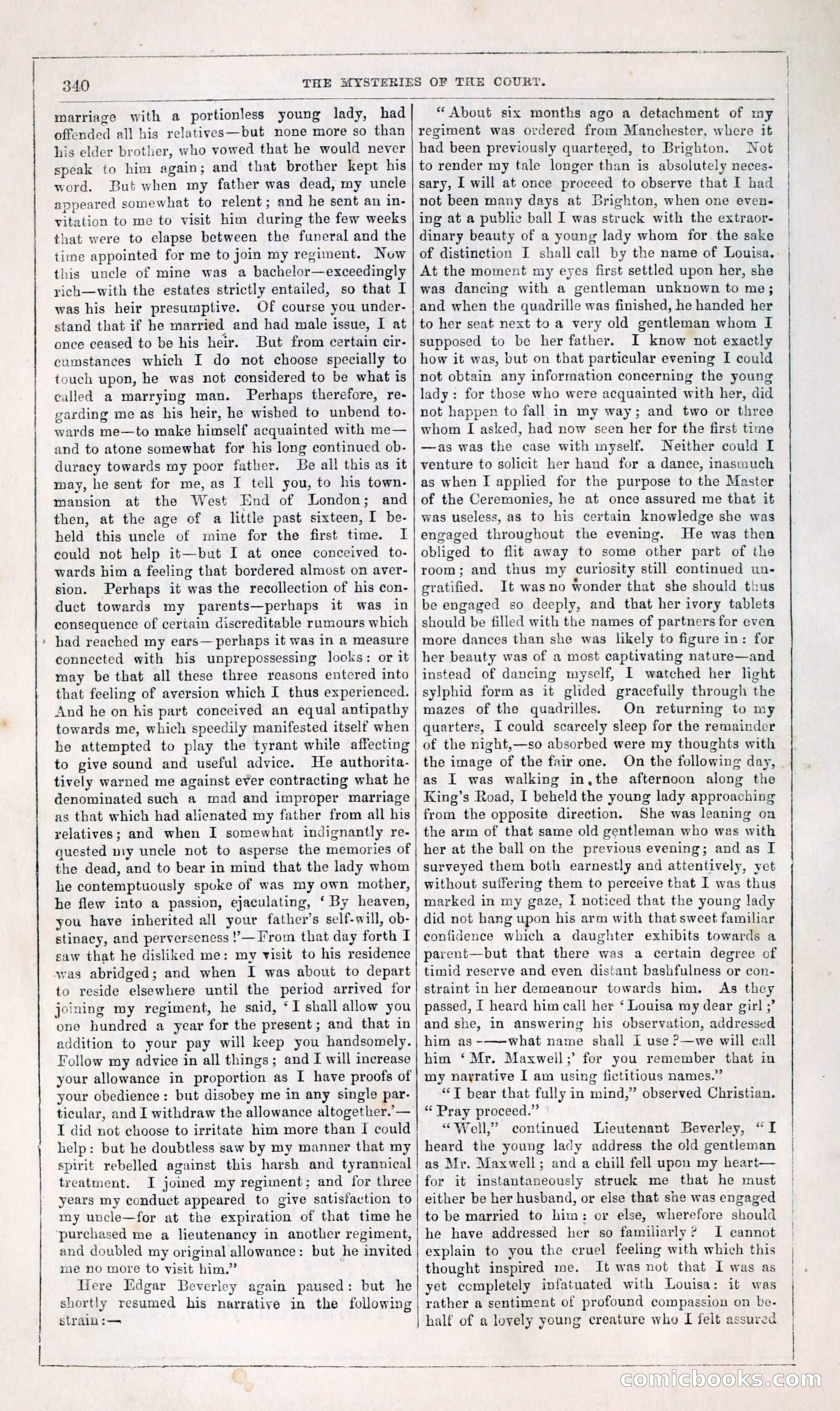
A restored page from Penny Dreadfuls, 1849. Page through the whole issue in the reader above.
📄 Transcribed text from this page (OCR, searchable)
Machine-transcribed from the original scan — historical spelling and the odd misread are preserved.
a ets 340 marriage with a portionless young lady, had offended all his relatives—but none more so than his elder brother, who vowed that he would never speak to him again; and that brother kept his word. But when my father was dead, my uncle appeared somewhat to relent; and he sent an in- vitation to me to visit him during the few weeks that were to elapse between the funeral and the time appointed for me to join my regiment. Now this uncle of mine was a bachelor—exceedingly rich—with the estates strictly entailed, so that I was his heir presumptive. Of course you under- stand that if he married and had male issue, I at once ceased to be his heir. But from certain cir- cumstances which I do not choose specially to touch upon, he was not considered to be what is ealled a marrying man. Perhaps therefore, re- earding me as his heir, he wished to unbend to- wards me—to make himself acquainted with me— and to atone somewhat for his long continued ob- duracy towards my poor father. Je all this as it may, he sent for me, as JI tell you, to his town- mansion at the West End of London; and then, at the age of a little past sixteen, I be- held this uncle of mine for the first time. I could not help it—but I at once conceived to- wards him a feeling that bordered almost on aver- sion. Perhaps it was the recollection of his con- duct towards my parents—perhaps it was in consequence of ceriain discreditable rumours which had reached my ears— perhaps it was in a measure connected with his unprepossessing looks: or it may be that all these three reasons entered into that feeling of aversion which I thus experienced. And he on his part conceived an equal antipathy towards me, which speedily manifested itself when he attempted to play the tyrant while affecting to give sound and useful advice. He authorita- tively warned me against ever contracting what he denominated such a mad and improper marriage as that which had alienated my father from all his relatives; and when I somewhat indignantly re- quested my uncle not to asperse the memories of the dead, and to bear in mind that the lady whom he contemptuously spoke of was my own mother, he flew into a passion, ejaculating, ‘ By heaven, you have inherited all your father’s self-will, ob- stinacy, and perverseness !’— From that day forth I saw that he disliked me: my visit to his residence was abridged; and when I was about to depart to reside elsewhere until the period arrived for joining my regiment, he said, ‘I shall allow you one hundred a year for the present; and that in addition to your pay will keep you handsomely. Follow my advice in all things ; and I will increase your allowance in proportion as I have proofs of your obedience: but disobey me in any single par- ticular, and I withdraw the allowance altogether.’— I did not choose to irritate him more than I could help: but he doubtless saw by my manner that my spirit rebelled against this harsh and tyrannical treatment. I joined my regiment; and for three years my conduct appeared to give satisfaction to my uncle—for at the expiration of that time he purchased me a lieutenancy in another regiment, and doubled my original allowance: but he inyited me no more to visit him.” Here Edgar Beverley again paused: but he shortly resumed his narrative in the following strall:— nr A LC LL IOLA LL LE LAL OL, A A a ee eee —_— es ae ee a —— THE MYSTERIES OF THE COURT. regiment was ordered from Manchester, where it had been previously quartered, to Brighton. Not to render my tale longer than is absolutely neces- sary, I will at once proceed to observe that I had not been many days at Brighton, when one even- ing at a public ball I was struck with the extraor- dinary beauty of a young lady whom for the sake of distinction I shall call by the name of Louisa. At the moment my eyes first settled upon her, she was dancing with a gentleman unknown to me; and when the quadrille was finished, he handed her to her seat next toa very old gentleman whom I supposed to be her father. I know not exactly how it was, but on that particular evening I could not obtain any information concerning the young lady: for those who were acquainted with her, did not happen to fall in my way; and two or three whom I asked, had now seen her for the first time —as was the case with myself. Neither could I venture to solicit her hand for a dance, inasmuch as when I applied for the purpose to the Master of the Ceremonies, he at once assured me that it was useless, as to his certain knowledge she was engaged throughout the evening. He was then obliged to flit away to some other part of the room; and thus my curiosity still continued un- gratified. It wasno wonder that she should thus be engaged so deeply, and that her ivory tablets should be filled with the names of partners for even more dances than she was likely to figure in: for her beauty was of a most captivating nature—and instead of dancing mysclf, I watched her leght sylphid form as it glided gracefully through the mazes of the quadrilles. On returning to my quarters, I could scarcely sleep for the remainder of the night,—so absorbed were my thoughts with the image of the fair one. On the following day, as I was walking in,the afternoon along the King’s Road, I beheld the young lady approaching from the opposite direction. She was leaning on the arm of that same old gentleman who was with her at the ball on the previous evening; and as I surveyed them both earnestly and attentively, yet without suffering them to perceive that I was thus marked in my gaze, I noticed that the young lady did not hang upon his arm with that sweet familiar confidence which a daughter exhibits towards a parent—but that there was a certain degree of timid reserve and even distant bashfulness or con- straint in her demeanour towards him. As they passed, I heard him call her ‘ Louisa my dear girl ;” and she, In answering his observation, addressed him as-——what name shall I use ?—we will eall him ‘Mr. Maxwell;’ for you remember that in my narrative I am using fictitious names.” “T bear that fully in mind,” observed Christian. ** Pray proceed.” “Well,” continued Lieutenant Beverley, “I heard the young lady address the old gentleman as Mr. Maxwell; and a chill fell upon my heart— for it instantaneously struck me that he must either be her husband, or else that she was engaged to be married to him: or else, wherefore should he have addressed her so familiarly? I cannot explain to you the cruel feeling with which this thought inspired me. It was not that I was as yet completely infatuated with Louisa: it was rather a sentiment of profound compassion on be- half of a lovely young creature who I felt assured COM (C * About six months ago a detachment of my meer eee | } } \ | 2 ee ee ee eee a = dae «5 i en Se