
Penny Dreadfuls, 1849 · page 345 of 394
The Mysteries of the Court of London — page 345: what you’re looking at
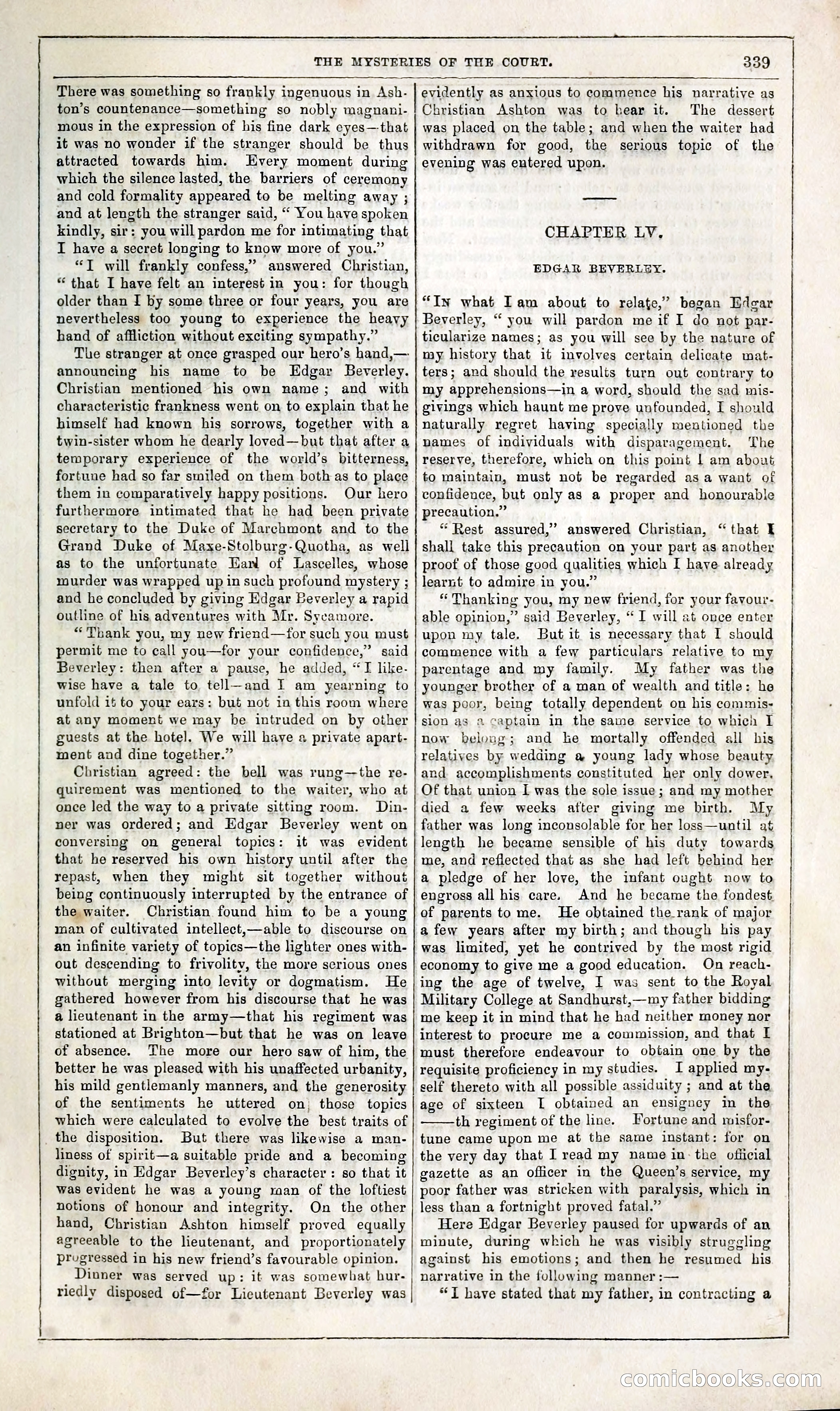
A restored page from Penny Dreadfuls, 1849. Page through the whole issue in the reader above.
📄 Transcribed text from this page (OCR, searchable)
Machine-transcribed from the original scan — historical spelling and the odd misread are preserved.
THE MYSTERIES OF THE COURT. There was something so frankly ingenuous in Ash- | evidently as anxious to commence his narrative as ton’s countenance—something so nobly magnani-! Christian Ashton was to hear it. mous in the expression of his fine dark eyes—that it was no wonder if the stranger should be thus attracted towards him. Every moment during which the silence lasted, the barriers of ceremony and cold formality appeared to be melting away ; and at length the stranger said, “ You have spoken kindly, sir: you will pardon me for intimating that I have a secret longing to know more of you.” “I will frankly confess,’ answered Christian, * that I have felt an interest in you: for though older than I by some three or four years, you are nevertheless too young to experience the heavy hand of affliction without exciting sympathy.” The stranger at once grasped our hero’s hand,—. announcing his name to be Edgar Beverley. Christian mentioned his own name; and with characteristic frankness went on to explain that he himself had known his sorrows, together with a twin-sister whom he dearly loved—but that after a temporary experience of the world’s bitterness, fortune had so far smiled on them both as to place them in comparatively happy positions. Our hero furthermore intimated that he had been private secretary to the Duke of Marchmont and to the Grand Duke of Maxe-Stolburg-Quotha, as well as to the unfortunate Ean of Lascelles, whose murder was wrapped up in such profound mystery ; and he concluded by giving Edgar Beverley a rapid outline of his adventures with Mr. Sycamore. “Thank you, my new friend—for such you must permit me to call you—for your confidence,” said Beverley: then after a pause, he added, “TI like- wise have a tale to tell—and I am yearning to unfold it to your ears: but not in this room where at any moment we may be intruded on by other guests at the hotel. We will have a private apart- ment and dine together.” Christian agreed: the bell was rung—the re- quirement was mentioned to the waiter, who at once led the way to a private sitting room. Din- ner was ordered; and Edgar Beverley went on conversing on general topics: it was evident that he reserved his own history until after the repast, when they might sit together without being continuously interrupted by the entrance of the waiter. Christian found him to be a young man of cultivated intellect,—able to discourse on an infinite variety of topics—the lighter ones with- out descending to frivolitv, the more serious ones without merging into levity or dogmatism. He gathered however from his discourse that he was a lieutenant in the army—that his regiment was stationed at Brighton—but that he was on leave of absence. The more our hero saw of him, the better he was pleased with his unaffected urbanity, his mild gentlemanly manners, and the generosity of the sentiments he uttered on; those topics which were calculated to evolve the best traits of the disposition. But there was likewise a man- liness of spirit—a suitable pride and a becoming dignity, in Edgar Beverley’s character: so that it was evident he was a young raan of the loftiest notions of honour and integrity. On the other hand, Christian Ashton himself proved equally agreeable to the lieutenant, and proportionately prugressed in his new friend’s favourable opinion. Dinner was served up: it was somewhat hur- riedly disposed of—for Lieutenant Beverley was 309 The dessert was placed on the table; and when the waiter had withdrawn for good, the serious topic of the evening was entered upon. CHAPTER LV. EDGAR BEVERLEY. “In what Tam about to relate,’ began Bdear Beverley, “ you will pardon me if I do not par- ticularize names; as you will see by the nature of my history that it involves certain delicate mat- ters; avd should the results turn out contrary to my apprehensions—in a word, should the sad mis- givings which haunt me prove unfounded, I should naturally regret having specially mentioned the names of individuals with disparagement. ‘The reserve, therefore, which on this point | am about to maintain, must not be regarded asa want of confidence, but only as a proper and honourable precaution.” * Rest assured,’ answered Christian, “that I shall take this precaution on your part as another proof of those good qualities which I have already learnt to admire in you.” “Thanking you, my new friend, for your favour- able opinion,” said Beverley, “I will at once enter upon my tale. Butit is necessary that I should commence with a few particulars relative to my parentage and my family. My father was the younger brother of a man of wealth and title: he was poor, being totally dependent on his commis- sion 4s 2 captain in the same service to which I now beloug; and ke mortally offended all his relatives by wedding a young lady whose beauty and accomplishments constituted her only dower. Of that union I was the sole issue; and my mother died a few weeks after giving me birth. My father was long inconsolable for her loss—until at length he became sensible of his duty towards me, and reflected that as she had left behind her a pledge of her love, the infant ought now to engross all his care. And he became the fondest of parents to me. He obtained the_rank of major afew years after my birth; and though his pay was limited, yet he contrived by the most rigid economy to give me a good education. On reach- ing the age of twelve, I was sent to the Royal Military College at Sandhurst,—my father bidding me keep it in mind that he had neither money nor interest to procure me a commission, and that I must therefore endeavour to obtain one by the requisite proficiency in my studies. I applied my- self thereto with all possible assiduity ; and at the age of sixteen [| obtained an ensigney in the th regiment of the line. Fortune and misfor- tune came upon me at the same instant: for on the very day that I read my name in- the official gazette as an officer in the Queen’s service, my poor father was stricken with paralysis, which in less than a fortnight proved fatal.” Here Edgar Beverley paused for upwards of an minute, during which he was visibly struggling against his emotions; and then he resumed his narrative in the following manner :— 1 have stated that my father, in contracting a GOMIIGIOOKSAEO