
Penny Dreadfuls, 1849 · page 262 of 394
The Mysteries of the Court of London — page 262: what you’re looking at
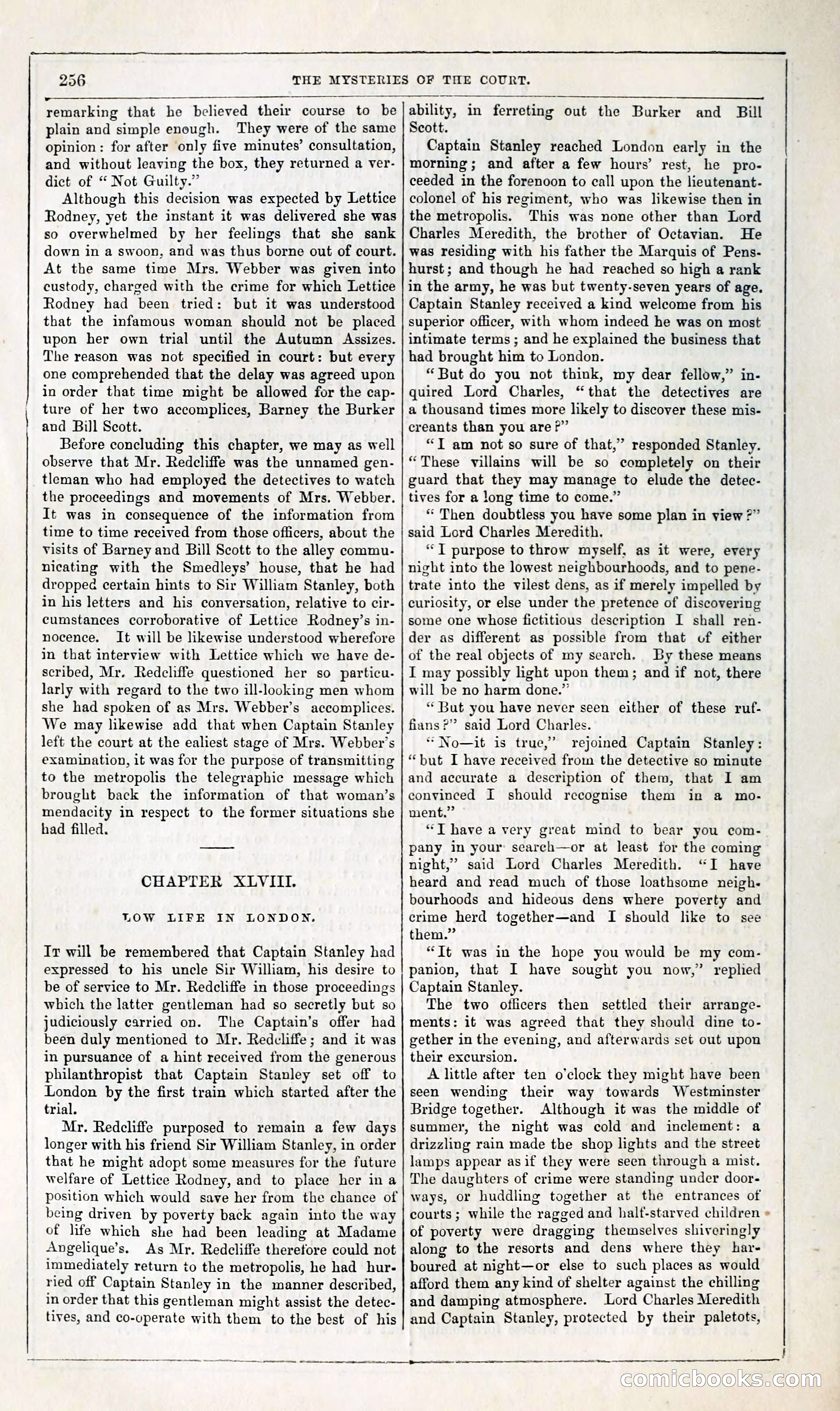
A restored page from Penny Dreadfuls, 1849. Page through the whole issue in the reader above.
📄 Transcribed text from this page (OCR, searchable)
Machine-transcribed from the original scan — historical spelling and the odd misread are preserved.
256 remarking that he believed their course to be plain and simple enough. They were of the same opinion: for after only five minutes’ consultation, and without leaving the box, they returned a ver- dict of “ Not Guilty.” Although this decision was expected by Lettice Rodney, yet the instant it was delivered she was so overwhelmed by her feelings that she sank down in a swoon, and was thus borne out of court. At the same time Mrs. Webber was given into custody, charged with the crime for which Lettice Rodney had been tried: but it was understood that the infamous woman should not be placed upon her own trial until the Autumn Assizes. The reason was not specified in court: but every one comprehended that the delay was agreed upon in order that time might be allowed for the cap- ture of her two accomplices, Barney the Burker and Bill Scott. Before concluding this chapter, we may as well observe that Mr. Redcliffe was the unnamed gen- tleman who had employed the detectives to watch the proceedings and movements of Mrs. Webber. It was in consequence of the information from time to time received from those officers, about the visits of Barney and Bill Scott to the alley commu- nicating with the Smedleys’ house, that he had droppec certain hints to Sir William Stanley, both in his letters and his conversation, relative to cir- cumstances corroborative of Lettice Rodney’s in- nocence. It will be likewise understood wherefore in that interview with Lettice which we have de- scribed, Mr. Redcliffe questioned her so particu- larly with regard to the two ill-looking men whom she had spoken of as Mrs. Webber’s accomplices. We may likewise add that when Captain Stanley left the court at the ealiest stage of Mrs. Webber’s examination, it was for the purpose of transmitting to the metropolis the telegraphic message which brought back the information of that woman’s mendacity in respect to the former situations she had filled, CHAPTER XLVIII. LOW LIFE IN LONDON. Ir will be remembered that Captain Stanley had expressed to his uncle Sir William, his desire to be of service to Mr. Redcliffe in those proceedings which the latter gentleman had so secretly but so judiciously carried on. The Captain’s offer had been duly mentioned to Mr. Redcliffe; and it was in pursuance of a hint received from the generous philanthropist that Captain Stanley set off to London by the first train which started after the trial. Mr. Redcliffe purposed to remain a few days longer with his friend Sir William Stanley, in order that he might adopt some measures for the future welfare of Lettice Rodney, and to place her ina position which would save her from the chance of being driven by poverty back again into the way of life which she had been leading at Madame Angelique’s. As Mr. Redcliffe therefore could not immediately return to the metropolis, he had hur- ried off Captain Stanley in the manner described, in order that this gentleman might assist the detec- tives, and co-operate with them to the best of his ae ee eee THE MYSTERIES OF THE COURT. ability, in ferreting out the Burker and Bill Scott. Captain Stanley reached London early in the morning; and after a few hours’ rest, he pro- ceeded in the forenoon to call upon the lieutenant- colonel of his regiment, who was likewise then in the metropolis. This was none other than Lord Charles Meredith, the brother of Octavian. He was residing with his father the Marquis of Pens- hurst; and though he had reached so high a rank in the army, he was but twenty-seven years of age. Captain Stanley received a kind welcome from his superior officer, with whom indeed he was on most intimate terms ; and he explained the business that had brought him to London. “But do you not think, my dear fellow,” in- quired Lord Charles, “that the detectives are a thousand times more likely to discover these mis- creants than you are?” “T am not so sure of that,” responded Stanley. “These villains will be so completely on their guard that they may manage to elude the detec- tives for a long time to come.” “Then doubtless you have some plan in view ?” said Lord Charles Meredith. ‘“T purpose to throw myself, as it were, every night into the lowest neighbourhoods, and to pene- trate into the vilest dens, as if merely impelled by curiosity, or else under the pretence of discovering some one whose fictitious description I shall ren- der as different as possible from that of either of the real objects of my search. By these means I may possibly hight upon them; and if not, there will be no harm done.”’ ‘“ But you have never seen either of these ruf- fians ?” said Lord Charles. * No—it is true,” rejoined Captain Stanley: “but I have received from the detective so minute and accurate a description of them, that I am convinced I should recognise them in a mo- ment,” “T have a very great mind to bear you com- pany in your search—or at least tor the coming night,’ said Lord Charles Meredith. “I have heard and read much of those loathsome neigh. bourhoods and hideous dens where poverty and crime herd together—and I should like to see them.” “It was in the hope you would be my com- panion, that I have sought you now,” replied Captain Stanley. The two officers then settled their arrange- ments: if was agreed that they should dine to- gether in the evening, and afterwards set out upon their excursion. A little after ten o'clock they might have been seen wending their way towards Westminster Bridge together. Although it was the middle of summer, the night was cold and inclement: a drizzling rain made the shop lights and the street lamps appear asif they were seen through a mist. The daughters of crime were standing under door- ways, or huddling together at the entrances of courts; while the ragged and half-starved children of poverty were dragging themselves shiveringly along to the resorts and dens where they har- boured at night—or else to such places as would afford them any kind of shelter against the chilling and damping atmosphere. Lord Charles Meredith and Captain Stanley, protected by their paletots, » — MICLIOC) @ “S (C(O)