
Penny Dreadfuls, 1849 · page 261 of 394
The Mysteries of the Court of London — page 261: what you’re looking at
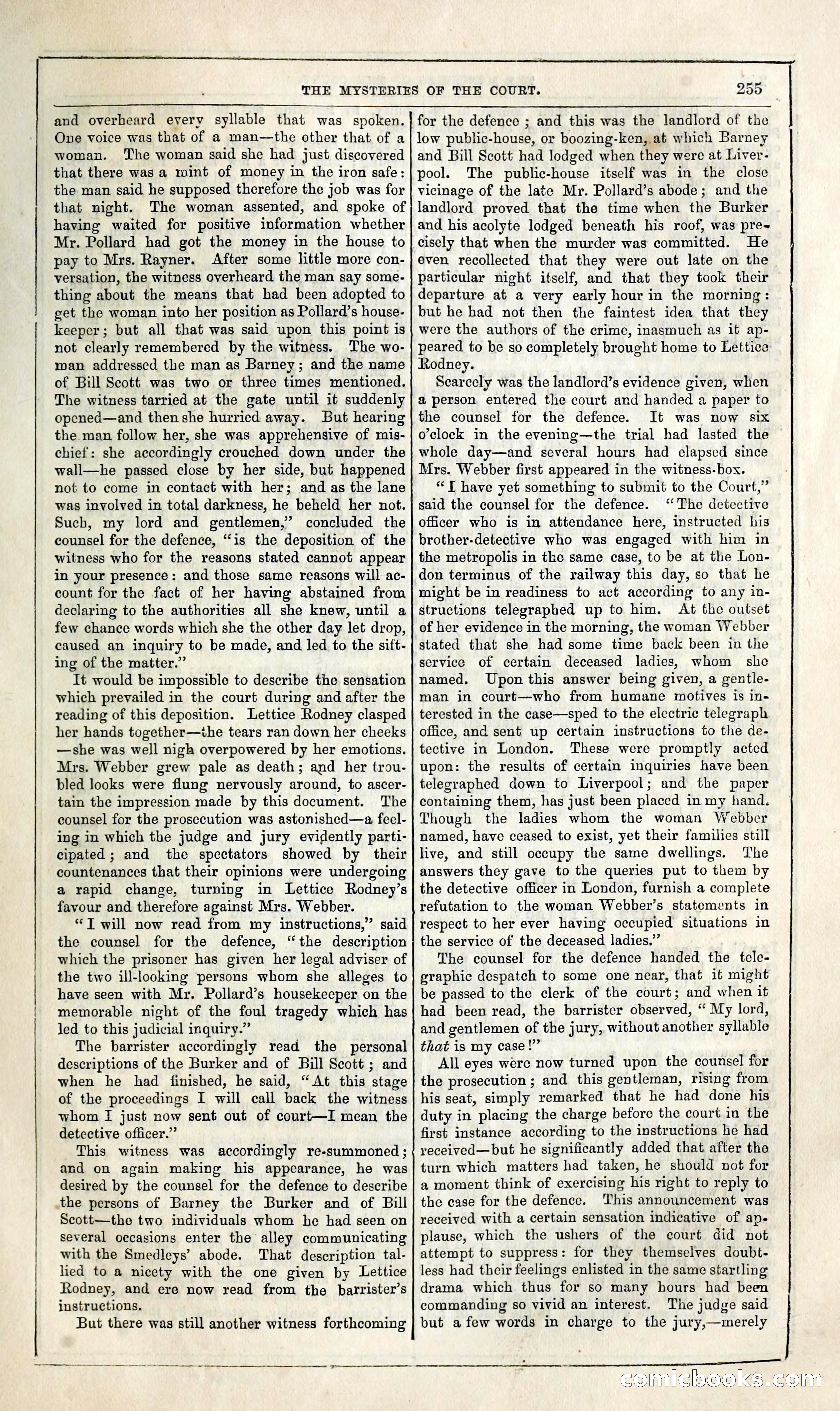
A restored page from Penny Dreadfuls, 1849. Page through the whole issue in the reader above.
📄 Transcribed text from this page (OCR, searchable)
Machine-transcribed from the original scan — historical spelling and the odd misread are preserved.
THE MYSTERIES OF THE COURT. 255 and overheard every syllable that was spoken. One voice was that of a man—the other that of a woman. The woman said she had just discovered that there was a mint of money in the iron safe: the man said he supposed therefore the job was for that night. The woman assented, and spoke of having waited for positive information whether Mr. Pollard had got the money in the house to pay to Mrs. Rayner. After some little more con- versation, the witness overheard the man say some- thing about the means that had been adopted to get the woman into her position as Pollard’s house- keeper; but all that was said upon this point is not clearly remembered by the witness. The wo- man addressed the man as Barney; and the name of Bill Scott was two or three times mentioned. The witness tarried at the gate until it suddenly opened—and then she hurried away. Sut hearing the man follow her, she was apprehensive of mis- chief: she accordingly crouched down under the wall—he passed close by her side, but happened not to come in contact with her; and as the lane was involved in total darkness, he beheld her not. Such, my lord and gentlemen,’ concluded the counsel for the defence, “is the deposition of the witness who for the reasons stated cannot appear in your presence: and those same reasons will ac- count for the fact of her having abstained from declaring to the authorities all she knew, until a few chance words which she the other day let drop, caused an inquiry to be made, and led to the sift- ing of the matter.” It would be impossible to describe the sensation which prevailed in the court during and after the reading of this deposition. Lettice Rodney clasped her hands together—the tears ran down her cheeks —she was well nigh overpowered by her emotions. Mrs. Webber grew pale as death; and her trou- bled looks were flung nervously around, to ascer- tain the impression made by this document. The counsel for the prosecution was astonished—a feel- ing in which the judge and jury evidently parti- cipated ; and the spectators showed by their countenances that their opinions were undergoing a rapid change, turning in Lettice Rodney’s favour and therefore against Mrs. Webber. J will now read from my instructions,” said the counsel for the defence, “the description which the prisoner has given her legal adviser of the two ill-looking persons whom she alleges to have seen with Mr. Pollard’s housekeeper on the memorable night of the foul tragedy which has Jed to this judicial inquiry.” The barrister accordingly read the personal descriptions of the Burker and of Bill Scott; and when he had finished, he said, “At this stage of the proceedings I will call back the witness whom I just now sent out of court—I mean the detective officer.” This witness was accordingly re-summoned ; and on again making his appearance, he was desired by the counsel for the defence to describe the persons of Barney the Burker and of Bill Scott—the two individuals whom he had seen on several occasions enter the alley communicating with the Smedleys’ abode. That description tal- lied to a nicety with the one given by Lettice Rodney, and ere now read from the barrister’s instructions. But there was still another witness forthcoming 99 for the defence ; and this was the landlord of the low public-house, or boozing-ken, at which Barney and Bill Scott had lodged when they were at Liver- pool. The public-house itself was in the close vicinage of the late Mr. Pollard’s abode; and the landlord proved that the time when the Burker and his acolyte lodged beneath his roof, was pre- cisely that when the murder was committed. He even recollected that they were out late on the particular night itself, and that they took their departure at a very early hour in the morning: but he had not then the faintest idea that they were the authors of the crime, inasmuch as it ap- peared to be so completely brought home to Lettice Rodney. Scearcely was the landlord’s evidence given, when a person entered the court and handed a paper to the counsel for the defence. It was now six o'clock in the evening—the trial had lasted the whole day—and several hours had elapsed since Mrs. Webber first appeared in the witness-box. “I have yet something to submit to the Court,” said the counsel for the defence. “The detective officer who is in attendance here, instructed his brother-detective who was engaged with him in the metropolis in the same case, to be at the Lon- don terminus of the railway this day, so that he might be in readiness to act according to any in- structions telegraphed up to him. At the outset of her evidence in the morning, the woman Webber stated that she had some time back been in the service of certain deceased ladies, whom _ she named. Upon this answer being given, a gentle- man in court—who from humane motives is in- terested in the case—sped to the electric telegraph office, and sent up certain instructions to the de- tective in London. These were promptly acted upon: the results of certain inquiries have been telecraphed down to Liverpool; and the paper containing them, has just been placed in my hand. Though the ladies whom the woman Webber named, have ceased to exist, yet their families still live, and still occupy the same dwellings. The answers they gave to the queries put to them by the detective officer in London, furnish a complete refutation to the woman Webber’s statements in respect to her ever having occupied situations in the service of the deceased ladies,” The counsel: for the defence handed the tele- graphic despatch to some one near, that it might be passed to the clerk of the court; and when it had been read, the barrister observed, “ My lord, and gentlemen of the jury, without another syllable that is my case!” All eyes were now turned upon the counsel for the prosecution ; and this gentleman, rising from his seat, simply remarked that he had done his duty in placing the charge before the courtin the first instance according to the instructions he had received—but he significantly added that after the turn which matters had taken, he should not for a moment think of exercising his right to reply to the case for the defence. ‘This announcement was received with a certain sensation indicative of ap- plause, which the ushers of the court did not attempt to suppress: for they themselves doubt- less had their feelings enlisted in the same startling drama which thus for so many hours had been commanding so vivid an interest. The judge said but afew words in charge to the jury,—merely (C(O) 1) (C 0)(0)(0) KS (C©)