
Penny Dreadfuls, 1849 · page 225 of 394
The Mysteries of the Court of London — page 225: what you’re looking at
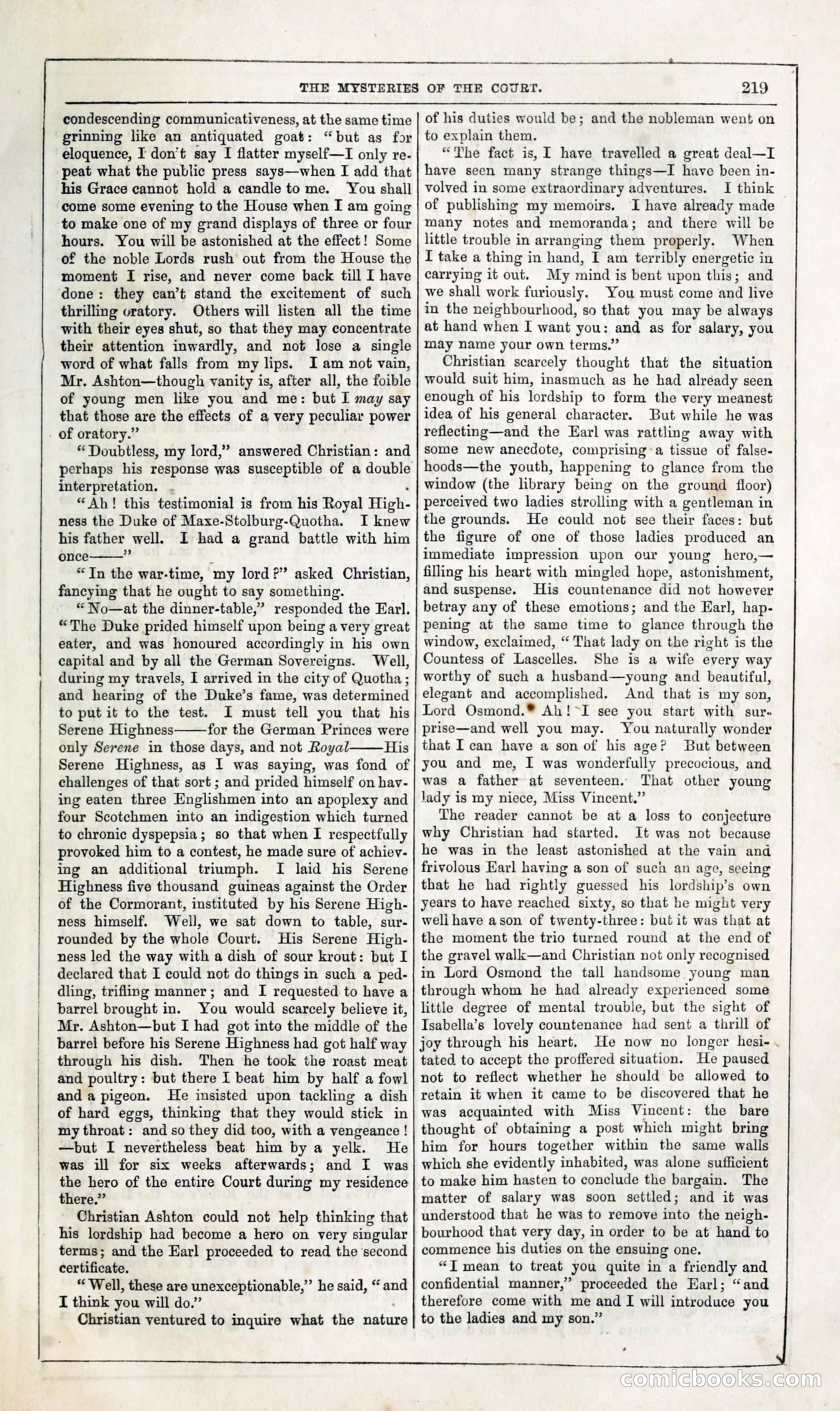
A restored page from Penny Dreadfuls, 1849. Page through the whole issue in the reader above.
📄 Transcribed text from this page (OCR, searchable)
Machine-transcribed from the original scan — historical spelling and the odd misread are preserved.
THE MYSTERIES OF THE COURT. 219 condescending communicativeness, at the same time grinning like an antiquated goat: “but as for eloquence, I don’t say I flatter myself—I only re- peat what the public press says—when I add that his Grace cannot hold a candle tome. You shall come some evening to the House when I am going to make one of my grand displays of three or four hours. You will be astonished at the effect! Some of the noble Lords rush out from the House the moment I rise, and never come back till I have done : they can’t stand the excitement of such thrilling oratory. Others will listen all the time with their eyes shut, so that they may concentrate their attention inwardly, and not lose a single word of what falls from my lips. I am not vain, Mr. Ashton—though vanity is, after all, the foible of young men like you and me: but I may say that those are the effects of a very peculiar power - of oratory.” * Doubtless, my lord,” answered Christian: and perhaps his response was susceptible of a double interpretation. . “Ah! this testimonial is from his Royal Hich- ness the Duke of Maxe-Stolburg-Quotha. I knew his father well. I had a grand battle with him once a In the war-time, my lord?” asked Christian, fancying that he ought to say something. “ No—at the dinner-table,” responded the Karl. “The Duke prided himself upon being avery great eater, and was honoured accordingly in his own capital and by all the German Sovereigns. Well, during my travels, 1 arrived in the city of Quotha; and hearing of the Duke’s fame, was determined to put it to the test. I must tell you that his Serene Highness for the German Princes were only Serene in those days, and not Royal His Serene Highness, as 1 was saying, was fond of challenges of that sort ; and prided himself on hav- ing eaten three Englishmen into an apoplexy and four Scotchmen into an indigestion which turned to chronic dyspepsia; so that when I respectfully provoked him to a contest, he made sure of achiev- ing an additional triumph. I laid his Serene Highness five thousand guineas against the Order of the Cormorant, instituted by his Serene High- ness himself. Well, we sat down to table, sur- rounded by the whole Court. His Serene High- ness led the way with a dish of sour krout: but I declared that I could not do things in such a ped- dling, trifling manner; and I requested to have a barrel brought in. You would scarcely believe it, Mr. Ashton—but I had got into the middle of the barrel before his Serene Highness had got half way through his dish. Then he took the roast meat and poultry: but there I beat him by half a fowl anda pigeon. He insisted upon tackling a dish of hard eggs, thinking that they would stick in my throat: and so they did too, with a vengeance ! —but I nevertheless beat him by a yelk. He was ill for six weeks afterwards; and I was the hero of the entire Court during my residence there.” Christian Ashton could not help thinking that his lordship had become a hero on very singular terms; and the Harl proceeded to read the second certificate. “Well, these are unexceptionable,” he said, “ and I think you will do.” Christian ventured to inquire what the nature of his duties would be; and the nobleman went on to explain them. “The fact is, I have travelled a great deal—I have seen many strange things—I have been in- volved in some extraordinary adventures. I think of publishing my memoirs. I have already made many notes and memoranda; and there will be little trouble in arranging them properly. When I take a thing in hand, I am terribly energetic in carrying it out. My mind is bent upon this; and we shall work furiously. You must come and live in the neighbourhood, so that you may be always at hand when I want you: and as for salary, you may name your own terms.” Christian scarcely thought that the situation would suit him, inasmuch as he had alréady seen enough of his lordship to form the very meanest idea of his general character. But while he was reflecting—and the Earl was rattling away with some new anecdote, comprising:a tissue of false- hoods—the youth, happening to glance from the window (the library being on the ground floor) perceived two ladies strolling with a gentleman in the grounds. He could not see their faces: but the figure of one of those ladies produced an immediate impression upon our young hero,— filling his heart with mingled hope, astonishment, and suspense. His countenance did not however betray any of these emotions; and the Earl, hap- pening at the same time to glance through the window, exclaimed, “ That lady on the right is the Countess of Lascelles. She is a wife every way worthy of such a husband—young and beautiful, elegant and accomplished. And that is my son, Lord Osmond.* Ah! ~I see you start with sur. prise—and well you may. You naturally wonder that I can have a son of his age? But between you and me, I was wonderfully precocious, and was a father at seventeen. That other young lady is my niece, Miss Vincent.” The reader cannot be at a loss to conjecture why Christian had started. It was not because he was in the least astonished at the vain and frivolous Earl having a son of such an age, seeing that he had rightly guessed his lordship’s own years to have reached sixty, so that he might very weli have ason of twenty-three: butit was that at the moment the trio turned round at the end of the gravel walk—and Christian not only recognised in Lord Osmond the tall handsome young man through whom he had already experienced some little degree of mental trouble, but the sight of Tsabella’s lovely countenance had sent a thrill of joy through his heart. tated to accept the proffered situation. He paused not to reflect whether he should be allowed to retain it when it came to be discovered that he was acquainted with Miss Vincent: the bare thought of obtaining a post which might bring him for hours together within the same walls which she evidently inhabited, was alone sufficient to make him hasten to conclude the bargain. The matter of salary was soon settled; and it was understood that he was to remove into the neigh- bourhood that very day, in order to be at hand to commence his duties on the ensuing one. “JT mean to treat you quite in a friendly and confidential manner,’ proceeded the Earl; “and therefore come with me and I will introduce you to the ladies and my son.” a a He now no longer hesi- . CO) (C(O) S 6)(0)(0)