
Penny Dreadfuls, 1849 · page 224 of 394
The Mysteries of the Court of London — page 224: what you’re looking at
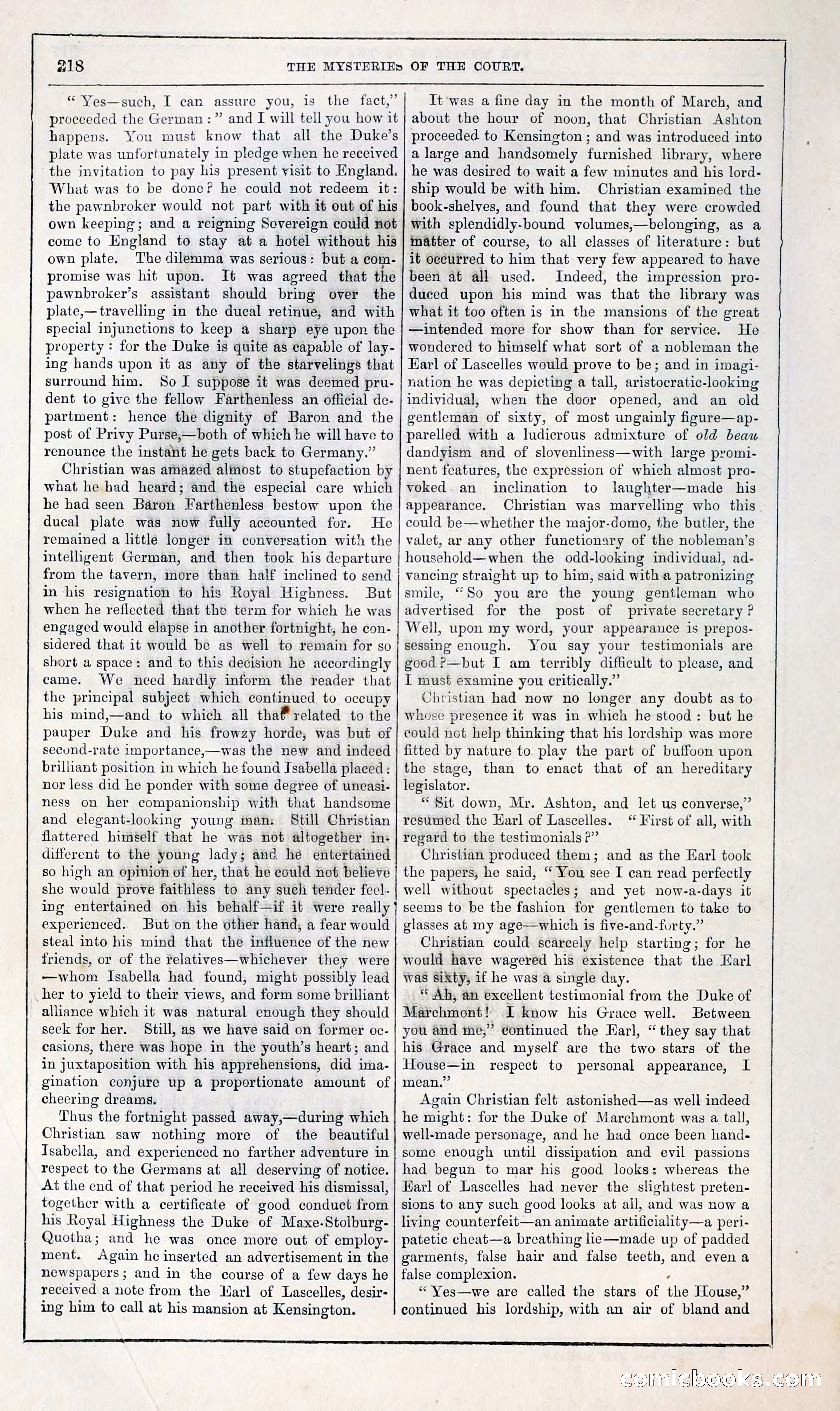
A restored page from Penny Dreadfuls, 1849. Page through the whole issue in the reader above.
📄 Transcribed text from this page (OCR, searchable)
Machine-transcribed from the original scan — historical spelling and the odd misread are preserved.
218 THE MYSTERIEs OF THE COURT. “ Yes—such, I can assure you, is the fact,” proceeded the German: ” and I will tell you how it happens. You must know that all the Duke’s plate was unfortunately in pledge when he received the invitation to pay his present visit to England. What was to be done? he could not redeem it: the pawnbroker would not part with it out of his own keeping; and a reigning Sovereign could not come to England to stay at a hotel without his own plate. The dilemma was serious: but a com- promise was hit upon. It was agreed that the pawnbroker’s assistant should bring over the plate,—travelling in the ducal retinue, and with special injunctions to keep a sharp eye upon the property : for the Duke is quite as capable of lay- ing hands upon it as any of the starvelings that surround him. So JI suppose it was deemed pru- dent to give the fellow Farthenless an official de- partment: hence the dignity of Baron and the post of Privy Purse,—both of which he will have to renounce the instant he gets back to Germany.” Christian was amazed alinost to stupefaction by what he had heard; and the especial care which he had seen Baron Farthenless bestow upon the ducal plate was now fully accounted for. He remained a little longer in conversation with the intelligent German, and then took his departure from the tavern, more than half inclined to send in his resignation to his Royal Highness. But when he reflected that tho term for which he was engaged would elapse in another fortnight, he con- sidered that it would be as well to remain for so short a space: and to this decision he accordingly came. We need hardly inform the reader that the principal subject which continued to occupy his mind,—and to which all tha related to the pauper Duke and his frowzy horde, was but of secund-rate importance,—was the new and indeed brilliant position in which he found Isabella placed : nor less did he ponder with some degree of uneasi- ness on her companionship with that handsome and elegant-looking young man: Still Christian flattered himself that he was not altogether in- different to the young lady; anc hé entertained so high an opinion of her, that he could not believe she would prove faithless to any such tender feel. ing entertained on his behalf—if it were really experienced. But on the other hand, a fear would steal into his mind that the influence of the new friends, or of the relatives—whichever they were —whom Isabella had found, might possibly lead her to yield to their views, and form some brilliant alliance which it was natural enough they should seek for her. Still, as we have said on former oc- casions, there was hope in the youth’s heart; and in juxtaposition with his apprehensions, did ima- gination conjure up a proportionate amount of cheering dreams. Thus the fortnight passed away,—during which Christian saw nothing more of the beautiful Isabella, and experienced no farther adventure in respect to the Germans at all deserving of notice. At the end of that period he received his dismissal, together with a certificate of good conduct from his Royal Highness the Duke of Maxe-Stolburg- Quotha; and he was once more out of employ- ment. Again he inserted an advertisement in the newspapers; and in the course of a few days he received a note from the Earl of Lascelles, desir- ing him to call at his mansion at Kensington. It'was a fine day in the month of March, and about the hour of noon, that Christian Ashton proceeded to Kensington ; and was introduced into a large and handsomely furnished library, where he was desired to wait a few minutes and his lord- ship would be with him. Christian examined the book-shelves, and found that they were crowded with splendidly-bound volumes,—belonging, as a matter of course, to all classes of literature: but if Occurred to him that very few appeared to have been af all used. Indeed, the impression pro- duced upon his mind was that the library was what it too often is in the mansions of the great —intended more for show than for service. He wondered to himself what sort of a nobleman the Earl of Lascelles would prove to be; and in imagi- nation he was depicting a tall, aristocratic-looking individual, when the door opened, and an old gentleman of sixty, of most ungainly figure—ap- parelled with a ludicrous admixture of old beau dandyism and of slovenliness—with large promi- nent features, the expression of which almost pro- voked an inclination to laughter—made his appearance. Christian was marvelling who this could be—whether the major-domo, the butler, the valet, ar any other functionary of the nobleman’s household—when the odd-looking individual, ad- vancing straight up to him, said with a patronizing smile, “So you are the young gentleman who advertised for the post of private secretary ? Well, upon my word, your appearance is prepos- sessing enough. You say your testimonials are good ?—but I am terribly difficult to please, and I must examine you critically.” Christian had now no longer any doubt as to whose presence it was in which he stood: but he could not help thinking that his lordship was more fitted by nature to play the part of buffoon upon the stage, than to enact that of an hereditary legislator. “Sit down, Mr. Ashton, and let us converse,” resumed the Earl of Lascelles. “ First of all, with regard to the testimonials ?” Christian produced them; and as the Earl took the papers, he said, “ You see I can read perfectly well without spectacles; and yet now-a-days it seems to be the fashion for gentlemen to take to glasses at my age—which is five-and-forty.” Christian could scarcely help starting; for he would have wagered his existence that the Earl was sixty, if he was a single day. _ “A, an excellent testimonial from the Duke of Marchmont! I know his Grace well. Between you and me,’ continued the Earl, “they say that his Grace and myself are the two stars of the House—in respect to personal appearance, I mean.” Again Christian felt astonished—as well indeed he might: for the Duke of Marchmont was a tall, well-made personage, and he had once been hand- some enough until dissipation and evil passions had begun to mar his good looks: whereas the Karl of Lascelles had never the slightest preten- sions to any such good looks at all, and was now a living counterfeit—an animate artificiality—a peri- patetic cheat—a breathing lie—made up of padded garments, false hair and false teeth, and even a false complexion. ; « Yes—we are called the stars of the House,” continued his lordship, with an ai of bland and RS LEE LIED EC TI CS a eee, ' Gomicdoo S (EO)