
Penny Dreadfuls, 1849 · page 205 of 394
The Mysteries of the Court of London — page 205: what you’re looking at
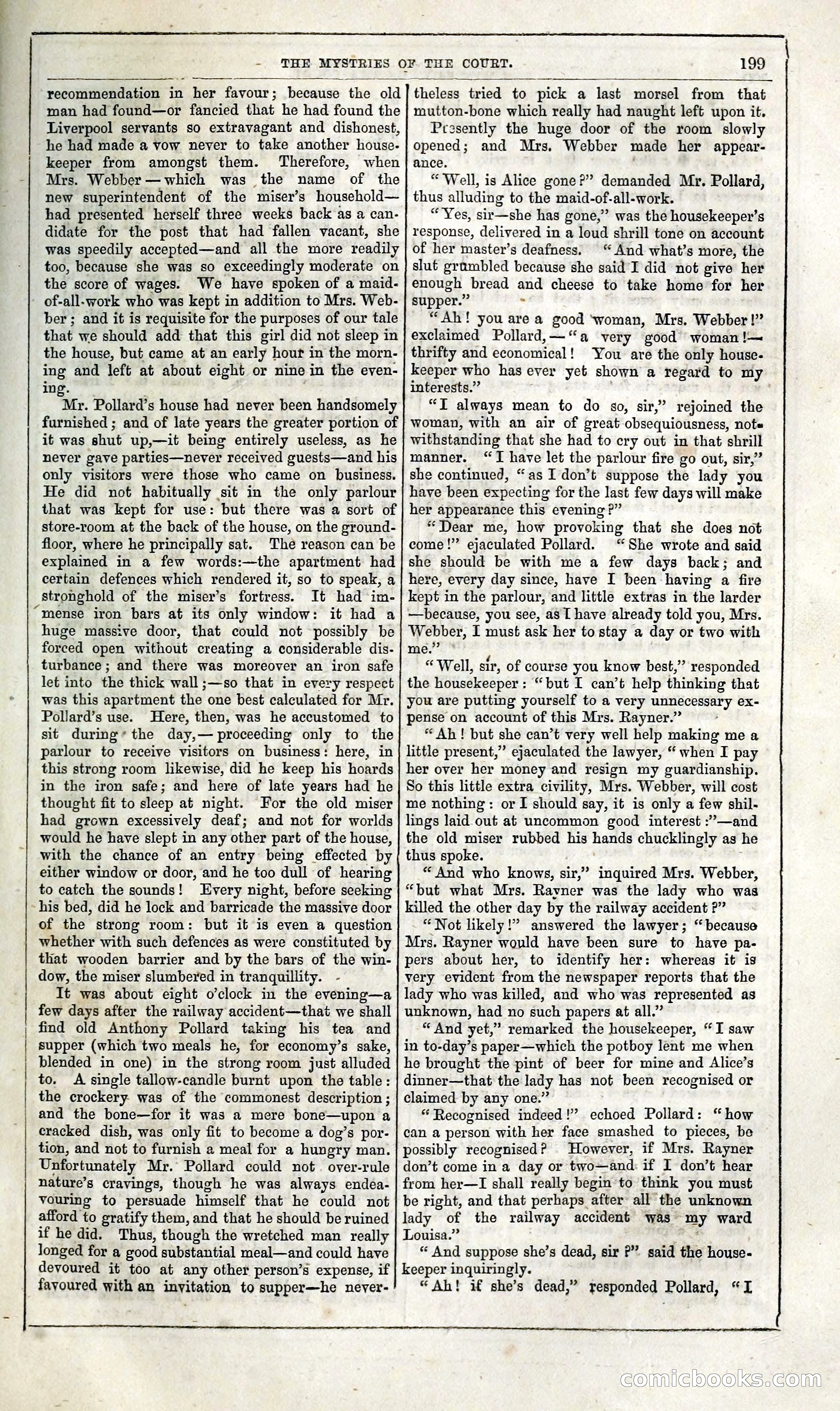
A restored page from Penny Dreadfuls, 1849. Page through the whole issue in the reader above.
📄 Transcribed text from this page (OCR, searchable)
Machine-transcribed from the original scan — historical spelling and the odd misread are preserved.
— - HE MYSTRIES OF THE COURT. recommendation in her favour; because the old man had found—or fancied that he had found the Liverpool servants so extravagant and dishonest, he had made a vow never to take another house- keeper from amongst them. ‘Therefore, had presented herself three weeks back as a can- didate for the post that had fallen vacant, she was speedily accepted—and all the more readily too, because she was so exceedingly moderate on the score of wages. We have spoken of a maid- of-all-work who was kept in addition to Mrs. Web- ber; and it is requisite for the purposes of our tale that we should add that this girl did not sleep in the house, but came at an early hour in the morn- ing and left at about eight or nine in the even- ing. | Mr. Pollard’s house had never been handsomely furnished ; and of late years the greater portion of if was shut up,—it being entirely useless, as he never gave parties—never received guests—and his only visitors were those who came on business. He did not habitually sit in the only parlour that was kept for use: but there was a sort of store-room at the back of the house, on the ground- floor, where he principally sat. The reason can be explained in a few words:—the apartment had certain defences which rendered it, so to speak, a stronghold of the miser’s fortress. It had im- “mense iron bars at its only window: it had a huge massive door, that could not possibly be forced open without creating a considerable dis- turbance ; and there was moreover an iron safe let into the thick wall;—so that in every respect was this apartment the one best calculated for Mr. Pollard’s use. Here, then, was he accustomed to sit during’ the day,— proceeding only to the parlour to receive visitors on business: here, in this strong room likewise, did he keep his hoards in the iron safe; and here of late years had he thought fit to sleep at night. For the old miser had grown excessively deaf; and not for worlds would he have slept in any other part of the house, with the chance of an entry being effected by either window or door, and he too dull of hearing to catch the sounds! Lvery night, before seeking his bed, did he lock and barricade the massive door of the strong room: but it is even a question whether with such defences as were constituted by that wooden barrier and by the bars of the win- dow, the miser slumbered in tranquillity. It was about eight o’clock in the evening—a few days after the railway accident—that we shall find old Anthony Pollard taking his tea and supper (which two meals he, for economy’s sake, blended in one) in the strong room just alluded to. A single tallow-candle burnt upon the table: the crockery was of the commonest description ; and the bone—for it was a mere bone—upon a cracked dish, was only fit to become a dog’s por- tion, and not to furnish 2 meal for a hungry man. Unfortunately Mr. Pollard could not. over-rule nature’s cravings, though he was always endea- vyouring to persuade himself that he could not afford to gratify them, and that he should be ruined if he did. Thus, though the wretched man really Jonged for a good substantial meal—and could have devoured it too at any other person’s expense, if fayoured with an inyitation to supper—he never- when Mrs. Webber —which was the name of the new superintendent of the miser’s household— 199 — theless tried to pick a last morsel from that mutton-bone which really had naught left upon it. Presently the huge door of the room slowly opened; and Mrs, Webber made her appear- ance. “Well, is Alice gone?” demanded Mr. Pollard, thus alluding to the maid-of-all-work. “Yes, sir—she has gone,” was the housekeeper’s response, delivered in a loud shrill tone on account of her master’s deafness. “And what’s more, the slut grombled because she said I did not give her enough bread and cheese to take home for her supper.” . “Ah! you are a good ‘woman, Mrs. Webber!” exclaimed Pollard,—‘“a very good woman !— thrifty and economical! ‘You are the only house- keeper who has ever yet shown a regard to my interests.” “I always mean to do go, sir,” rejoined the woman, with an air of preat obsequiousness, note withstanding that she had to cry out in that shrill manner. “T have let the parlour fire go out, sir,” she continued, “as I don’t suppose the lady you have been expecting for the last few days will make her appearance this evening ?” *'Dear me, how provoking that she does not come!” ejaculated Pollard. “She wrote and said she should be with me a few days back; and here, every day since, have I been having a fire kept in the parlour, and little extras in the larder —hbecause, you see, as [ have already told you, Mrs. Webber, I must ask her to stay a day or two with me.’?."" “Well, sir, of course you know best,” responded the housekeeper: “but I can’t help thinking that you are putting yourself to a very unnecessary ex- pense on account of this Mrs. Rayner.” * Ah! but she can’t very well help making me a little present,” ejaculated the lawyer, “ when I pay her over her money and resign my guardianship. So this little extra civility, Mrs. Webber, will cost me nothing: or I should say, it is only a few shil- lings laid out at uncommon good interest :’—and the old miser rubbed his hands chucklingly as he thus spoke. | “And who knows, sir,” inquired Mrs. Webber, “but what Mrs. Rayner was the lady who was killed the other day by the railway accident ?” “Not likely!” answered the lawyer; “because Mrs. Rayner would have been sure to have pa- pers about her, to identify her: whereas it is very evident from the newspaper reports that the lady who was killed, and who was represented as unknown, had no such papers at all.” “And yet,” remarked the housekeeper, “I saw in to-day’s paper—which the potboy lent me when he brought the pint of beer for mine and Alice’s dinner—that the lady has not been recognised or claimed by any one.” “ Recognised indeed!’ echoed Pollard: “how can a person with her face smashed to pieces, be possibly recognised? However, if Mrs. Rayner don’t come in a day or two—and: if I don’t hear from her—I shall really begin to think you must be right, and that perhaps after all the unknown lady of the railway accident was my ward Louisa.” : «“ And suppose she’s dead, sir P” said the house- keeper inquiringly. “Ah! if she’s dead,” responded Pollard, “I DOOKS (C(O) (C(O)