
Penny Dreadfuls, 1849 · page 204 of 394
The Mysteries of the Court of London — page 204: what you’re looking at
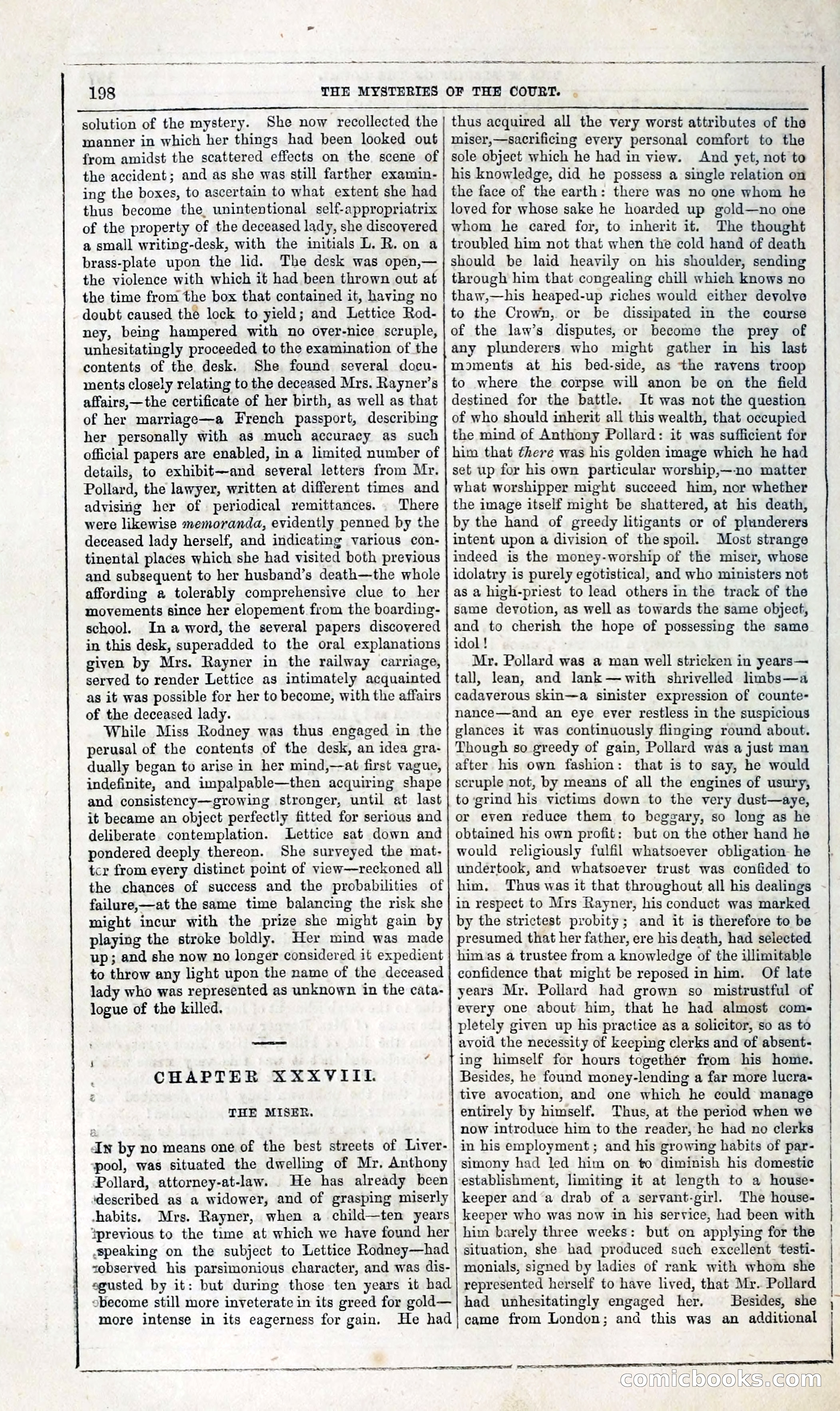
A restored page from Penny Dreadfuls, 1849. Page through the whole issue in the reader above.
📄 Transcribed text from this page (OCR, searchable)
Machine-transcribed from the original scan — historical spelling and the odd misread are preserved.
—_— 198 solution of the mystery. She now recollected the manner in which her things had been looked out from amidst the scattered effects on the scene of the accident; and as she was still farther examin- ing the boxes, to ascertain to what extent she had thus become the unintentional self-appropriatrix of the property of the deceased lady, she discovered a small writing-desk, with the initials L. R. on a brass-plate upon the lid. The desk was open,— the violence with which it had been thrown out at the time from the box that contained it, having no doubt caused the lock to yield; and Lettice Rod- ney, being hampered with no over-nice scruple, unhesitatingly proceeded to the examination of the contents of the desk. She found several docu- ments closely relating to the deceased Mrs. Rayner’s affairs,—the certificate of her birth, as well as that of her marriage—a French passport, describing her personally with as much accuracy as such official papers are enabled, in a limited number of details, to exhibit~and several letters from Mr. Pollard, the lawyer, written at different times and advising her of periodical remittances. There were likewise memoranda, evidently penned by the deceased lady herself, and indicating various con- tinental places which she had visited both previous and subsequent to her husband’s death—the whole affording a tolerably comprehensive clue to her movements since her elopement from the boarding- school. Ina word, the several papers discovered in this desk, superadded to the oral explanations given by Mrs. Rayner in the railway carriage, served to render Lettice as intimately acquainted as it was possible for her to become, with the affairs of the deceased lady. While Miss Rodney was thus engaged in the perusal of the contents of the desk, an idea gra- 7 -_=- Se —— e+ eee ——E — — a ~- _— - ee ROT re i ee ene ee ee er es eee THE MYSTERIES OF THE COURT. . thus acquired all the very worst attributes of the miser,—sacrificing every personal comfort to the sole object which he had in view. And yet, not to his knowledge, did he possess a single relation on the face of the earth: there was no one whom he loved for whose sake he hoarded up gold—no one whom he cared for, to inherit it. The thought troubled him not that when the cold hand of death should be laid heavily on his shoulder, sending through him that congealing chill which knows no thaw,—his heaped-up riches would either devolve to the Crown, or be dissipated in the course of the law’s disputes, or become the prey of any plunderers who might gather in his last moments at his bed-side, as the ravens troop to where the corpse will anon be on the field destined for the battle. of who should inherit all this wealth, that occupied the mind of Anthony Pollard: it was sufficient for him that there was his golden image which he had set up for his own particular worship,—no matter what worshipper might succeed him, nor whether the image itself might be shattered, at his death, by the hand of greedy litigants or of plunderers intent upon a division of the spoil. indeed is the money-worship of the miser, whose idolatry is purely egotistical, and who ministers not as a high-priest to lead others in the track of the same devotion, as well as towards the same object, and to cherish the hope of possessing the same idol ! It was not the question Most strange Mr. Pollard was a man well stricken in years— tall, lean, and lank—with shrivelled limbs—a cadaverous skin—a sinister expression of counte- nance—and an eye ever restless in the suspicious glances it was continuously flinging round about. Though so greedy of gain, Pollard was a just man after his own fashion: that is to say, he would scruple not, by means of all the engines of usury, to grind his victims down to the very dust—aye, or even reduce them to beggary, so long as he obtained his own profit: but on the other hand he would religiously fulfil whatsoever obligation- he undertook, and whatsoever trust was confided to him, Thus was it that throughout all his dealings in respect to Mrs Rayner, his conduct was marked by the strictest probity; and it is therefore to be presumed that her father, ere his death, had selected him as a trustee from a knowledge of the illimitable confidence that might be reposed in him. Of late years Mr. Pollard had grown so mistrustful of every one about him, that he had almost com- pletely given up his practice as a solicitor, so as to avoid the necessity of keeping clerks and of absent- dually began to arise in her mind,—at first vague, indefinite, and impalpable—then acquiring shape and consistency—growing stronger, until at last it became an object perfectly fitted for serious and deliberate contemplation. Lettice sat down and pondered deeply thereon. She surveyed the mat- tcr from every distinct point of view—reckoned all the chances of success and the probabilities of failure,—at the same time balancing the risk she might incur with the prize she might gain by playing the stroke boldly. Her mind was made up; and she now no longer considered it expedient to throw any light upon the name of the deceased lady who was represented as unknown in the cata- logue of the killed. CHAPTER XXXVIII. THE MISER. In by no means one of the best streets of Liver- pool, was situated the dwelling of Mr, Anthony Pollard, attorney-at-law. He has already been described as a widower, and of grasping miserly habits. Mrs. Rayner, when a child—ten years ‘previous to the time at which we have found her speaking on the subject to Lettice Rodney—had sobserved his parsimonious character, and was dis- egusted by it: but during those ten years it had obecome still more inveterate in its greed for gold— He had more intense in its eagerness for gain. ing himself for hours together from his home. Besides, he found money-lending a far more lucra~ tive avocation, and one which he could manage entirely by himself. Thus, at the period when we now introduce him to the reader, he had no clerks in his employment; and his growing habits of par- simony had led him on to diminish his domestic establishment, limiting it at length to a house- keeper and a drab of a servant-girl. The house- keeper who was now in his service, had been with him barely three weeks: but on applying for the situation, she had produced such excellent testi- monials, signed by ladies of rank with whom she represented herself to have lived, that Mr. Pollard had unhesitatingly engaged her. JBesides, she came from London; and this was an additional ee eee - i i ni - i ae er MICLOOOKS. COM a (CO)