
Penny Dreadfuls, 1849 · page 17 of 394
The Mysteries of the Court of London — page 17: what you’re looking at
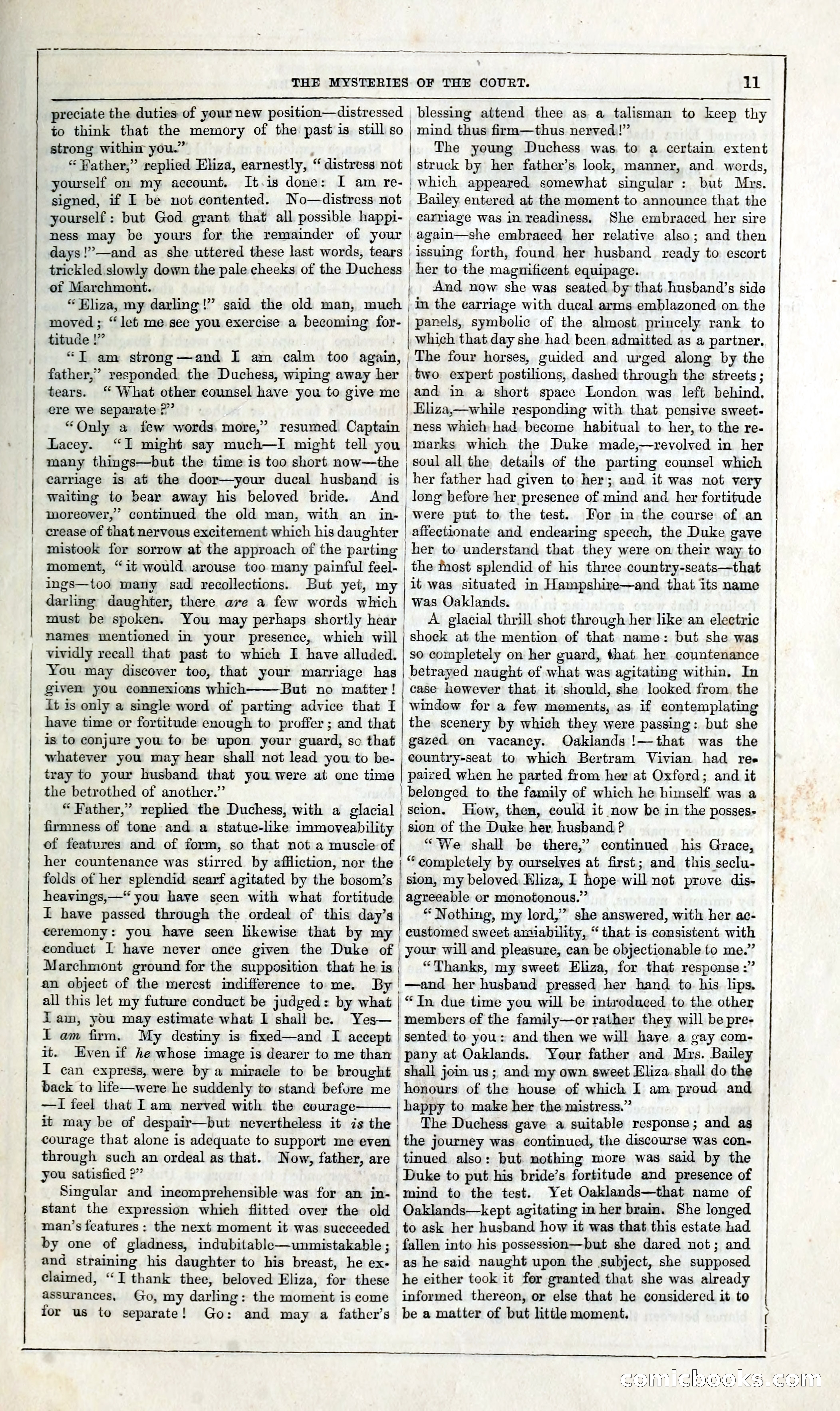
A restored page from Penny Dreadfuls, 1849. Page through the whole issue in the reader above.
📄 Transcribed text from this page (OCR, searchable)
Machine-transcribed from the original scan — historical spelling and the odd misread are preserved.
oe teen a TR THE MYSTERIES OF THE COURT. 11 preciate the duties of your new position—distressed to think that the memory of the past is stall so strong within you.” “ Father,” replied Eliza, earnestly, “ distress not yourself on my account. It.is done: I am re- signed, if I be not contented. No—distress not yourself: but God grant that all possible happi- ness may be yours for the remainder of your days !’”—and as she uttered these last words, tears trickled slowly down the pale cheeks of the Duchess of Marchmont. “ Bliza, my darling!” said the old man, much moved ; “let me see you exercise a becoming for- titude !” “T am strong—and I am calm too again, father,” responded the Duchess, wiping away her tears. “ What other counsel have you to give me ere we separate ?” “Only a few words. more,’ resumed Captain Lacey. “I might say much—I might tell you many things—but the time is too short now—the carriage is at the door—your ducal husband is waiting to bear away his beloved bride. And moreover,’ continued the old man, with an in- crease of that nervous excitement which his daughter mistook for sorrow at the approach of the parting moment, “it would arouse too many painful feel- ings—too many sad recollections. But yet, my darling daughter, there are a few words which must be spoken. You may perhaps shortly hear names mentioned in your presence, which will vividly recall that past to which I have alluded. You may discover too, that your marriage has given you connexions which But no matter! ft is only a single word of parting advice that I have time or fortitude enough to proffer ; and that is to conjure you to be upon your guard, so that whatever you may hear shall not lead you to be- tray to your husband that you were ai one time the betrothed of another.” “ Father,’ replied the Duchess, with a glacial firmness of tone and a statue-like immoveability of features and of form, so that not a muscle of her countenance was stirred by affliction, nor the folds of her splendid scarf agitated by the bosom’s heavings,—“ you have seen with what fortitude I have passed through the ordeal of this day’s ceremony: you have seen likewise that by my conduct I have never once given the Duke of Marchmont ground for the supposition that he is an object of the merest imdifference to me. By all this let my future conduct be judged: by what iam, you may estimate what I shall be. |mind thus firm—thus nerved Yes— | ft am firm. My destiny is fixed—and I accept | blessing attend thee as a talisman to keep thy }?? The young Duchess was to a certain extent struck by her father’s look, manner, and words, which appeared. somewhat singular: but Mrs. | Bailey entered at the moment to announce that the | carrlage was in readiness. She embraced her sire again—she embraced her relative also; and then issuing forth, found her husband ready to escort _her to the magnificent equipage. And now she was seated by that husband’s side in the carriage with ducal arms emblazoned on the parels, symbolic of the almost princely rank to which that day she had been admitted as a partner. The four horses, guided and urged along by the two expert postilions, dashed through the streets; and in a short space London was left behind. Eliza,—while responding with that pensive sweet- ness which had become habitual to her, to the re- marks which the Duke made,—revolved in her soul all the details of the parting counsel which her father had given to her; and it was not very long before her presence of mind and her fortitude were put to the test. For im the course of an affectionate and endearing speech, the Duke gave her to understand that they were on their way to the fhost splendid of his three country-seats—that it was situated in Hampshire—and that its name was Oaklands. A glacial thrill shot through her like an electric shock at the mention of that name: but she was so completely on her guard, that her countenance betrayed naught of what was agitating within. In case however that it. should, she looked from the window for a few moments, as if contemplating the scenery by which they were passing: but she gazed on vacancy. Oaklands !—that was the country-seat to which Bertram Vivian had ree paized when he parted from her at Oxford; and it belonged to the family of which he himself was a scion. How, then, could it now be in the posses- sion of the Duke her husband ? “We shall be there,’ continued his Grace, “completely by ourselves at first; and this seclu- sion, my beloved Eliza, I hope will not prove dis- agreeable or monotonous.” “ Nothing, my lord,” she answered, with her ac- eustomed sweet amiability, “that is consistent with your will and pleasure, can be objectionable to me.” “Thanks, my sweet Eliza, for that response :” —and her husband pressed her hand to his lips. “In due time you will be introduced to the other members of the family—or rather they will be pre- sented to you: and then we will have a gay com- it. Even if he whose image is dearer to me than pany at Oaklands. Your father and Mrs. Bailey I can express, were by a miracle to be brought shall joim us; and my own sweet Eliza shall do the back to life—were he suddenly to stand before me | honours of the house of which I am proud and —I feel that I am nerved with the courage it may be of despair—but nevertheless it is the courage that alone is adequate to support me even through such an ordeal as that. you satisfied ?” Singular and incomprehensible was for an in- stant the expression whieh flitted over the old man’s features : the next moment it was succeeded — by one of gladness, indubitable—unmistakable ; and straining his daughter to his breast, he ex- claimed, “I thank thee, beloved Eliza, for these assurances, Go, my darling: the moment is come for us to separate! Go: and may a father’s Now, father, are | | happy to make her the mistress.” The Duchess gave a suitable response; and as the journey was continued, the discourse was con- tinued also: but nothing more was said by the Duke to put his bride’s fortitude and presence of mind to the test. Yet Oaklands—that name of Oaklands—kept agitating in her brain. She longed to ask her husband how it was that this estate had fallen into his possession—but she dared not; and as he said naught upon the subject, she supposed he either took it fer granted that she was already informed thereon, or else that he considered it to be a matter of but little moment. hit a RN AG ttt ee (C(O) DOOKS (C(O)