
Penny Dreadfuls, 1849 · page 16 of 394
The Mysteries of the Court of London — page 16: what you’re looking at
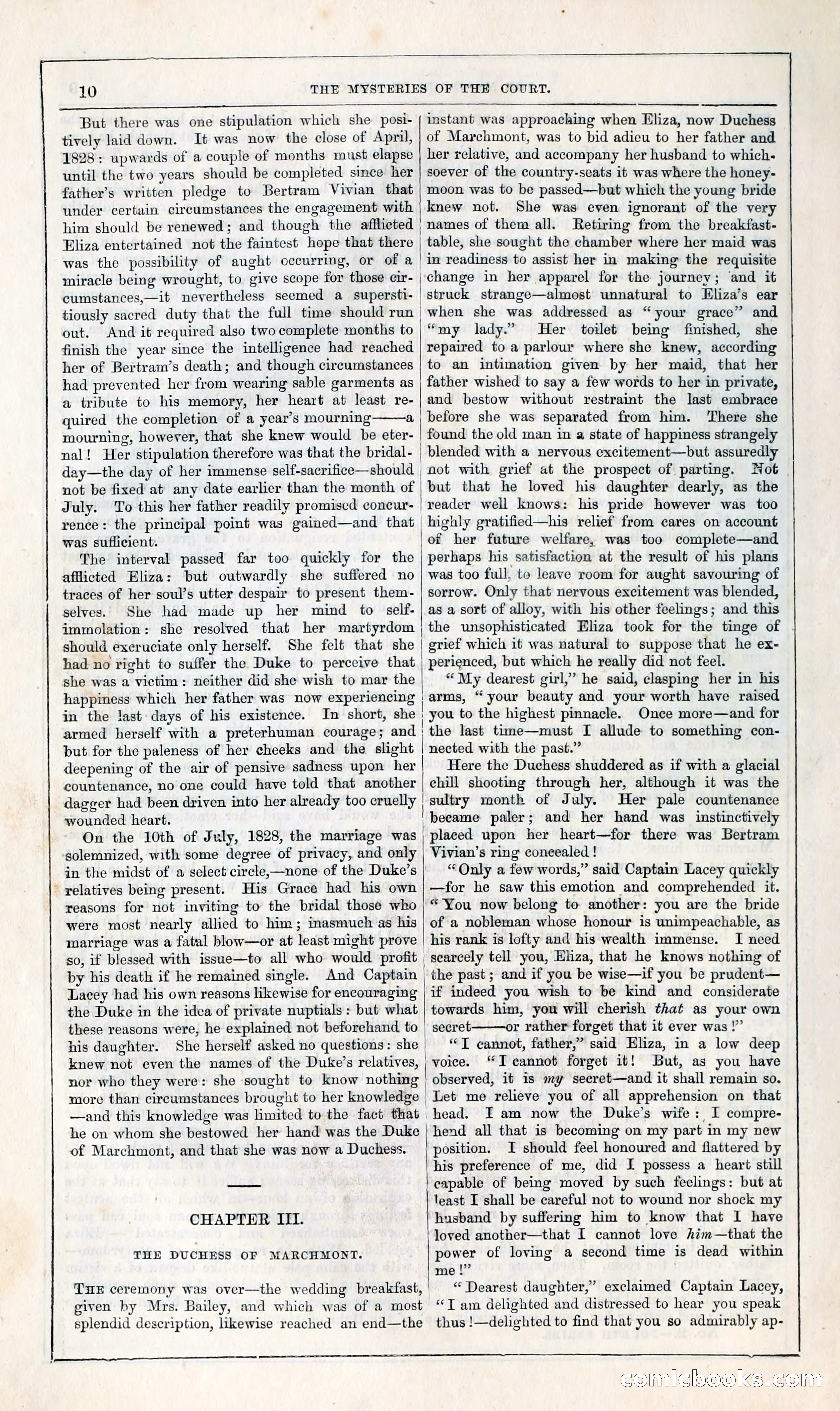
A restored page from Penny Dreadfuls, 1849. Page through the whole issue in the reader above.
📄 Transcribed text from this page (OCR, searchable)
Machine-transcribed from the original scan — historical spelling and the odd misread are preserved.
| Ce 10 But there was one stipulation which she posi- tively laid down. It was now the close of April, 1828 : upwards of a couple of months must elapse until the two years should be completed since her father’s written pledge to Bertram Vivian that under certain circumstances the engagement with him should be renewed; and though the afflicted Eliza entertained not the faintest hope that there was the possibility of aught occurring, or of a miracle being wrought, to give scope for those cir- cumstances,—it nevertheless seemed a supersti- tiously sacred duty that the full time should run out. And it required also two complete months to finish the year since the intelligence had reached her of Bertram’s death; and though circumstances had prevented her from wearing sable garments as a tribute to his memory, her heart at least re- quired the completion of a year’s mourning a mourning, however, that she knew would be eter- nal! Her stipulation therefore was that the bridal- day—the day of her immense self-sacrifice—should not be fixed at any date earlier than the month of July. To this her father readily promised concur- rence: the principal point was gained—and that was sufficient: The interval passed far too quickly for the afflicted Eliza: but outwardly she suffered no traces of her soul’s utter despair to present them- selves. She had made up her mind to self- immolation: she resolved that her martyrdom should exeruciate only herself. She felt that she had no right to suffer the Duke to perceive that she was a victim: neither did she wish to mar the happiness which her father was now experiencing in the last: days of his existence. armed herself with a preterhuman courage; and but for the paleness of her cheeks and the slight deepening of the air of pensive sadness upon her In short, she : you to the highest pinnacle. | THE MYSTERIES OF THE COURT. instant was approaching when Eliza, now Duchess of Marchmont, was to bid adieu to her father and her relative, and accompany her husband to which- soever of the country-seats it was where the honey- moon was to be passed—but which the young bride knew not. She was even ignorant of the very names of them all. Retiring from the breakfast- table, she sought the chamber where her maid was in readiness to assist her in making the requisite change in her apparel for the journey; ‘and it struck strange—almost unnatural to Eliza’s ear when she was addressed as “your grace” and “my lady.” Her toilet being finished, she repaired to a parlour where she knew, according to an intimation given by her maid, that her father wished to say a few words to her in private, and bestow without restraint the last embrace before she was separated from him. There she found the old man in a state of happiness strangely blended with a nervous excitement—but assuredly not with grief at the prospect of parting. Wot but that he loved his daughter dearly, as the reader well knows: his pride however was too highly gratified—his relief from cares on account of her future welfare, was too complete—and perhaps his satisfaction at the result of his plans was too full, to leave room for aught savouring of sorrow. Only that nervous excitement was blended, as a sort of alloy, with his other feelings; and this the unsophisticated Eliza took for the tinge of . grief which it was natural to suppose that he ex- perienced, but which he really did not feel. “My dearest girl,” he said, clasping her in his arms, “your beauty and your worth have raised Ounce more—and for the last time—must I allude to something con- nected with the past.” Here the Duchess shuddered as if with a glacial countenance, no one could have told that another | chill shooting through her, although it was the dagger had been driven into her already too cruelly | sultry month of July. wounded heart. On the 10th of July, 1828, the marriage was solemnized, with some degree of privacy, and only in the midst of a select circle,—none of the Duke’s relatives being present. His Grace had his own reasons for not inviting to the bridal those who were most nearly allied to him; inasmuch as his marriage was a fatal blow—or at least might prove so, if blessed with issue—to all who would profit by his death if he remained single. And Captain Lacey had his own reasons likewise for encouraging the Duke in the idea of private nuptials : but what these reasons were, he explained not beforehand to his daughter. She herself asked no questions: she knew not even the names of the Duke’s relatives, nor who they were: she sought to know nothing more than circumstances brought to her knowledge | —and this knowledge was limited to the fact that he on whom she bestowed her hand was the Duke of Marchmont, and that she was now a Duchess. CHAPTER III. THE DUCHESS OF MARCHMONT. THE ceremony was over—the wedding breakfast, given by Mrs. Bailey, and which was of a most splendid description, likewise reached an end—the Her pale countenance became paler; and her hand was instinctively placed upon her heart—for there was Bertram Vivian’s ring concealed ! “Only a few words,” said Captain Lacey quickly —for he saw this emotion and comprehended it. * You now belong to another: you are the bride of a nobleman whose honour is unimpeachable, as his rank is lofty and his wealth immense. I need searcely tell you, Eliza, that he knows nothing of the past ; and if you be wise—if you be prudent— if indeed you wish to be kind and considerate towards him, you will cherish that as your own secret———or rather forget that it ever was!” “T cannot, father,” said Eliza, in a low deep voice. “IT cannot forget it! But, as you have observed, it is my seeret—and it shall remain so. Let me relieve you of all apprehension on that head. ZT am now the Duke’s wife: I compre- hend all that is becoming on my part in my new position. I should feel honoured and flattered by his preference of me, did I possess a heart still capable of being moved by such feelings: but at least I shall be careful not to wound nor shock my husband by suffering him to know that I have loved another—that I cannot love him—that the power of loving a second time is dead within me |” “‘ Dearest daughter,” exclaimed Captain Lacey, “T am delighted and distressed to hear you speak thus !—delighted to find that you so admirably ap- EO JOO mile CS (C(O)