
Penny Dreadfuls, 1849 · page 158 of 394
The Mysteries of the Court of London — page 158: what you’re looking at
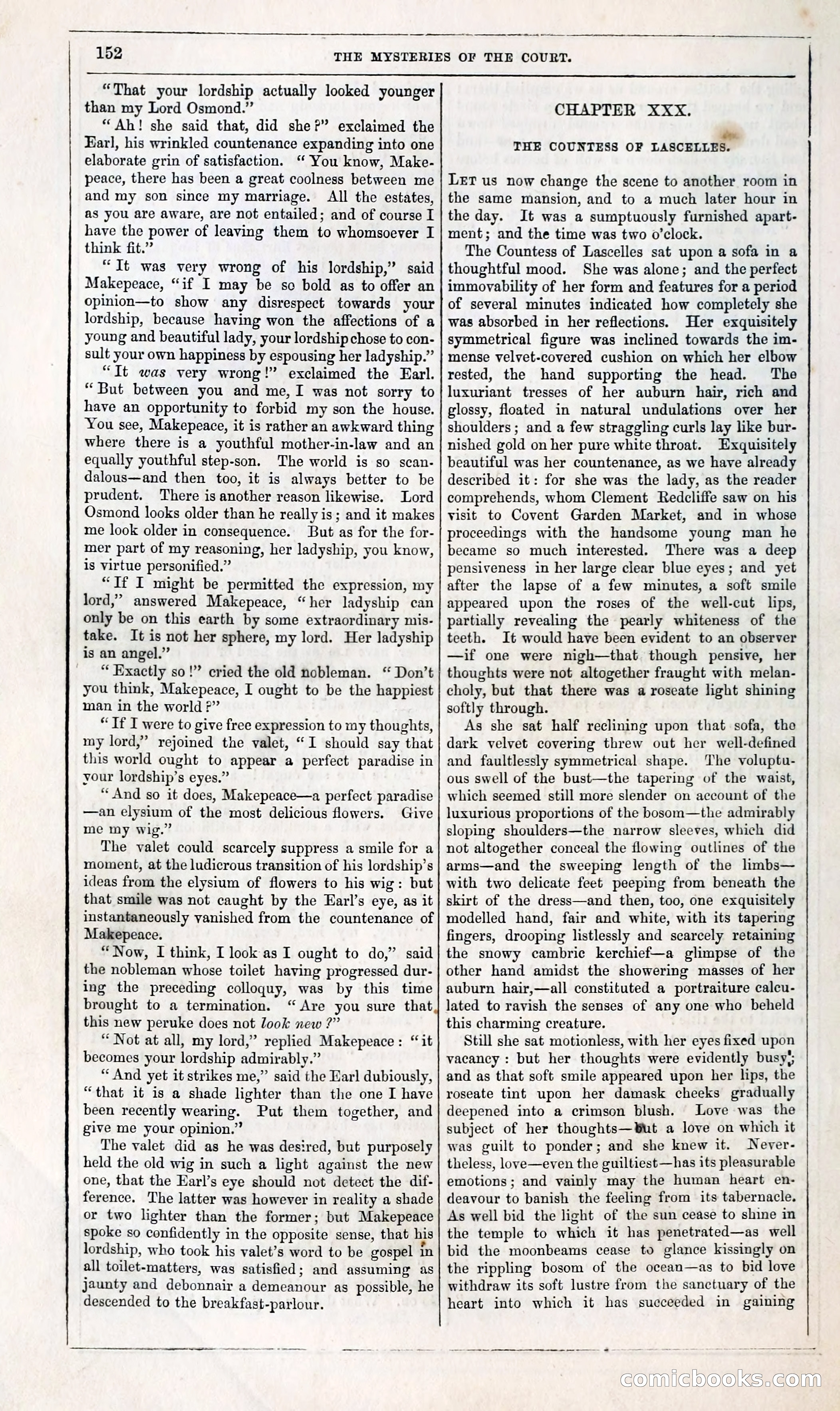
A restored page from Penny Dreadfuls, 1849. Page through the whole issue in the reader above.
📄 Transcribed text from this page (OCR, searchable)
Machine-transcribed from the original scan — historical spelling and the odd misread are preserved.
152 rt rr rt tt THE MYSTERIES OF THE COURT. “That your lordship actually looked younger than my Lord Osmond.” “Ah! she said that, did she?” exclaimed the Kar], his wrinkled countenance expanding into one elaborate grin of satisfaction. “ You know, Make- peace, there has been a great coolness between me and my son since my marriage. All the estates, as you are aware, are not entailed; and of course I have the power of leaving them to whomsoever I think fit.” “It was very wrong of his lordship,” said Makepeace, “if I may be so bold as to offer an opinion—to show any disrespect towards your lordship, because having won the affections of a young and beautiful lady, your lordship chose to con- sult your own happiness by espousing her ladyship.” “It was very wrong!” exclaimed the Earl. ‘But between you and me,I was not sorry to have an opportunity to forbid my son the house. You see, Makepeace, it is rather an awkward thing where there is a youthful mother-in-law and an equally youthful step-son. The world is so scan- dalous—and then too, it is always better to be prudent. There is another reason likewise. Lord Osmond looks older than he really is; and it makes me look older in consequence. But as for the for- mer part of my reasoning, her ladyship, you know, 1s virtue personified.” “Tf I might be permitted the expression, my lord,” answered Makepeace, “her ladyship can only be on this earth by some extraordinary mis- take. It is not her sphere, my lord. Her ladyship is an angel.” “Exactly so!” cried the old nobleman. “ Don’t you think, Makepeace, I ought to be the happiest man in the world?” “Tf I were to give free expression to my thoughts, my lord,” rejoined the valet, “I should say that this world ought to appear a perfect paradise in your lordship’s eyes.” “And so it does, Makepeace—a perfect paradise —an elysium of the most delicious flowers. Give me my wig.” The valet could scarcely suppress a smile for a moment, at the ludicrous transition of his lordship’s ideas from the elysium of flowers to his wig: but that smile was not caught by the Earl’s eye, as it instantaneously vanished from the countenance of Makepeace. “Now, I think, I look as I ought to do,” said the nobleman whose toilet having progressed dur- ing the preceding colloquy, was by this time brought to a termination. “Are you sure that this new peruke does not look new ?” “Not at all, my lord,” replied Makepeace: “it becomes your lordship admirably.” “And yet it strikes me,” said the Earl dubiously, “that it is a shade lighter than the one I have been recently wearing. Put them together, and give me your opinion.” The valet did as he was desired, but purposely held the old wig in such a light against the new one, that the Earl’s eye should not detect the dif- ference. The latter was however in reality a shade or two lighter than the former; but Makepeace spoke so confidently in the opposite sense, that his lordship, who took his valet’s word to be gospel in all toilet-matters, was satisfied; and assuming as jaunty and debonnair a demeanour as possible, he descended to the breakfast-parlour. es A ee —- = — + CHAPTER XXX. om THE COUNTESS OF LASCELLES. LET us now change the scene to another room in the same mansion, and to a much later hour in the day. It was a sumptuously furnished apart- ment; and the time was two o’clock. The Countess of Lascelles sat upon a sofa in a thoughtful mood. She was alone; and the perfect immovability of her form and features for a period of several minutes indicated how completely she was absorbed in her reflections. Her exquisitely symmetrical figure was inclined towards the im- mense velvet-covered cushion on which her elbow rested, the hand supporting the head. The luxuriant tresses of her auburn hair, rich and glossy, floated in natural undulations over her shoulders; and a few straggling curls lay like bur- nished gold on her pure white throat. Exquisitely beautiful was her countenance, as we have already described it: for she was the lady, as the reader comprehends, whom Clement Redcliffe saw on his visit to Covent Garden Market, and in whose proceedings with the handsome young man he became so much interested. There was a deep pensiveness in her large clear blue eyes; and yet after the lapse of a few minutes, a soft smile appeared upon the roses of the well-cut lips, partially revealing the pearly whiteness of the teeth. It would have been evident to an observer —if one were nigh—that though pensive, her thoughts were not altogether fraught with melan- choly, but that there was a roseate light shining softly through. As she sat half reclining upon that sofa, the dark velvet covering threw out her well-defined and faultlessly symmetrical shape. The voluptu- ous swell of the bust—the tapering of the waist, which seemed still more slender on account of the luxurious proportions of the bosom—the admirably sloping shoulders—the narrow sleeves, which did not altogether conceal the flowing outlines of the arms—and the sweeping length of the limbs— with two delicate feet peeping from beneath the skirt of the dress—and then, too, one exquisitely modelled hand, fair and white, with its tapering fingers, drooping listlessly and scarcely retaining the snowy cambric kerchief—a glimpse of the other hand amidst the showering masses of her auburn hair,—all constituted a portraiture calcu- lated to ravish the senses of any one who beheld this charming creature. Still she sat motionless, with her eyes fixed upon vacancy : but her thoughts were evidently busy); and as that soft smile appeared upon her lips, the roseate tint upon her damask cheeks gradually deepened into a crimson blush. Love was the subject of her thoughts—®ut a love on which it was guilt to ponder; and she knew it. Never- theless, love—even the guiltiest—has its pleasurable emotions; and vainly may the human heart en- deavour to banish the feeling from its tabernacle. As well bid the light of the sun cease to shine in the temple to which it has penetrated—as well bid the moonbeams cease to glance kissingly on the rippling bosom of the ocean—as to bid love withdraw its soft lustre from the sanctuary of the heart into which it has succeeded in gaining E@ DOO S