
Penny Dreadfuls, 1849 · page 67 of 394
The Mysteries of the Court of London — page 67: what you’re looking at
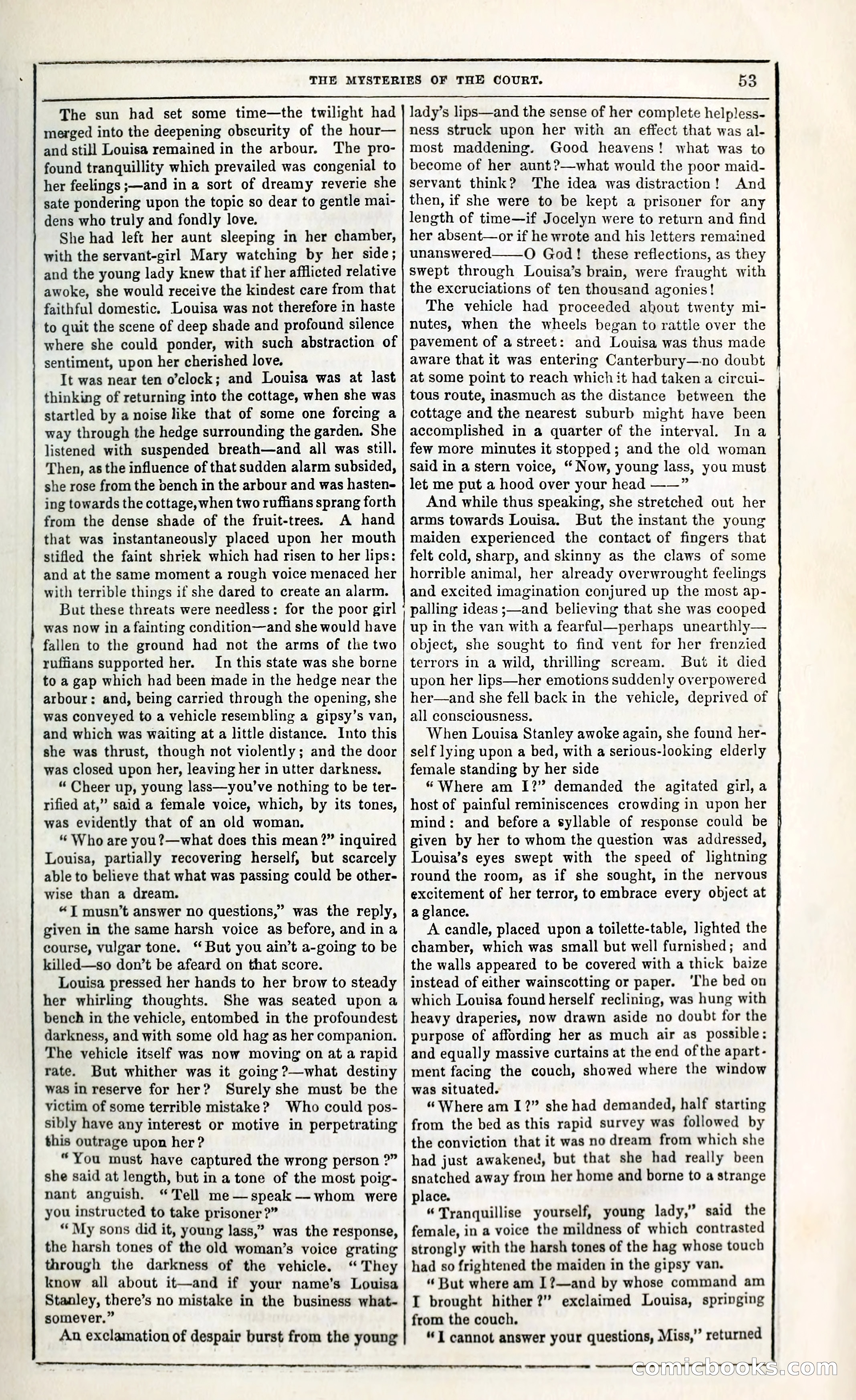
A restored page from Penny Dreadfuls, 1849. Page through the whole issue in the reader above.
📄 Transcribed text from this page (OCR, searchable)
Machine-transcribed from the original scan — historical spelling and the odd misread are preserved.
a a EE IT NS IEE LG I ST I IE I I SL LOE LI ET I SIE ET THE MYSTERIES OF THE COURT. 53 eg ean Se ee amen ELT eT EE Ae A ELLIMOMM TIM omen rn eee ae ee ee The sun had set some time—the twilight had merged into the deepening obscurity of the hour— and still Louisa remained in the arbour. The pro- found tranquillity which prevailed was congenial to her feelings ;—and in a sort of dreamy reverie she sate pondering upon the topic so dear to gentle mai- dens who truly and fondly love. She had left her aunt sleeping in her chamber, with the servant-girl Mary watching by her side; and the young lady knew that if her afflicted relative awoke, she would receive the kindest care from that faithful domestic. Louisa was not therefore in haste to quit the scene of deep shade and profound silence where she could ponder, with such abstraction of sentiment, upon her cherished love. It was near ten o’clock; and Louisa was at last thinking of returning into the cottage, when she was startled by a noise like that of some one forcing a way through the hedge surrounding the garden. She listened with suspended breath—and all was still. | Then, as the influence of that sudden alarm subsided, she rose from the bench in the arbour and was hasten- ing towards the cottage, when two ruffians sprang forth from the dense shade of the fruit-trees. A hand that was instantaneously placed upon her mouth stifled the faint shriek which had risen to her lips: and at the same moment a rough voice menaced her with terrible things if she dared to create an alarm. But these threats were needless: for the poor girl was now in a fainting condition—and she would have fallen to the ground had not the arms of the two ruffians supported her. In this state was she borne to a gap which had been made in the hedge near the arbour: and, being carried through the opening, she was conveyed to a vehicle resembling a gipsy’s van, and which was waiting at a little distance. Into this she was thrust, though not violently; and the door was closed upon her, leaving her in utter darkness. “ Cheer up, young lass—you’ve nothing to be ter- rified at,” said a female voice, which, by its tones, was evidently that of an old woman. “ Who are you?—what does this mean 2” inquired Louisa, partially recovering herself, but scarcely able to believe that what was passing could be other- wise than a dream. “J musn’t answer no questions,” was the reply, given in the same harsh voice as before, and ina course, vulgar tone. ‘ But you ain’t a-going to be killed—so don’t be afeard on that score. Louisa pressed her hands to her brow to steady her whirling thoughts. She was seated upon a bench in the vehicle, entombed in the profoundest darkness, and with some old hag as her companion. The vehicle itself was now moving on at a rapid rate. But whither was it going ?—what destiny was in reserve for her? Surely she must be the victim of some terrible mistake? Who could pos- sibly have any interest or motive in perpetrating this outrage upon her ? “You must have captured the wrong person 2” she said at length, but in a tone of the most poig- nant anguish. “Tell me—speak—whom were you instructed to take prisoner ?” “My sons did it, young lass,” was the response, the harsh tones of the old woman’s voice grating through the darkness of the vehicle. “They know all about it—and if your name’s Louisa Stanley, there’s no mistake in the business what- somever.” An exclamation of despair burst from the young EE, em HE HAAN ONOTON ES lady’s lips—and the sense of her complete helpless- ness struck upon her with an effect that was al- most maddening. Good heavens! what was to become of her aunt ?—what would the poor maid- servant think? ‘The idea was distraction! And then, if she were to be kept a prisoner for any length of time—if Jocelyn were to return and find her absent—or if he wrote and his letters remained unanswered O God! these reflections, as they swept through Louisa’s brain, were fraught with the excruciations of ten thousand agonies! The vehicle had proceeded ahout twenty mi- nutes, when the wheels began to rattle over the pavement of astreet: and Louisa was thus made aware that it was entering Canterbury—no doubt at some point to reach which it had taken a circui- tous route, inasmuch as the distance between the cottage and the nearest suburb might have been accomplished in a quarter of the interval. Ina few more minutes it stopped; and the old woman said in a stern voice, “ Now, young lass, you must let me put a hood over your head ——” And while thus speaking, she stretched out her arms towards Louisa. But the instant the young maiden experienced the contact of fingers that felt cold, sharp, and skinny as the claws of some horrible animal, her already overwrought feelings and excited imagination conjured up the most ap- palling ideas ;—and believing that she was cooped up in the van with a fearful—perhaps unearthly— object, she sought to find vent for her frenzied terrors in a wild, thrilling scream. But it died upon her lips—her emotions suddenly overpowered her—and she fell back in the vehicle, deprived of all consciousness. When Louisa Stanley awoke again, she found her- self lying upon a bed, with a serious-looking elderly female standing by her side “ Where am I?” demanded the agitated girl, a host of painful reminiscences crowding in upon her mind: and before a syllable of response could be given by her to whom the question was addressed, Louisa’s eyes swept with the speed of lightning round the room, as if she sought, in the nervous excitement of her terror, to embrace every object at a glance. A candle, placed upon a toilette-table, lighted the chamber, which was small but well furnished; and the walls appeared to be covered with a thick baize instead of either wainscotting or paper. ‘The bed on which Louisa found herself reclining, was hung with heavy draperies, now drawn aside no doubt for the purpose of affording her as much air as possible: and equally massive curtains at the end of the apart - ment facing the couch, showed where the window was situated. “ Where am I?” she had demanded, half starting from the bed as this rapid survey was followed by the conviction that it was no dream from which she had just awakened, but that she had really been snatched away from her home and borne to a strange place. “Tranquillise yourself, young lady,” said the female, in a voice the mildness of which contrasted strongly with the harsh tones of the hag whose touch had so frightened the maiden in the gipsy van. ‘But where am 1?—and by whose command am I brought hither?” exclaimed Louisa, springing from the couch. “I cannot answer your questions, Miss,” returned (C(O)