
Penny Dreadfuls, 1849 · page 66 of 394
The Mysteries of the Court of London — page 66: what you’re looking at
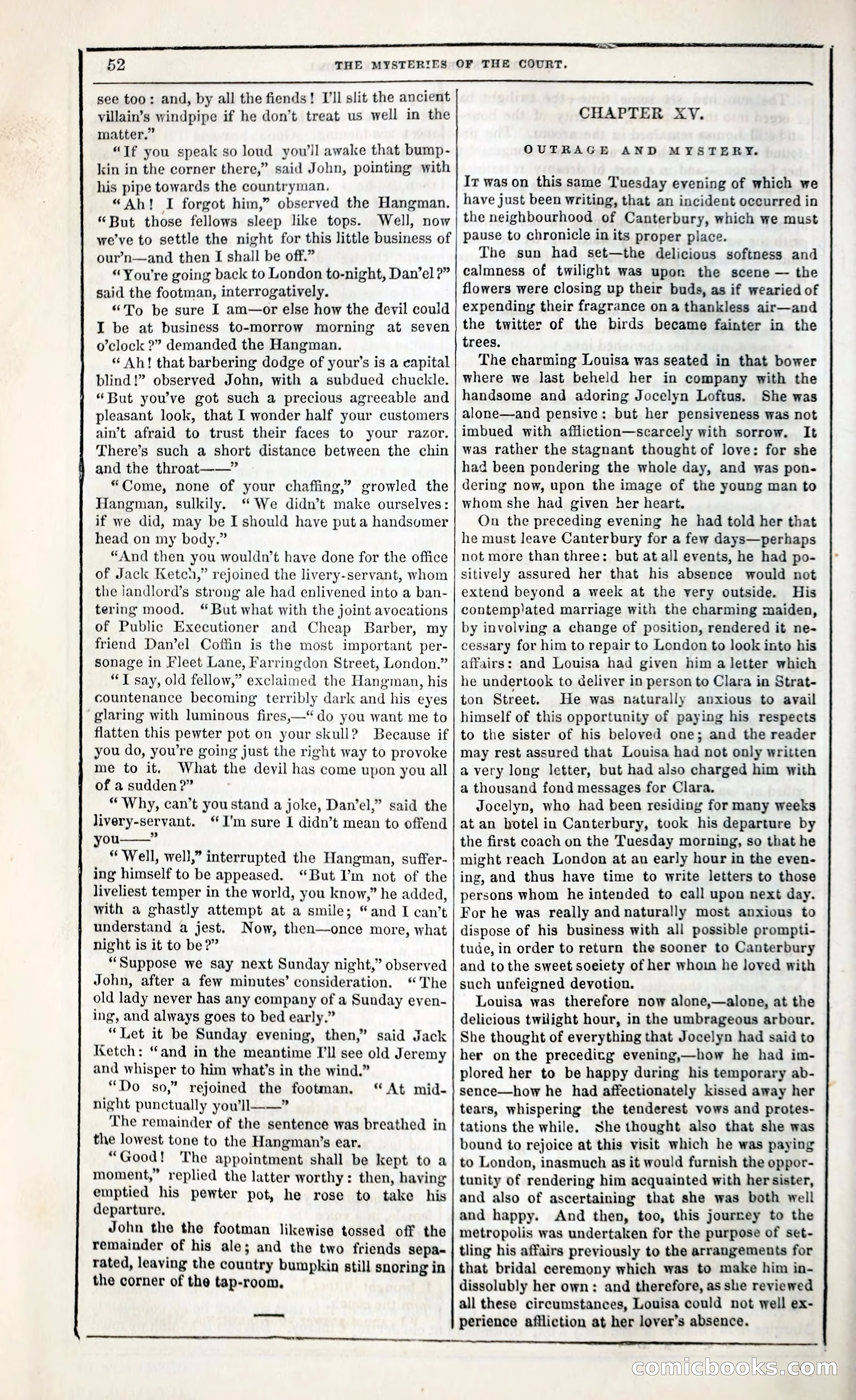
A restored page from Penny Dreadfuls, 1849. Page through the whole issue in the reader above.
📄 Transcribed text from this page (OCR, searchable)
Machine-transcribed from the original scan — historical spelling and the odd misread are preserved.
———— mmmmmmmmnnnnmmnesmmsesseteneeeesccceescesiectasaeccssasaaaaaaaasaaasadaaaaasasssscasasssaaassaamassaaaa THE MYSTERIES OF THE COURT. 52 un see too: and, by all the fiends! I'll slit the ancient villain’s windpipe if he don’t treat us well in the matter.” “If you speak so loud you'll awake that bump- kin in the corner there,” said John, pointing with his pipe towards the countryman. “Ah! I forgot him,” observed the Hangman. “But those fellows sleep like tops. Well, now we’ve to settle the night for this little business of our’n—and then I shall be off.” “You're going back to London to-night, Dan’el ?” said the footman, interrogatively. “To be sure I am—or else how the devil could I be at business to-morrow morning at seven o’clock ?” demanded the Hangman. * Ah! that barbering dodge of your’s is a capital blind!” observed John, with a subdued chuckle. “But you’ve got such a precious agreeable and pleasant look, that I wonder half your customers ain’t afraid to trust their faces to your razor. There’s such a short distance between the chin and the throat——” “Come, none of your chaffing,” growled the Hangman, sulkily. “ We didn’t make ourselves: if we did, may be I should have put a handsomer head on my body.” “And then you wouldn’t have done for the office of Jack Ketch,” rejoined the livery-servant, whom the jandlord’s strong ale had enlivened into a ban- tering mood. But what with the joint avocations of Public Executioner and Cheap Barber, my friend Dan’el Coffin is the most important per- sonage in Fleet Lane, Farringdon Street, London.” “IT say, old fellow,” exclaimed the Hangman, his countenance becoming terribly dark and his eyes glaring with luminous fires,—* do you want me to flatten this pewter pot on your skull? Because if you do, youre going just the right way to provoke me to it. What the devil has come upon you all of a sudden ?” “ Why, can’t you stand a joke, Dan’el,” said the livery-servant. ‘I’m sure I didn’t mean to offend Pee ei * Well, well,” interrupted the Hangman, suffer- ing himself to be appeased. “But I’m not of the liveliest temper in the world, you know,” he added, with a ghastly attempt at a smile; “and I can’t understand a jest. Now, then—once more, what night is it to be?” “Suppose we say next Sunday night,” observed John, after a few minutes’ consideration. “The old lady never has any company of a Sunday eyen- ing, and always goes to bed early.” “Let it be Sunday evening, then,” said Jack Ketch: “and in the meantime I'll see old Jeremy and whisper to him what’s in the wind.” “Do so,” rejoined the footman. night punctually you’ll——” The remainder of the sentence was breathed in the lowest tone to the Hangman’s ear. “Good! The appointment shall be kept to a moment,” replied the latter worthy: then, haying emptied his pewter pot, he rose to take his departure. John the the footman likewise tossed off the remainder of his ale; and the two friends sepa- rated, leaving the country bumpkin still snoring in the corner of the tap-room, * At mid- —_—eo_—_ re eee CHAPTER XV. OUTRAGE AND MYSTERY. It was on this same Tuesday evening of which we have just been writing, that an incident occurred in the neighbourhood of Canterbury, which we must pause to chronicle in its proper place. The sun had set—the delicious softness and calmness of twilight was upon the scene — the flowers were closing up their buds, as if wearied of expending their fragrance ona thankless air—and the twitter of the birds became fainter in the trees. The charming Louisa was seated in that bower where we last beheld her in company with the handsome and adoring Jocelyn Loftus. She was alone—and pensive: but her pensiveness was not imbued with affliction—scarcely with sorrow. It was rather the stagnant thought of love: for she had been pondering the whole day, and was pon- dering now, upon the image of the young man to whom she had given her heart, On the preceding evening he had told her that he must leave Canterbury for a few days—perhaps not more than three: but at all events, he had po- sitively assured her that his absence would not extend beyond a week at the very outside. His contemp/ated marriage with the charming maiden, by involving a change of position, rendered it ne- cessary for him to repair to London to look into his affairs: and Louisa had given him a letter which he undertook to deliver in person to Clara in Strat- ton Street. He was naturally anxious to avail himself of this opportunity of paying his respects to the sister of his beloved one; and the reader may rest assured that Louisa had not only written avery long letter, but had also charged him with a thousand fond messages for Clara. Jocelyn, who had been residing for many weeks at an botel in Canterbury, took his departure by the first coach on the Tuesday morning, so that he might reach London at an early hour in the even- ing, and thus have time to write letters to those persons whom he intended to call upon next day. For he was really and naturally most anxious to dispose of his business with all possible prompti- tude, in order to return the sooner to Canterbury and to the sweet soeiety of her whoin he loved with such unfeigned devotion. Louisa was therefore now alone,—alone, at the delicious twilight hour, in the umbrageous arbour. She thought of everything that Jocelyn had said to her onthe preceditg evening,—how he had im- plored her to be happy during his temporary ab- sence—how he had affectionately kissed away her tears, whispering the tenderest vows and protes- tations the while. She thought also that she was bound to rejoice at this visit which he was paying to London, inasmuch as it would furnish the oppor- tunity of rendering him acquainted with her sister, and also of ascertaining that she was both well and happy. And then, too, this journey to the metropolis was undertaken for the purpose of set- tling his affairs previously to the arrangements for that bridal ceremony which was to make him in- dissolubly her own: and therefore, as she reviewed all these circumstances, Louisa could not well ex- perience affliction at her lover’s absence. (Eo) CONNIECLOOOKS