
Penny Dreadfuls, 1849 · page 60 of 394
The Mysteries of the Court of London — page 60: what you’re looking at
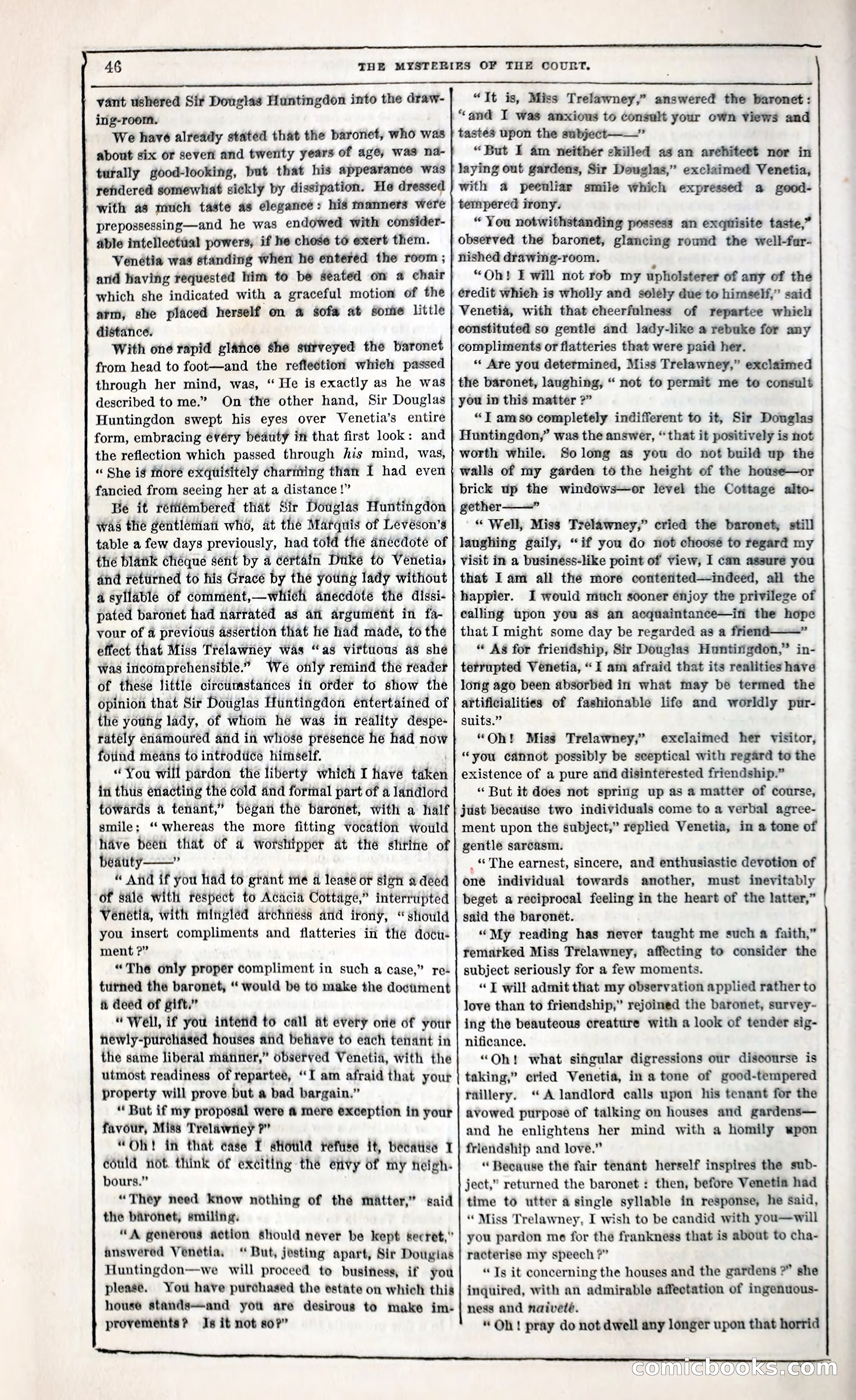
A restored page from Penny Dreadfuls, 1849. Page through the whole issue in the reader above.
📄 Transcribed text from this page (OCR, searchable)
Machine-transcribed from the original scan — historical spelling and the odd misread are preserved.
46 THE MYSTERIES OF THE COURT. vant ushered Sir Douglas Huntingdon into the draw- ing-room. We havé already stated that the baronet, who was about six or sever and twenty years of age; was na- turally good-looking, but that his appearance was refidered somewhat sickly by dissipation. He dressed with 28 much taste as elegance: his manners were prepossessing—and he was endowed with consider- able intellectual powers, if he chose to exert them. Venctia was standing when he entered the room ; anid having requested him to be seated on a chair which she indicated with a graceful motion of the arm, she placed herself on @ sofa at some little distance. With one rapid glance she surveyed the baronet from head to foot—and the refleétion which passed through her mind, was, “ He is exactly as he was described to me.” On the other hand, Sir Douglas Huntingdon swept his eyes over Venetia’s entire form, embracing évéry béauty in that first look: and the reflection which passed through his mind, was, “ She ig more exquisitely charming than I had even fancied from seeing her at a distance !” Be it réffiiémbered that Sir Douglas Huntingdon | was the gentlenian who, at the Marfquis of Leveson’s table a few days previously, had told the anecdote of thé blank cheque sent by a certain Dtike to Venetia, and returned to his Gracé by the yoting lady without a syllable of comment,—which anecdote the dissi- pated baronet had narrated as afi argument in fa- your of 4 previous assertion that hé had made, to the effect that Miss Trelawney was “as virtuous as she was incomprehensible.” We ofily remind the reader of these little circumstances if order to show the opinion that Sir Douglas Huntingdon entertained of the young lady, of whom he was itt reality despe- ritely enamoured and in whose presence he had now foiind means to introdiée himself. . “You will pardon the liberty which I have taken in thus enacting the cold and formal part of 4 landlord towards 4 tenant,” began thé baronet, with a half smile; ‘‘ whereas the more fitting vocation would have been that of a Worshipper at the shrine of beatity—” “ And if you had to grant te a lease or sigh a deed of silé with respect to Acacia Cottage,” interrupted Venétia, with tifiigled atrchriess and irony, “should you insert compliments and flatteries in the doéu- ment ?” “Thé only proper compliment in such a case,” re- tured the baronet, “ would be to make the document ii deed of gift.” “Well, if you intetid to call at every one of your newly-purchased houses and beliave to each tenant in the same liberal manner,” observed Venetia, with the utmost readiness of repartee, “I am afraid that your property will prove but a bad bargain.” “ But if my proposal were @ mere exception in your favour, Miss Trelawney ?” “Oh! in that case I should réfise it, becatige I could not. think of exciting the envy of my neigh. bours.” “They need know nothing of the matter,’ said the baronet, smiling. “A generous action should never be kept secret,” answered Venetia, “ But, josting apart, Sir Dougias Huntingdon—we will proceed to business, if you please. You have purchased the estate on which this house stands—and you are desirous to make im- provements? Is it not so?” “It is, Miss Trelawney,” answered the baronet: “and I was anxious to consult your own Views and tastes upon the snbject——” “But I 4m neither ckilled ag an architect nor in laying out gardens, Sir Douglas,” exclaimed Venetia, with a peeuliar smile which expressed a good- tempered irony. “ You notwithstanding possess an exqtisite taste,” observed the baronet, glancing round the well-far- nished drawimg-room. “Oh! I will not rob my upholsterer of any of the éredit which is wholly and solely due to himself,” said Venetia, with that cheerfulness of repartee which constituted so gentle and lady-like a rebuke for any compliments or flatteries that were paid her. “ Are you determined, Miss Trelawney,” exclaimed the baronet, laughing, “ not to permit me to consult you in this matter ?” “T amso completely indifferent to it, Sir Douglas Huntingdon,” was the answer, “that it positively is not worth while. Solong as you do not build up the walls of my garden to the height of the house—or brick up the windows—or level the Cottage alto- gether——” “ Well, Miss Trelawney,” cried the baronet, still laughing gaily, “if you do not choose to regard my Visit in a business-like point of view, I can assure you that Lam all the more contented—ideed, all the happier. I would much sooner énjoy the privilege of calling upon you as an acquaintance—in the hope that I might some day be regarded as a friend———” “ As for friendship, Sir Douglas Huntingdon,” in- tetrupted Venetia, “I am afraid that its realities have long ago been absorbed in what may be termed the artificialities of fashionable life and worldly pur- suits.” “Oh! Miss Trelawney,’ exclaimed her visitor, “you cannot possibly be sceptical with regard to the existence of a pure and disinterested friendship.” “ But it does not spring up as a matter of course, just becatise two individuals come to a verbal agree- ment upon the subject,” replied Venetia, in a tone of gentle sarcasm. _* The earnest, sincere, and enthusiastic devotion of one individual towards another, must inevitably beget a reciprocal feeling in the heart of the latter,” said the baronet. “My reading has never taught me such a faith,” remarked Miss Trelawney, affecting to consider the subject seriously for a few moments. “TJ will admit that my observation applied rather to love than to friendship,” rejoined the baronet, survey- ing the beauteous creature with a look of tender sig- nificance. “Oh! what singular digressions our discourse is taking,” cried Venetia, ina tone of good-tempered raillery. ‘“ A landlord calls upon his tenant for the avowed purpose of talking on houses and gardens— and he enlightens her mind with a homily upon friendship and love.” “ Because the fair tenant herself inspires the sub- ject,” returned the baronet : then, before Venetia had time to utter a single syllable in response, he Said, “ Miss Trelawney, I wish to be candid with you—will you pardon me for the frankness that is about to cha- racterise my speech ?” “Ts it concerning the houses and the gardens ?” she inquired, with an admirable affectation of ingenuous- ness and naiveté. “Oh! pray do not dwell any longer upon that horrid CCOLMIL MONO Om