
Penny Dreadfuls, 1849 · page 59 of 394
The Mysteries of the Court of London — page 59: what you’re looking at
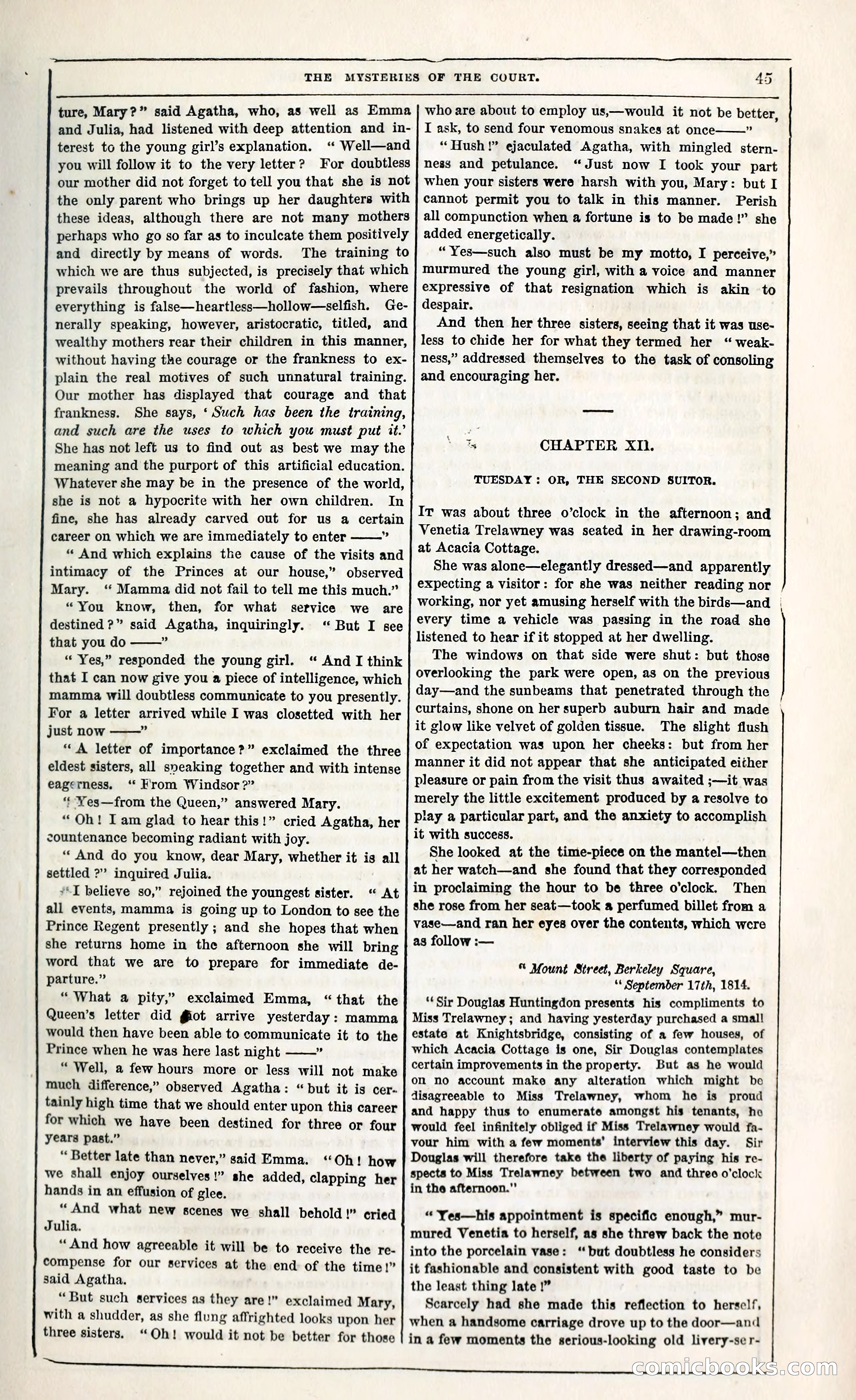
A restored page from Penny Dreadfuls, 1849. Page through the whole issue in the reader above.
📄 Transcribed text from this page (OCR, searchable)
Machine-transcribed from the original scan — historical spelling and the odd misread are preserved.
THE MYSTERIES OF THE COURT. 45 ture, Mary?” said Agatha, who, as well as Emma and Julia, had listened with deep attention and in- terest to the young girl’s explanation. ‘“ Well—and you will follow it to the very letter? For doubtless our mother did not forget to tell you that she is not the only parent who brings up her daughters with these ideas, although there are not many mothers perhaps who go so far as to inculcate them positively and directly by means of words. The training to which we are thus subjected, is precisely that which prevails throughout the world of fashion, where everything is false—heartless—hollow—selfish. Ge- nerally speaking, however, aristocratic, titled, and wealthy mothers rear their children in this manner, without having the courage or the frankness to ex- plain the real motives of such unnatural training. Our mother has displayed that courage and that frankness. She says, ‘ Such has been the training, and such are the uses to which you must put it.’ She has not left us to find out as best we may the meaning and the purport of this artificial education. Whatever she may be in the presence of the world, she is not a hypocrite with her own children. In fine, she has already carved out for us a certain career on which we are immediately to enter x “ And which explains the cause of the visits and intimacy of the Princes at our house,” observed Mary. ‘“‘ Mamma did not fail to tell me this much.” “You know, then, for what service we are destined ?” said Agatha, inquiringly. ‘“ But I see that you do fe “Yes,” responded the young girl. ‘“ And I think that I can now give you a piece of intelligence, which mamma will doubtless communicate to you presently. For a letter arrived while I was closetted with her just now ——” “A letter of importance?” exclaimed the three eldest sisters, all sneaking together and with intense eagerness. ‘* H'rom Windsor?” ‘‘ Yes—from the Queen,” answered Mary. “Oh! Iam glad to hear this!” cried Agatha, her countenance becoming radiant with joy. ‘“ And do you know, dear Mary, whether it is all settled ?” inquired Julia. **I believe so,” rejoined the youngest sister. “ At all events, mamma is going up to London to see the Prince Regent presently ; and she hopes that when she returns home in the afternoon she will bring word that we are to prepare for immediate de- parture.” “What a pity,” exclaimed Emma, “that the Queen’s letter did @ot arrive yesterday: mamma would then have been able to communicate it to the Prince when he was here last night ——” “ Well, a few hours more or less will not make much difference,” observed Agatha: “but it is cer. tainly high time that we should enter upon this career for which we have been destined for three or four years past.” “ Better late than never,” said Emma. “Oh! how we shall enjoy ourselves!” she added, clapping her hands in an effusion of glee. “And what new scenes we shall behold!” cried Julia. “And how agreeable it will be to receive the re- compense for our services at the end of the time!” said Agatha. “But such services as they are!” exclaimed Mary, with a shudder, as she flung affrighted looks upon her three sisters. “Oh! would it not be better for those ———vsS———$—— SEF IClaMAly who are about to employ us,—would it not be better, I ask, to send four venomous snakes at once " “Hush!” ejaculated Agatha, with mingled stern- ness and petulance. “Just now I took your part when your sisters were harsh with you, Mary: but I cannot permit you to talk in this manner. Perish all compunction when a fortune is to be made!” she added energetically. “Yes—such also must be my motto, I perceive,” murmured the young girl, with a voice and manner expressive of that resignation which is akin to despair. And then her three sisters, seeing that it was use- less to chide her for what they termed her “ weak- ness,” addressed themselves to the task of consoling and encouraging her. 2 CHAPTER XI. TUESDAY: OR, THE SECOND SUITOR. Iv was about three o’clock in the afternoon; and Venetia Trelawney was seated in her drawing-room at Acacia Cottage. She was alone—elegantly dressed—and apparently expecting a visitor: for she was neither reading nor working, nor yet amusing herself with the birds—and every time a vehicle was passing in the road she listened to hear if it stopped at her dwelling. The windows on that side were shut: but those overlooking the park were open, as on the previous day—and the sunbeams that penetrated through the curtains, shone on her superb auburn hair and made it glow like velvet of golden tissue. The slight flush of expectation was upon her cheeks: but from her manner it did not appear that she anticipated either pleasure or pain from the visit thus awaited ;—it was merely the little excitement produced by a resolve to play a particular part, and the anxiety to accomplish it with success. She looked at the time-piece on the mantel—then at her watch—and she found that they corresponded in proclaiming the hour to be three o’clock. Then she rose from her seat—took a perfumed billet from a vase—and ran her eyes over the contents, which were as follow :— ® Mount Street, Berkeley Square, “ September 17th, 1814. *¢Sir Douglas Huntingdon presents his compliments to Miss Trelawney; and having yesterday purchased a small estate at Knightsbridge, consisting of a few houses, of which Acacia Cottage is one, Sir Douglas contemplates certain improvements in the property. But as he would on no account make any alteration which might bo disagreeable to Miss Trelawney, whom he is proud and happy thus to enumerate amongst his tenants, ho would feel infinitely obliged if Miss Trelawney would fa- vour him with a few moments’ interview this day. Sir Douglas will therefore take the liberty of paying his re- spects to Miss Trelawney between two and three o'clock in the afternoon." “ Yes—his appointment is specific enough,” mur- mured Venetia to herself, as she threw back the note into the porcelain vase: ‘but doubtless he considers it fashionable and consistent with good taste to be the least thing late |” Scarcely had she made this reflection to herself, when a handsome carriage drove up to the door—ani in a few moments the serious-looking old livery-se r- (C(O)