
Penny Dreadfuls, 1849 · page 356 of 394
The Mysteries of the Court of London — page 356: what you’re looking at
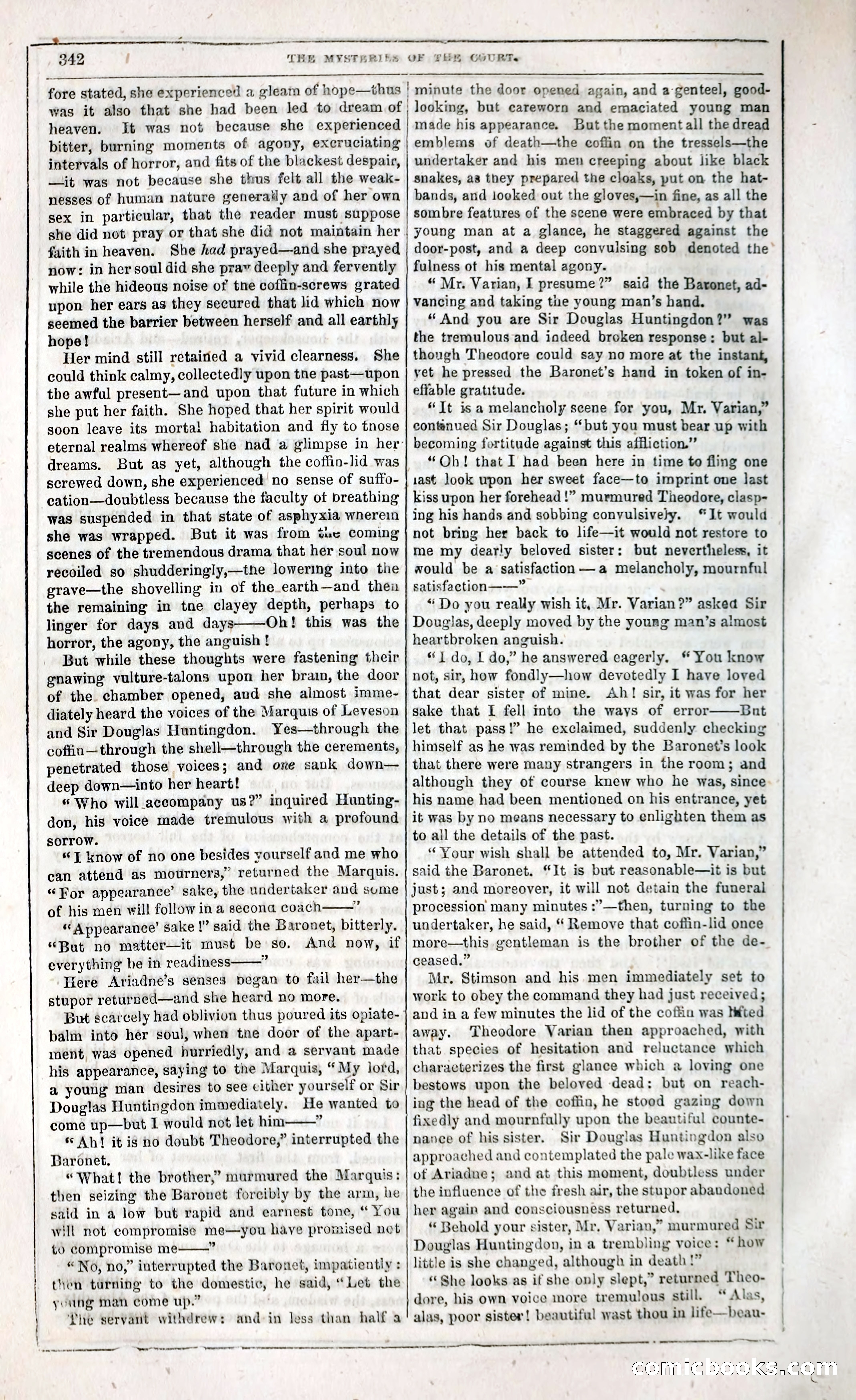
A restored page from Penny Dreadfuls, 1849. Page through the whole issue in the reader above.
📄 Transcribed text from this page (OCR, searchable)
Machine-transcribed from the original scan — historical spelling and the odd misread are preserved.
- ee : —_ in eel THE MYSTERINS fore stated, she experienced a gleam of hope—thus was it also that she had been led to dream of | heaven. It was not because she experienced bitter, burning moments of agony, excruciating intervals of horror, and fits of the blackest despair, —it was not because she thus felt all the weak- nesses of human nature generally and of her own sex in particular, that the reader must suppose she did not pray or that she did not maintain her faith in heaven. She had prayed—and she prayed now: in hersoul did she prav deeply and fervently while the hideous noise of tne coffin-screws grated upon her ears as they secured that lid which now seemed the barrier between herself and all earthly hope! Her mind still retained a vivid clearness. She could think calmy, collectedly upon the past—upon the awful present—and upon that future in which she put her faith. She hoped that her spirit would soon leave its morta! habitation and fly to tnose eternal realms whereof she nad a glimpse in her: dreams. But as yet, although the coffin-lid was | screwed down, she experienced no sense of sufto- cation—doubtless because the faculty ot breathing was suspended in that state of asphyxia wnereim she was wrapped. But it was from suc commg scenes of the tremendous drama that her soul now recoiled so shudderingly,—the lowering into the grave—the shovelling in of the earth—and thea the remaining in tne clayey depth, perhaps to linger for days and days——Oh! this was the horror, the agony, the anguish ! But while these thoughts were fastening their gnawing vulture-talons upon her brain, the door of the. chamber opened, and she almost imme- diately heard the voices of the Marquis of Leveson and Sir Douglas Huntingdon. Yes—through the coffin—through the shell—through the cerements, penetrated those voices; and one sank down— deep down—into her heart! “ Who will.accompany us?” inquired Hunting- don, his voice made tremulous with a profound sorrow. “T know of no one besides yourself and me who ean attend as mourners,” returned the Marquis. “For appearance’ sake, the undertaker and sume of his men will follow in a secona coach i" “ Appearance’ sake !” said the Baronet, bitterly. “But no matter—it must be so. And now, if everything be in readiness——” Here Ariadne’s senses pegan to fail her—the stupor returned—and she heard no more. But scarcely had oblivion thus poured its opiate- balm into her soul, when tne door of the apart- ment, was opened hurriedly, and a servant made his appearance, saying to the Marquis, “ My lord, a young man desires to see cither yourself or Sir Douglas Huntingdon immediately. He wanted to come up—but I would not let him——” ‘Ah! it is no doubt Theodore,” interrupted the Baronet, “What! the brother,’ murmured the Marquis: then seizing the Baronet forcibly by the arm, he said in a low but rapid and earnest tone, “ You will not compromise me—you have promised net to compromise me——” «No, no,” interrupted the Baronet, impatiently : then turning to the domestic, he said, “Let the young man come up.” : Phe servant withdrew: and-in less than half a! alas, ll eet ee ceil ee ee ae ee er OF THEE OVURT. ' minute the door opened again, and a-genteel, good- looking, but ecareworn and emaciated young man made his appearance. But the momentall the dread emblems of death—the coffin on the tressels—the undertaker and his men creeping about like black snakes, aa they prepared the cloaks, put on the hat- bands, and looked out the gloves,—in fine, as all the sombre features of the scene were embraced by that young man at a glance, he staggered against the door-post, and a deep convulsing sob denoted the’ fulness ot his mental agony. “ Mr. Varian, I presume?” said the Baronet, ad- vancing and taking tue young man’s hand. “‘ And you are Sir Douglas Huntingdon?” was the tremulous and iadeed broken response: but al- though Theodore could say no more at the instant, yet he pressed the Baronet’s hand in token of in- effable gratitude. “Tt isa melancholy scene for you, Mr. Varian,” contanued Sir Douglas; “but you must bear up with becoming fortitude against this affliction.” “Oh! that I had been here in time to fling one 1ast look upon her sweet face—to imprint one last kiss upon her forehead!” murmured Theodore, clasp- ing his hands and sobbing conyulsively. It would not bring her back to life—it would not restore to me my dearly beloved sister: but nevertheless, it would be a satisfaction —a melancholy, mournful satisfaction——” “Do you really wish it, Mr. Varian?” asked Sir Douglas, deeply moved by the young man’s almost heartbroken anguish. “J do, I do,” he answered eagerly. You know not, sir, how fondly—how devotedly I have loved that dear sister of mine. Ah! sir, it was for her sake that I fell into the ways of error——Bnt let that pass!” he exclaimed, suddenly checking himself as he was reminded by the Baronet’s look that there were many strangers in the room; and although they of course knew who he was, since his name had been mentioned on his entrance, yet it was by no means necessary to enlighten them as to all the details of the past. “Your wish shall be attended to, Mr. Varian,” said the Baronet. “It is but reasonable—it is but just; and moreover, it will not detain the funeral procession many minutes :’—then, turning to the undertaker, he said, “‘ Remove that coflin-lid once more—this gentleman is the brother of the de- ceased.” ) Mr. Stimson and his men immediately set to work to obey the command they had just received; and in a few minutes the lid of the coffin was Mtted away. ‘Theodore Varian then approached, with that species of hesitation and reluctance which characterizes the first glance which a loving one bestows upon the beloved dead: but on reach- ing the head of the coffin, he stood gazing down fixedly and mournfully upon the beautiful counte- nanee of his sister. Sir Douglas Huntingdon also approached and contemplated the pale wax-like face of Ariadne; and at this moment, doubtless under the influence of the fresh air, the stupor abandoned her again and consciousness returned, “ Behold your sister, Mr. Varian,” murmured Sir Douglas Huntingdon, in a trembling voice: “how little is she changed, although in death!” «She looks as if she only slept,” returned Theo- dore, his own voice more tremulous still. “Alas, poor sister! beautiful wast thou in life—beau- o_o ——— i | / ' im (EO) 0)(0)(0) (C S (E()