
Penny Dreadfuls, 1849 · page 355 of 394
The Mysteries of the Court of London — page 355: what you’re looking at
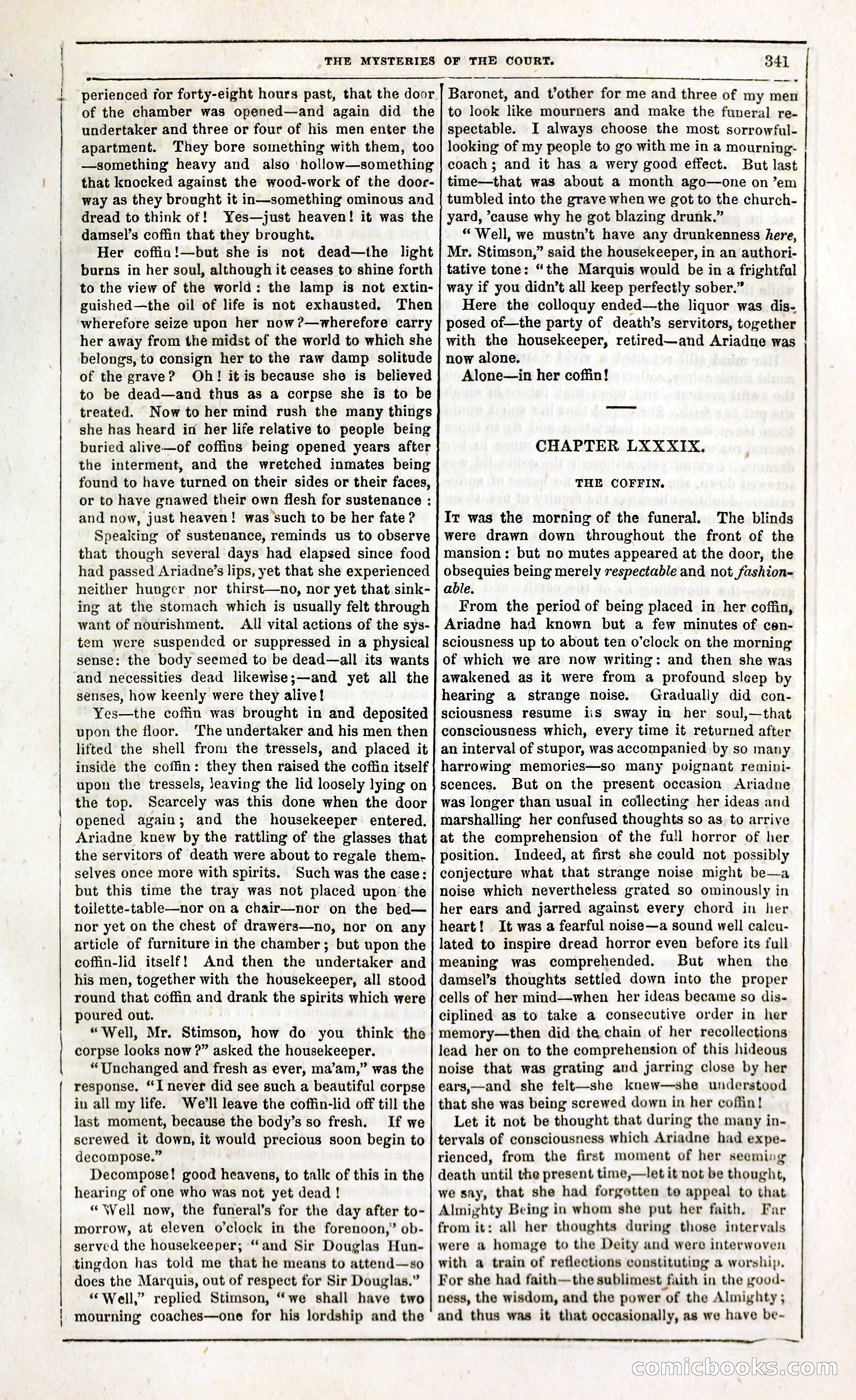
A restored page from Penny Dreadfuls, 1849. Page through the whole issue in the reader above.
📄 Transcribed text from this page (OCR, searchable)
Machine-transcribed from the original scan — historical spelling and the odd misread are preserved.
Se ss eee | THE MYSTERIES OF THE COURT. perienced for forty-eight hours past, that the door of the chamber was opened—and again did the undertaker and three or four of his men enter the They bore something with them, too —something heavy and also hollow—something that knocked against the wood-work of the door- way as they brought it in—something ominous and Yes—just heaven! it was the apartment. dread to think of! damsel’s coffin that they brought. Her coffin!—but she is not dead—the light burns in her soul, although it ceases to shine forth to the view of the world: the lamp is not extin- guished—the oil of life is not exhausted. Then wherefore seize upon her now?—wherefore carry her away from the midst of the world to which she belongs, to consign her to the raw damp solitude of the grave? Oh! it is because she is believed to be dead—and thus as a corpse she is to be treated. Now to her mind rush the many things she has heard in her life relative to people being buried alive—of coffins being opened years after the interment, and the wretched inmates being found to have turned on their sides or their faces, or to have gnawed their own flesh for sustenance : and now, just heaven! was'such to be her fate ? Speaking of sustenance, reminds us to observe that though several days had elapsed since food had passed Ariadne’s lips, yet that she experienced neither hunger nor thirst—no, nor yet that sink- ing at the stomach which is usually felt through want of nourishment. All vital actions of the sys- tem were suspended or suppressed in a physical sense: the body seemed to be dead—all its wants ‘and necessities dead likewise;—and yet all the senses, how keenly were they alive! Yes—the coffin was brought in and deposited upon the floor. ‘The undertaker and his men then lifted the shell from the tressels, and placed it inside the coffin: they then raised the coffin itself upon the tressels, Jeaving the lid loosely lying on the top. Scarcely was this done when the door opened again; and the housekeeper entered. Ariadne knew by the rattling of the glasses that the servitors of death were about to regale them- selves once more with spirits. Such was the case: but this time the tray was not placed upon the toilette-table—nor on a chair—nor on the bed— nor yet on the chest of drawers—no, nor on any article of furniture in the chamber ; but upon the coffin-lid itself! Amd then the undertaker and his men, together with the housekeeper, all stood round that coffin and drank the spirits which were poured out. “Well, Mr. Stimson, how do you think the corpse looks now ?” asked the housekeeper. “Unchanged and fresh as ever, ma’am,” was the response. “I never did see such a beautiful corpse in all my life. We'll leave the coffin-lid off till the last moment, because the body’s so fresh. If we screwed it down, it would precious soon begin to decompose.” Decompose! good heavens, to talle of this in the hearing of one who was not yet dead ! “Well now, the funeral’s for the day after to- morrow, at eleven o’clock in the forenoon,” ob- served the housekeeper; “and Sir Douglas Hun- tingdon has told me that he means to attend—so does the Marquis, out of respect for Sir Douglas.” “Well,” replied Stimson, “we shall have two mourning coaches—one for his lordship and the ——————————————SEE—_—_eEE>—————————— eee eee —_—_—— « Baronet, and t’other for me and three of my men to look like mourners and make the funeral re- spectable. I always choose the most sorrowful- looking of my people to go with me in a mourning- coach; and it has a wery good effect. But last time—that was about a month ago—one on ’em tumbled into the grave when we got to the church- yard, ’cause why he got blazing drunk.” “ Well, we mustn’t have any drunkenness here, Mr. Stimson,” said the housekeeper, in an authori- tative tone: “the Marquis would be in a frightful way if you didn’t all keep perfectly sober.” Here the colloquy ended—the liquor was dis- posed of—the party of death’s servitors, together with the housekeeper, retired—and Ariadne was now alone. Alone—in her coffin! CHAPTER LXXXIX. THE COFFIN. Ir was the morning of the funeral. The blinds were drawn down throughout the front of the mansion: but no mutes appeared at the door, the obsequies being merely respectable and not fashion- able. From the period of being placed in her coffin, Ariadne had known but a few minutes of cen- sciousness up to about ten o’clock on the morning of which we are now writing: and then she was awakened as it were from a profound sleep by hearing a strange noise. Gradually did con- sciousness resume 1iS sway in her soul,—that consciousness which, every time it returned after an interval of stupor, was accompanied by so many harrowing memories—so many poignant remini- scences. But on the present occasion Ariadne was longer than usual in collecting her ideas and marshalling her confused thoughts so as to arrive at the comprehension of the fu!l horror of her position. Indeed, at first she could not possibly conjecture what that strange noise might be—a noise which nevertheless grated so ominously in her ears and jarred against every chord in her heart! It was a fearful noise—a sound well calcu- lated to inspire dread horror even before its full meaning was comprehended. But when the damsel’s thoughts settled down into the proper cells of her mind—when her ideas became so dis- ciplined as to take a consecutive order in her memory—then did the chain of her recollections lead her on to the comprehension of this hideous noise that was grating and jarring close by her ears,—and she telt—she knew—she understood that she was being screwed down in her coffin! Let it not be thought that during the many in- tervals of consciousness which Ariadne had expe- rienced, from the first moment of her seeming death until the present time,—let it not be thought, we say, that she had forgetten te appeal to that Almizhty Being in whom she put her faith. Far from it: all her thoughts during those intervals were a homage to the Deity and were interwoven with a train of reflections constituting a worship. For she had faith—the sublimest faith in the good- ness, the wisdom, and the power of the Almighty ; and thus was it that occasionally, as we have be- a MICLOOOKS. CO (C (C(O)