
Penny Dreadfuls, 1849 · page 35 of 394
The Mysteries of the Court of London — page 35: what you’re looking at
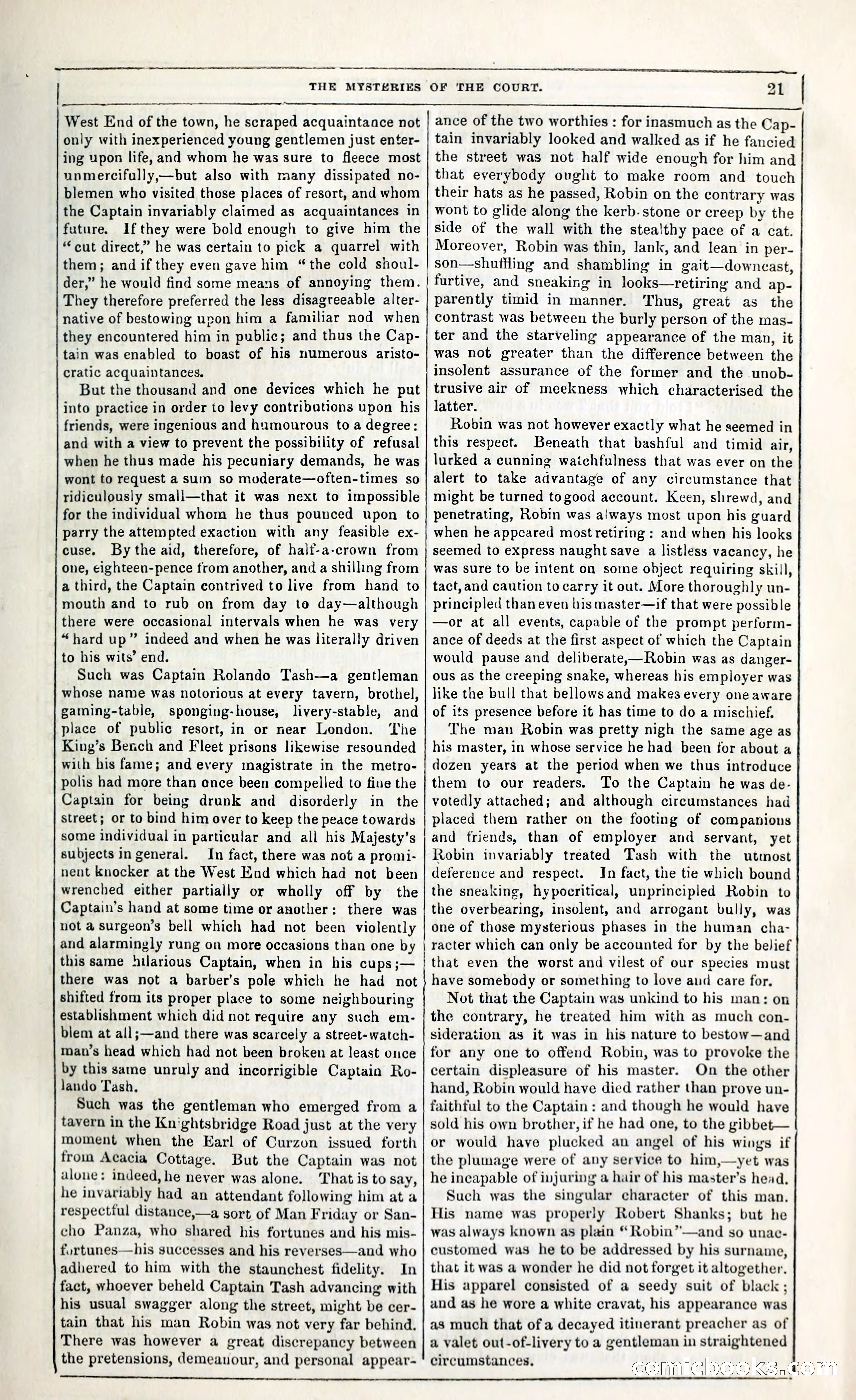
A restored page from Penny Dreadfuls, 1849. Page through the whole issue in the reader above.
📄 Transcribed text from this page (OCR, searchable)
Machine-transcribed from the original scan — historical spelling and the odd misread are preserved.
er THE MYSTERIES OF THE COURT. | West End of the town, he scraped acquaintance not only with inexperienced young gentlemen just enter- ing upon life, and whom he was sure to fleece most unmercifully,—but also with many dissipated no- blemen who visited those places of resort, and whom the Captain invariably claimed as acquaintances in future. Ifthey were bold enough to give him the ‘cut direct,” he was certain to pick a quarrel with them; and if they even gave him “the cold shoul- der,” he would find some means of annoying them. They therefore preferred the less disagreeable alter- native of bestowing upon him a familiar nod when they encountered him in public; and thus the Cap- tain was enabled to boast of his numerous aristo- cratic acquaintances. But the thousand and one devices which he put into practice in order to levy contributions upon his friends, were ingenious and humourous to a degree: and with a view to prevent the possibility of refusal when he thus made his pecuniary demands, he was wont to request a sum so muderate—often-times so ridiculously small—that it was next to impossible for the individual whom he thus pounced upon to parry the attempted exaction with any feasible ex- cuse. By the aid, therefore, of half-a-crown from one, eighteen-pence from another, and a shilling from a third, the Captain contrived to live from hand to mouth and to rub on from day to day—although there were occasional intervals when he was very “hard up” indeed and when he was literally driven to his wits’ end. Such was Captain Rolando Tash—a gentleman whose name was notorious at every tavern, brothel, gaming-table, sponging-house, livery-stable, and place of public resort, in or near London. Tie King’s Bench and Fleet prisons likewise resounded with his fame; and every magistrate in the metro- polis had more than ence been compelled to fine the Captain for being drunk and disorderly in the street; or to bind him over to keep the peace towards some individual in particular and all his Majesty’s subjects in general. In fact, there was not a promi- nent knocker at the West End which had not been wrenched either partially or wholly off by the Captain’s hand at some time or another: there was not a surgeon’s bell which had not been violently and alarmingly rung on more occasions than one by this same hilarious Captain, when in his cups ;— there was not a barber’s pole which he had not shifted from its proper place to some neighbouring establishment which did not require any such em- blem at all;—and there was scarcely a street-watch- man’s head which had not been broken at least once by this same unruly and incorrigible Captain Ro- lando Tash, Such was the gentleman who emerged from a tavern in the Knightsbridge Road just at the very moment when the Earl of Curzon issued forth from Acacia Cottage. But the Captain was not aloue: indeed, he never was alone. ‘That is to say, he invariably had an attendant following him at a respectful distance,—a sort of Man F riday or San- cho Panza, who shared his fortunes and his mis- furtunes—his successes and his reverses—and who adhered to him with the staunchest fidelity. In fact, whoever beheld Captain Tash advancing with his usual swagger along the street, might be cer- tain that his man Robin was not very far behind. There was however a great discrepancy between the pretensions, demeanour, and personal appear- eshte saeco oe et ance of the two worthies : for inasmuch as the Cap- tain invariably looked and walked as if he fancied the street was not half wide enough for him and that everybody ought to make room and touch their hats as he passed, Robin on the contrary was wont to glide along the kerb. stone or creep by the side of the wall with the stealthy pace of a cat. Moreover, Robin was thin, lank, and lean in per- son—shufiling and shambling in gait—downcast, furtive, and sneaking in looks—retiring and ap- parently timid in manner. Thus, great as the contrast was between the burly person of the mas- ter and the starveling appearance of the man, it was not greater than the difference between the insolent assurance of the former and the unob- trusive air of meekness which characterised the latter. Robin was not however exactly what he seemed in this respect. Beneath that bashful and timid air, lurked a cunning watchfulness that was ever on the alert to take advantage of any circumstance that might be turned togood account. Keen, slirewd, and penetrating, Robin was always most upon his guard when he appeared most retiring : and when his looks seemed to express naught save a listless vacancy, he was sure to be intent on some object requiring skill, tact, and caution to carry it out. More thoroughly un- principled than even his master—if that were possible —or at all events, capable of the prompt perfurm- ance of deeds at the first aspect of which the Captain would pause and deliberate,—Robin was as danger- ous as the creeping snake, whereas his employer was like the bull that bellows and makes every one aware of its presence before it has time to do a mischief. The man Robin was pretty nigh the same age as his master, in whose service he had been for about a dozen years at the period when we thus introduce them to our readers. To the Captain he was de- votedly attached; and although circumstances had placed them rather on the footing of companions and friends, than of employer and servant, yet Robin invariably treated Tash with the utmost deference and respect. In fact, the tie which bound the sneaking, hypocritical, unprincipled Robin to the overbearing, insolent, and arrogant bully, was one of those mysterious phases in the human cha- racter which can only be accounted for by the belief that even the worst and vilest of our species must have somebody or something to love aud care for. Not that the Captain was unkind to his man: on the contrary, he treated him with as much con- sideration as it was in his nature to bestow—and for any one to offend Robin, was to provoke the certain displeasure of his master. On the other hand, Robin would have died rather than prove un- faithful to the Captain : and though he would have sold his own brother, if he had one, to the gibbet— or would have plucked an angel of his wings if the plumage were of any service to him,—yet was he incapable of injuring a hair of his master’s head. Such was the singular character of this man. His name was properly Robert Shanks; but he was always known as plain “ Robin’’—and so unae- customed was he to be addressed by his surname, that it was a wonder he did not forget it altogether. His apparel consisted of a seedy suit of black ; and as he wore a white cravat, his appearance was as much that of a decayed itinerant preacher as of a valet out-of-livery to a gentleman in straightened circumstances. COMIC OOOXS..¢