
Penny Dreadfuls, 1849 · page 34 of 394
The Mysteries of the Court of London — page 34: what you’re looking at
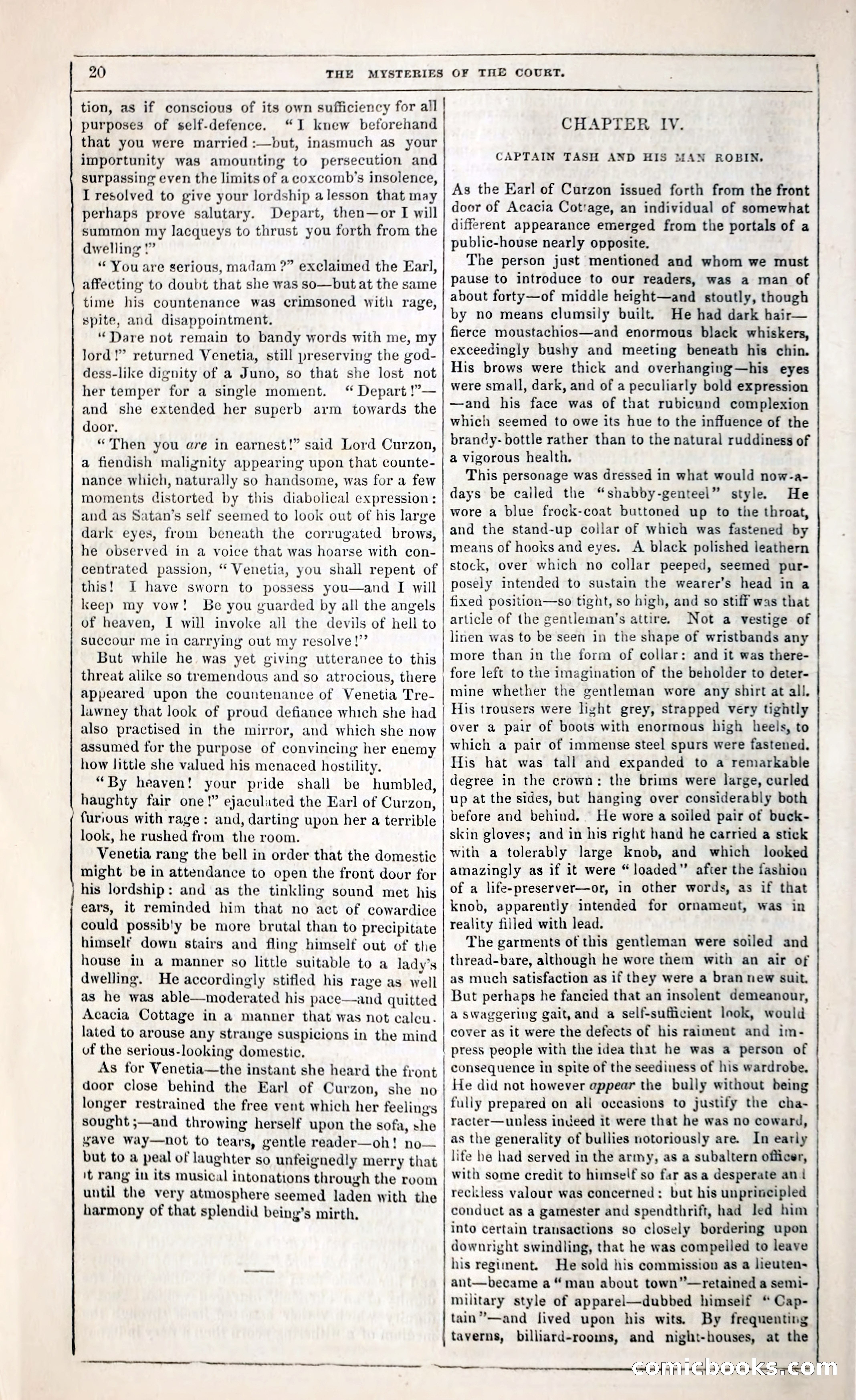
A restored page from Penny Dreadfuls, 1849. Page through the whole issue in the reader above.
📄 Transcribed text from this page (OCR, searchable)
Machine-transcribed from the original scan — historical spelling and the odd misread are preserved.
_—-- 20 tion, as if conscious of its own sufficiency for all purposes of self-defence. “I knew beforehand that you were married :—but, inasmuch as your importunity was amounting to persecution and surpassing even the limits of a coxcomb’s insolence, I resolved to give your lordship alesson that may perhaps prove salutary. Depart, then—or I will summon my lacqueys to thrust you forth from the dwelling !” ‘You are serious, madam ?” exclaimed the Earl, affecting to doubt that she was so—but at the same time his countenance was crimsoned with rage, spite, and disappointment. ‘Dare not remain to bandy words with me, my Jord!” returned Venetia, still preserving the god- dess-like dignity of a Juno, so that she lost not her temper for a single moment. “ Depart !”— and she extended her superb arm towards the door. “Then you are in earnest!” said Lord Curzon, a fiendish malignity appearing upon that counte- nance which, naturally so handsome, was for a few moments distorted by this diabolical expression: and as Satan’s self seemed to look out of his large dark eyes, from beneath the corrugated brows, he observed in a voice that was hoarse with con- centrated passion, “ Venetia, you shall repent of this! I have sworn to possess you—and I will keep my vow! Be you guarded by all the angels of heaven, I will invoke all the devils of hell to succour me in carrying out my resolve!” But while he was yet giving utterance to this threat alike so tremendous and so atrocious, there appeared upon the countenance of Venetia Tre- lawney that look of proud defiance which she had also practised in the mirror, and which she now assumed for the purpose of convincing her enemy how little she valued his menaced hostility. “By heaven! your pride shall be humbled, haughty fair one!” ejaculated the Earl of Curzon, furious with rage: and, darting upon her a terrible look, he rushed from the room. Venetia rang the bell in order that the domestic might be in attendance to open the front dour for his lordship: and as the tinkling sound met his ears, it reminded him that no act of cowardice could possib'y be more brutal than to precipitate himselt down stairs and fling himself out of the house in a manner so little suitable to a ladv’s dwelling. He accordingly stifled his rage as well as he was able—moderated his pace—and quitted Acacia Cottage in a manner that was not calcu. lated to arouse any strange suspicions in the mind of the serious-looking domestic, As for Venetia—the instant she heard the front door close behind the Earl of Curzon, she no longer restrained the free vent which her feelings sought ;—and throwing herself upon the sofa, she yave way—not to tears, gentle reader—oh! no— but to a peal of laughter so unfeignedly merry that it rang in its musical intonations through the room until the very atmosphere seemed laden with the harmony of that splendid being’s mirth. nan 1 0 } THE MYSTERIES OF THE COURT. CHAPTER IV. CAPTAIN TASH AND HIS MAN ROBIN. As the Earl of Curzon issued forth from the front door of Acacia Cottage, an individual of somewhat different appearance emerged from the portals of a public-house nearly opposite. The person just mentioned and whom we must pause to introduce to our readers, was a man of about forty—of middle height—and stoutly, though by no means clumsily built. He had dark hair— fierce moustachios—and enormous black whiskers, exceedingly bushy and meeting beneath his chin. His brows were thick and overhanging—his eyes were small, dark, and of a peculiarly bold expression —and his face was of that rubicund complexion which seemed to owe its hue to the inffuence of the brandy- bottle rather than to the natural ruddiness of a vigorous health. This personage was dressed in what would now-a- days be called the “shabby-genteel” style. He wore a blue frock-coat buttoned up to the throat, and the stand-up collar of which was fastened by means of hooks and eyes. A black polished leathern stock, over which no collar peeped, seemed pur- posely intended to sustain the wearer’s head in a fixed position—so tight, so high, and so stiff was that article of the gentleman’s attire. Not a vestige of linen was to be seen in the shape of wristbands any more than in the form of collar: and it was there- fore left to the imagination of the beholder to deter- mine whether the gentleman wore any shirt at all. His trousers were light grey, strapped very tightly over a pair of boots with enormous high heels, to which a pair of immense steel spurs were fastened. His hat was tall and expanded to a remarkable degree in the crown: the brims were large, curled up at the sides, but hanging over considerably both before and behind. He wore a soiled pair of buck- skin gloves; and in his right hand he carried a stick with a tolerably large knob, and which looked amazingly as if it were “loaded” after the fashion of a life-preserver—or, in other words, as if that knob, apparently intended for ornameut, was in reality filled with lead. The garments of this gentleman were soiled and thread-bare, although he wore them with an air of as much satisfaction as if they were a bran new suit, But perhaps he fancied that an insolent demeanour, a swaggering gait, and a self-sufficient look, would cover as it were the defects of his raiment and im- press people with the idea that he was a person of consequence in spite of the seediuess of his wardrobe. He did not however appear the bully without being fully prepared on all occasions to justify the cha- racter—unless indeed it were that he was no coward, as the generality of bullies notoriously are. In early life he had served in the army, as a subaltern officer, with some credit to himself so far as a desperate an { reckless valour was concerned: but his unprincipled conduct as a gamester and spendthrift, had led him into certain transactions so closely bordering upon downright swindling, that he was compelled to leave his regiment. He sold his commission as a lieuten- ant—became a “man about town”—retained a semi- military style of apparel—dubbed himself “ Cap- tain”—and lived upon his wits. By frequenting taverns, billiard-rooms, and night-houses, at the RAH KEL SOX) co —_—— TTT eeesS SS S$ 0 Naaae 00S