
Penny Dreadfuls, 1849 · page 292 of 394
The Mysteries of the Court of London — page 292: what you’re looking at
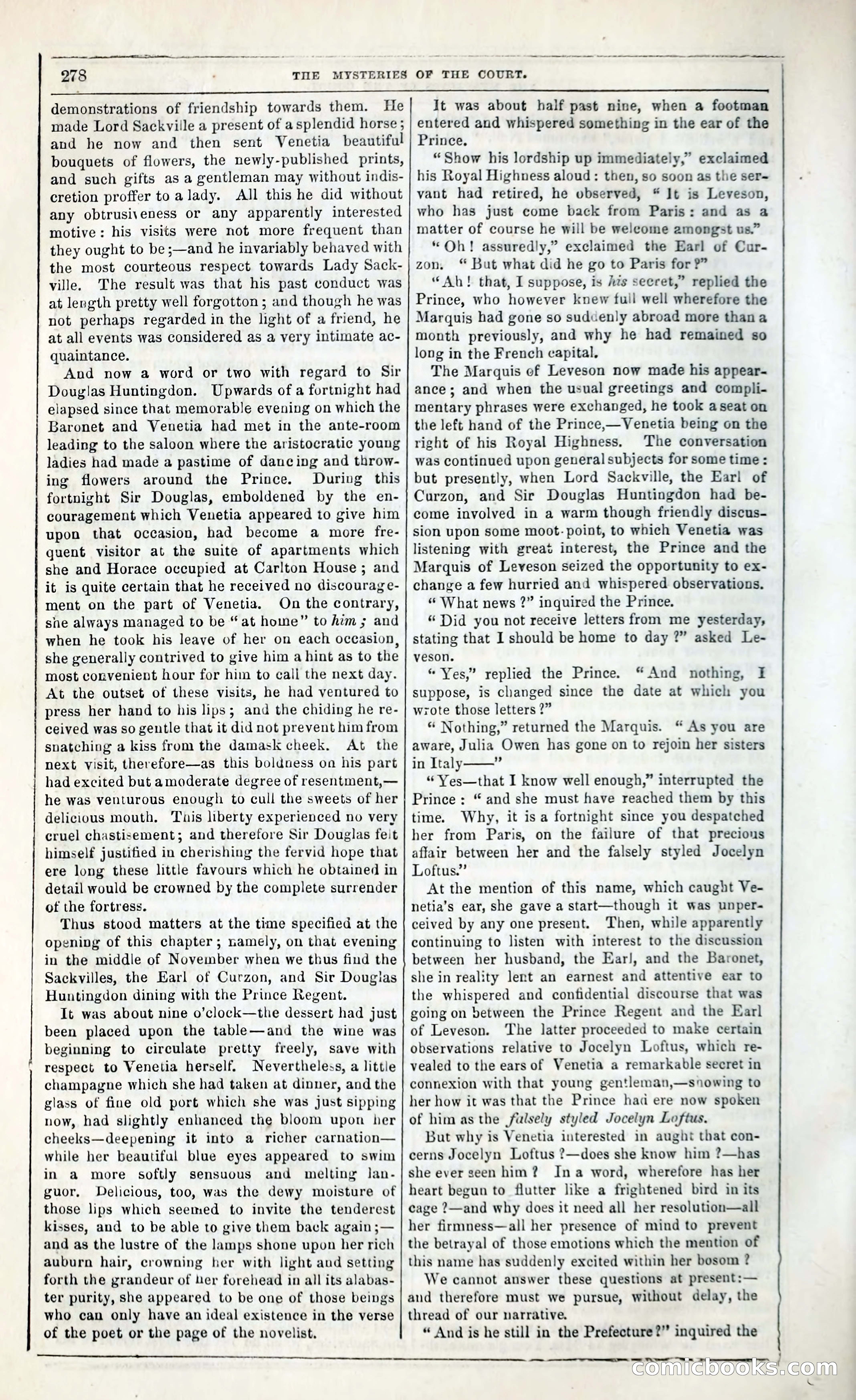
A restored page from Penny Dreadfuls, 1849. Page through the whole issue in the reader above.
📄 Transcribed text from this page (OCR, searchable)
Machine-transcribed from the original scan — historical spelling and the odd misread are preserved.
demonstrations of friendship towards them. He made Lord Sackville a present of asplendid horse; and he now and then sent Venetia beautiful bouquets of flowers, the newly-published prints, and such gifts as a gentleman may without indis- cretion proffer to alady. All this he did without any obtrusiveness or any apparently interested motive: his visits were not more frequent than they ought to be ;—and he invariably behaved with the most courteous respect towards Lady Sack- ville. The result was that his past conduct was at length pretty well forgotton ; and though he was not perhaps regarded in the light of a friend, he at all events was considered as a very intimate ac- quaintance. And now a word or two with regard to Sir Douglas Huntingdon. Upwards of a fortnight had elapsed since that memorable evening on which the Baronet and Venetia had met in the ante-room leading to the saloon where the aristocratic young ladies had made a pastime of dancing and throw- ing flowers around the Prince. During this fortnight Sir Douglas, emboldened by the en- couragement which Venetia appeared to give him upon that occasion, had become a more fre- quent visitor at the suite of apartments which she and Horace occupied at Carlton House ; and it is quite certain that he received no discourag e- ment on the part of Venetia. On the contrary, sne always managed to be “at home” to him ; and when he took his leave of her on each occasion, she generally contrived to give him a hint as to the most convenient hour for him to call the next day. At the outset of these visits, he had ventured to press her hand to his lips; and the chiding he re- ceived was so gentle that it did not prevent him from snatching a kiss from the damask cheek. At the next visit, therefore—as this boldness on his part | had excited but amoderate degree of resentment,— he was venturous enough to cull the sweets of her delicious mouth. Tuis liberty experienced no very cruel chastisement; and therefore Sir Douglas feit himself justified in cherishing the fervid hope that ere long these little favours which he obtained in detail would be crowned by the complete surrender of the fortress. Thus stood matters at the time specified at the opening of this chapter; namely, on that evening in the middle of November when we thus find the Sackvilles, the Earl of Curzon, and Sir Dougias Huntingdon dining with the Prince Regent. It was about nine o’clock—the dessert had just been placed upon the table—and the wine was beginning to circulate pretty freely, save with respect to Venetia herself. Nevertheless, a little champagne which she had taken at dinner, and the glass of fine old port which she was just sipping now, had slightly enhanced the bloom upon her cheeks—deepening it into a richer carnation— while her beautiful blue eyes appeared to swim in a more softly sensuous and melting lan- guor. Delicious, too, was the dewy moisture of those lips which seemed to invite the tenderest kisses, and to be able to give them back again ;— and as the lustre of the lamps shone upon her rich auburn hair, crowning her with light and setting forth the grandeur of Ler forehead in all its alabas- ter purity, she appeared to be one of those beings who can only have an ideal existence in the verse of the poet or the page of the novelist. SL sss een THE MYSTERIES OF THE COURT. mee eee ete It was about half past nine, when a footman entered and whispered something in the ear of the Prince. “Show his lordship up immediately,” exclaimed his Royal Highness aloud: then, so soon as the ser- vant had retired, he observed, “ Jt is Leveson, who has just come back from Paris: and as a matter of course he will be weleome amongst us.” “Oh! assuredly,” exclaimed the Earl of Cur- zon. “ But what did he go to Paris for ?” “Ah! that, I suppose, is his secret,” replied the Prince, who however knew full well wherefore the Marquis had gone so suddenly abroad more than a month previously, and why he had remained so long in the French capital. The Marquis ef Leveson now made his appear- ance; and when the usual greetings and compli- mentary phrases were exchanged, he took aseat on the left hand of the Prince,—Venetia being on the right of his Royal Highness. The conversation was continued upon general subjects for some time : but presently, when Lord Sackville, the Earl of Curzon, and Sir Douglas Huntingdon had be- come involved in a warm though friendly discus- sion upon some moot- point, to which Venetia was listening with great interest, the Prince and the Marquis of Leveson seized the opportunity to ex- change a few hurried and whispered observations. “ What news 2?” inquired the Prince. “Did you not receive letters from me yesterday, stating that I should be home to day ?” asked Le- veson. “ Yes,” replied the Prince. “And nothing, I suppose, is changed since the date at which you wrote those letters ?” “ Nothing,” returned the Marquis. “As you are aware, Julia Owen has gone on to rejoin her sisters in Italy * “‘“Yes—that I know well enough,” interrupted the Prince : “ and she must have reached them by this time. Why, it isa fortnight since you despatched her from Paris, on the failure of that precious affair between her and the falsely styled Jocelyn Loftus.” At the mention of this name, which caught Ve- netia’s ear, she gave a start—though it was unper- ceived by any one present. Then, while apparently continuing to listen with interest to the discussion between her husband, the Earl, and the Baronet, she in reality lent an earnest and attentive ear to the whispered and confidential discourse that was going on between the Prince Regent and the Earl of Leveson. The latter proceeded to make certain observations relative to Jocelyn Loftus, which re- vealed to the ears of Venetia a remarkable secret in connexion with that young gentleman,—snowing to her how it was that the Prince had ere now spoken of him as the fulsely styled Jocelyn Loftus, But why is Venetia interested in aught that con- cerns Jocelyn Loftus ?—does she know him ?—has she ever geen him? Ina word, wherefore has her heart begun to flutter like a frightened bird in its cage ?—and why does it need all her resolution—all her firmness—all her presence of mind to prevent the betrayal of those emotions which the mention of this name has suddenly excited within her bosom ? We cannot answer these questions at present:— and therefore must we pursue, without delay, the thread of our narrative. “ And is he still in the Prefecture?” inquired the a ee rt 0 ee eet ee GComiuiGciooks) (€()