
Penny Dreadfuls, 1849 · page 291 of 394
The Mysteries of the Court of London — page 291: what you’re looking at
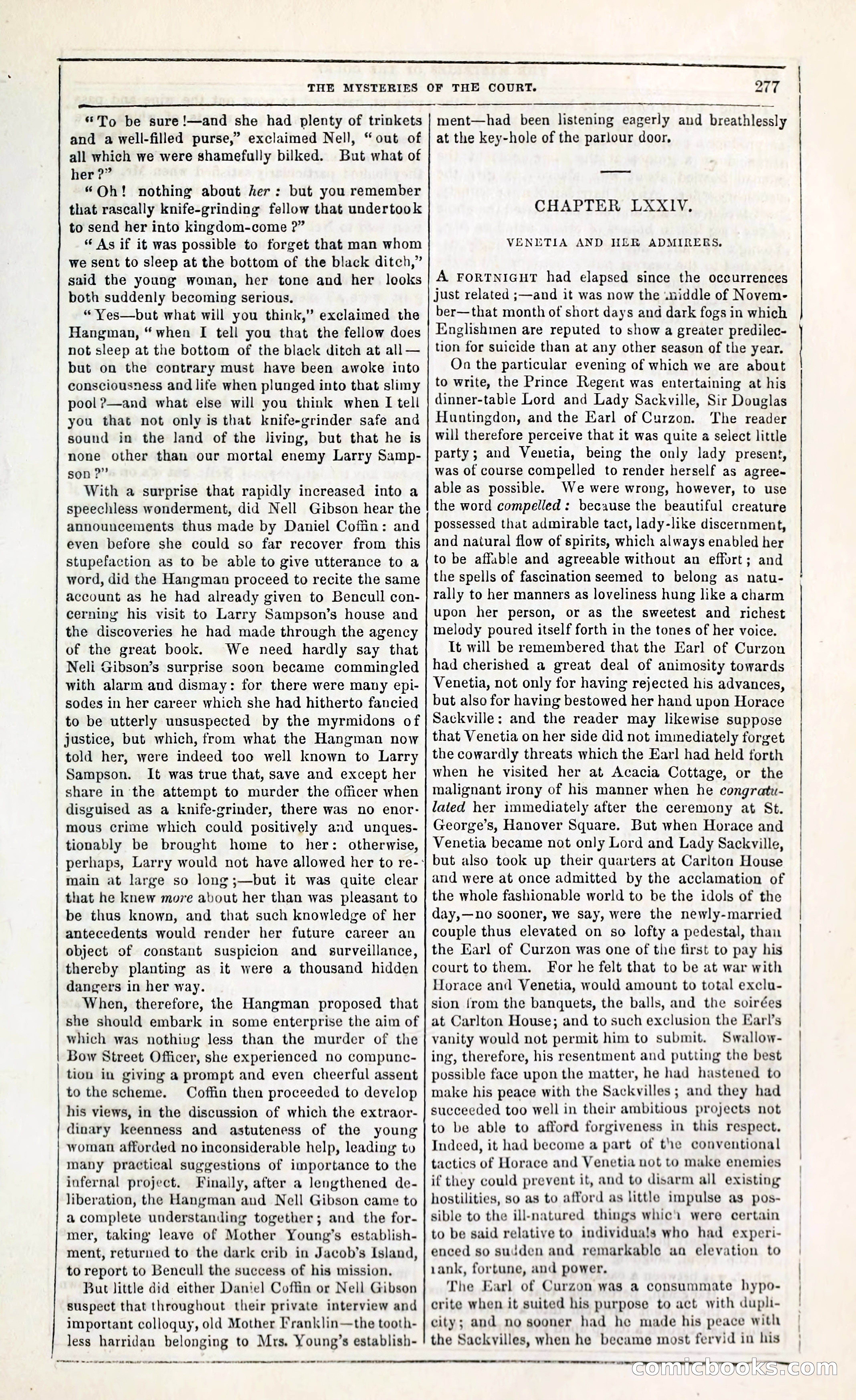
A restored page from Penny Dreadfuls, 1849. Page through the whole issue in the reader above.
📄 Transcribed text from this page (OCR, searchable)
Machine-transcribed from the original scan — historical spelling and the odd misread are preserved.
a THE MYSTERIES OF THE COURT. 27 ‘**To be sure !—and she had plenty of trinkets and awell-filled purse,” exclaimed Nell, “out of all which we were shamefully bilked. But what of her ?” “Oh! nothing about ker: but you remember that rascally knife-grinding fellow that undertook to send her into kingdom-come ?” “ Asif it was possible to forget that man whom we sent to sleep at the bottom of the black ditch,” said the young woman, her tone and her looks both suddenly becoming serious. “ Yes—but what will you think,” exclaimed the Hangman, “when [ tell you that the fellow does not sleep at the bottom of the black ditch at all — but on the contrary must have been awoke into consciousness and life when plunged into that slimy pool ?—and what else will you think when I tell you that not only is that knife-grinder safe and sound in the land of the living, but that he is none other than our mortal enemy Larry Samp- son ?” With a surprise that rapidly increased into a speechless wonderment, did Nell Gibson hear the announcements thus made by Daniel Coffin: and even before she could so far recover from this stupefaction as to be able to give utterance to a word, did the Hangman proceed to recite the same account as he had already given to Bencull con- cerning his visit to Larry Sampson’s house and the discoveries he had made through the agency of the great book. We need hardly say that Neli Gibson’s surprise soon became commingled with alarm and dismay: for there were many epi- sodes in her career which she had hitherto fancied to be utterly unsuspected by the myrmidons of justice, but which, from what the Hangman now told her, were indeed too well known to Larry Sampson. It was true that, save and except her share in the attempt to murder the officer when disguised as a knife-grinder, there was no enor- mous crime which could positively aud unques- tionably be brought home to her: otherwise, perhaps, Larry would not have allowed her to re-: main at large so long ;—but it was quite clear that he knew more about her than was pleasant to be thus known, and that such knowledge of her antecedents would render her future career an object of constant suspicion and surveillance, thereby planting as it were a thousand hidden dangers in her way. When, therefore, the Hangman proposed that she should embark in some enterprise the aim of which was nothivg less than the murder of the Bow Street Officer, she experienced no compunc- tiou in giving a prompt and even cheerful assent to the scheme. Coffin then proceeded to develop his views, in the discussion of which the extraor- dinary keenness and astuteness of the young woman afforded no inconsiderable help, leading tu many practical suggestions of importance to the infernal project. Finally, after a lengthened de- liberation, the Hangman aud Nell Gibson came to a complete understanding together; and the for- mer, taking’ leave of Mother Young’s establish- ment, returned to the dark crib in Jacob’s Island, to report to Bencull the success of his mission, But little did either Daniel Coffin or Nell Gibson suspect that throughout their private interview and important colloquy, old Mother I’ranklin—the tooth- less harridan belonging to Mrs, Young’s establish- SO er AE ER OU ee Ee EE Fe ee en ment—had been listening eagerly and breathlessly at the key-hole of the parlour door, —_—__- CHAPTER LXXIV, VENETIA AND HER ADMIRERS. A FORTNIGHT had elapsed since the occurrences just related ;—and it was now the .niddle of Novem- ber—that month of short days and dark fogs in which Englishmen are reputed to show a greater predilec- tion for suicide than at any other season of the year. On the particular evening of which we are about to write, the Prince Regent was entertaining at his dinner-table Lord and Lady Sackville, Sir Douglas Huntingdon, and the Earl of Curzon. The reader will therefore perceive that it was quite a select little party; and Venetia, being the only lady present, was of course compelled to render herself as agree- able as possible. We were wrong, however, to use the word compelled: because the beautiful creature possessed that admirable tact, lady-like discernment, and natural flow of spirits, which always enabled her to be affable and agreeable without an effort; and the spells of fascination seemed to belong as natu- rally to her manners as loveliness hung like a charm | nS AS upon her person, or as the sweetest and richest melody poured itself forth in the tones of her voice. It will be remembered that the Earl of Curzon had cherished a great deal of animosity towards Venetia, not only for having rejected his advances, but also for having bestowed her hand upon Horace Sackville: and the reader may likewise suppose that Venetia on her side did not immediately forget the cowardly threats which the Earl had held forth when he visited her at Acacia Cottage, or the malignant irony of his manner when he congratu- lated her immediately after the ceremony at St. George’s, Hanover Square. But when Horace and Venetia became not only Lord and Lady Sackville, but also took up their quarters at Carlton House and were at once admitted by the acclamation of the whole fashionable world to be the idols of the day,—no sooner, we say, were the newly-married couple thus elevated on so lofty a pedestal, than the Earl of Curzon was one of the first to pay his court to them. For he felt that to be at war with Horace and Venetia, would amount to total exclu- sion {rom the banquets, the balls, and the soirées at Carlton House; and to such exclusion the Karl’s vanity would not permit him to submit. Swallow- ing, therefore, his resentment and putting the best possible face upon the matter, he had hastened to make his peace with the Sackvilles ; and they had succeeded too well in their ambitious projects not to be able to afford forgiveness in this respect. Indeed, it had become a part of te conventional tactics of Horace and Venetia not to make enemies if they could prevent it, and to disarm all existing hostilities, so as to afford as little impulse as pos- | sible to the ill-natured things whic were certain to be said relative to individuals who had experi- enced so sudden and remarkable ano elevation to 1ank, fortune, and power, The Earl of Curzon was a consummate hypo- crite when it suited his purpose to act with dupli- city; and no sooner had he made his peace with | the Sackvilles, when he became most fervid in his | =o 8 60~eeeecomicbooks,co