
Penny Dreadfuls, 1849 · page 186 of 394
The Mysteries of the Court of London — page 186: what you’re looking at
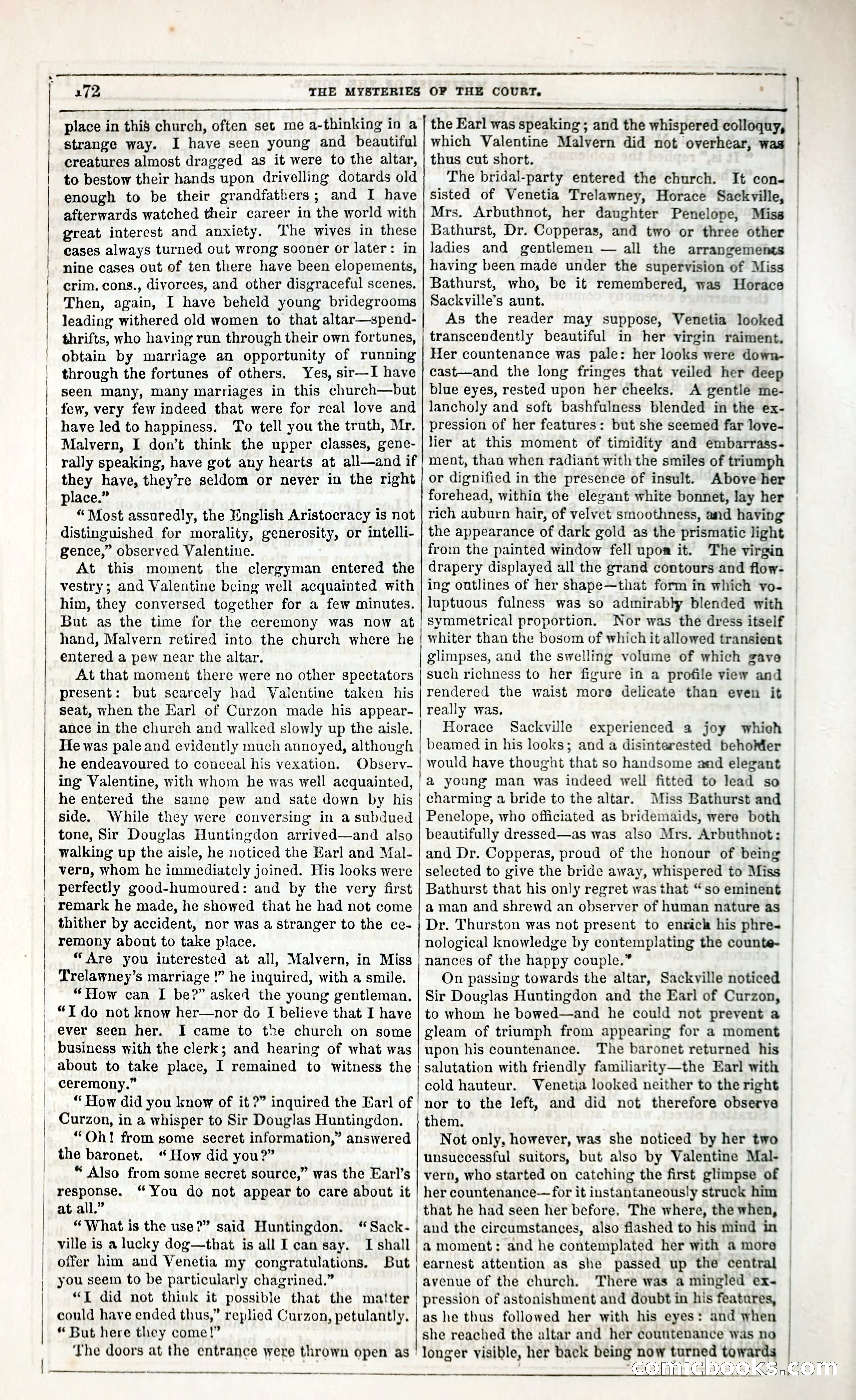
A restored page from Penny Dreadfuls, 1849. Page through the whole issue in the reader above.
📄 Transcribed text from this page (OCR, searchable)
Machine-transcribed from the original scan — historical spelling and the odd misread are preserved.
172 place in this church, often set me a-thinking in a strange way. I have seen young and beautiful creatures almost dragged as it were to the altar, to bestow their hands upon drivelling dotards old enough to be their grandfathers; and I have afterwards watched their career in the world with great interest and anxiety. The wives in these cases always turned out wrong sooner or later: in nine cases out of ten there have been elopements, crim. cons., divorces, and other disgraceful scenes, Then, again, I have beheld young bridegrooms leading withered old women to that altar—spend- thrifts, who having run through their own fortunes, obtain by marriage an opportunity of running through the fortunes of others. Yes, sir—I have seen many, many marriages in this church—but few, very few indeed that were for real love and have led to happiness. To tell you the truth, Mr. Malvern, I don’t think the upper classes, gene- rally speaking, have got any hearts at all—and if they have, they’re seldom or never in the right place.” “Most assuredly, the English Aristocracy is not distinguished for morality, generosity, or intelli- gence,” observed Valentine. At this moment the clergyman entered the vestry; and Valentine being well acquainted with him, they conversed together for a few minutes. But as the time for the ceremony was now at hand, Malvern retired into the church where he entered a pew near the altar. At that moment there were no other spectators present: but scarcely had Valentine taken his seat, when the Earl of Curzon made his appear- ance in the church and walled slowly up the aisle. He was pale and evidently much annoyed, although he endeavoured to conceal his vexation. Observ- ing Valentine, with whom he was well acquainted, he entered the same pew and sate down by his side. While they were conversing in a subdued tone, Sir Douglas Huntingdon arrived—and also walking up the aisle, he noticed the Earl and Mal- vero, whom he immediately joined. His looks were perfectly good-humoured: and by the very first remark he made, he showed that he had not come thither by accident, nor was a stranger to the ce- remony about to take place. “Are you interested at all, Malvern, in Miss Trelawney’s marriage !” he inquired, with a smile. “How can I be?” asked the young gentleman. “I do not know her—nor do I believe that I have ever seen her. business with the clerk; and hearing of what was about to take place, I remained to witness the ceremony.” “ How did you know of it ?” inquired the Earl of Curzon, in a whisper to Sir Douglas Huntingdon. “Oh! from some secret information,” answered the baronet. “How did you?” “ Also from some secret source,” was the Earl’s response. “You do not appear to care about it at all.” “What is the use?” said Huntingdon. “Sack- ville is a lucky dog—that is all I can say. I shall offer him and Venetia my congratulations. But you seem to be particularly chagrined.” “T did not think it possible that the matter could have ended thus,” repliod Curzon, petulantly. “ But here they come!” ‘The doors at the entrance were thrown open as -- —_—— — rr ee I came to the church on some | —— Oe ae ee ee THE MYSTERIES OF THE COURT, , the Earl was speaking ; and the whispered colloquy, which Valentine Malvern did not overhear, was thus cut short. The bridal-party entered the church. It con- sisted of Venetia Trelawney, Horace Sackville, | Mrs. Arbuthnot, her daughter Penelope, Miss © Bathurst, Dr. Copperas, and two or three other ladies and gentlemen — all the arrangemenss having been made under the supervision of Miss Bathurst, who, be it remembered, was Horace Sackville’s aunt. As the reader may suppose, Venetia looked transcendently beautiful in her virgin raiment. Her countenance was pale: her looks were down- cast—and the long fringes that veiled her deep blue eyes, rested upon her cheeks. A gentle me- lancholy and soft bashfulness blended in the ex- | pression of her features: but she seemed far love- lier at this moment of timidity and embarrass- ment, than when radiant with the smiles of triumph or dignified in the presence of insult. Above her forehead, within the elegant white bonnet, lay her rich auburn hair, of velyet smoothness, and having | the appearance of dark gold as the prismatic light from the painted window fell upoa it. The virgin drapery displayed all the grand contours and flow- ing outlines of her shape—that form in which vo- luptuous fulness was so admirably blended with symmetrical proportion. Nor was the dress itself whiter than the bosom of which it allowed transient glimpses, and the swelling volume of which gave such richness to her figure in a profile view and rendered the waist more delicate than even it really was. Horace Sackville experienced a joy whieh beamed in his looks; and a disinterested behowler would have thought that so handsome and elegant a young man was indeed well fitted to lead so charming a bride to the altar. Miss Bathurst and Penelope, who officiated as bridemaids, were both beautifully dressed—as was also Mrs. Arbuthnot: and Dr. Copperas, proud of the honour of being selected to give the bride away, whispered to Miss Bathurst that his only regret was that “so eminent a man and shrewd an observer of human nature as Dr. Thurston was not present to enxich his phre- nological knowledge by contemplating the counte- nances of the happy couple.” On passing towards the altar, Sackville noticed Sir Douglas Huntingdon and the Earl of Curzon, to whom he bowed—and he could not prevent a gleam of triumph from appearing for a moment upon his countenance. The baronet returned his salutation with friendly familiarity—the Earl with cold hauteur. Venetia looked neither to the right nor to the left, and did not therefore observe them. . Not only, however, was she noticed by her two unsuccessful suitors, but also by Valentine Mal- vern, who started on catching the first glimpse of her countenance—for it instantaneously struck him that he had seen her before, The where, the when, and the circumstances, also flashed to his mind in a moment: and he contemplated her with a more earnest attention as she passed up the central avenue of the church. There was a mingled ex. pression of astonishment and doubt in his features, as he thus followed her with his eyes: and when | she reached the altar and her countenance was no longer visible, her back being now turned to -EC 0)(0)(0) KS s —_—_ --— - =