
Penny Dreadfuls, 1849 · page 185 of 394
The Mysteries of the Court of London — page 185: what you’re looking at
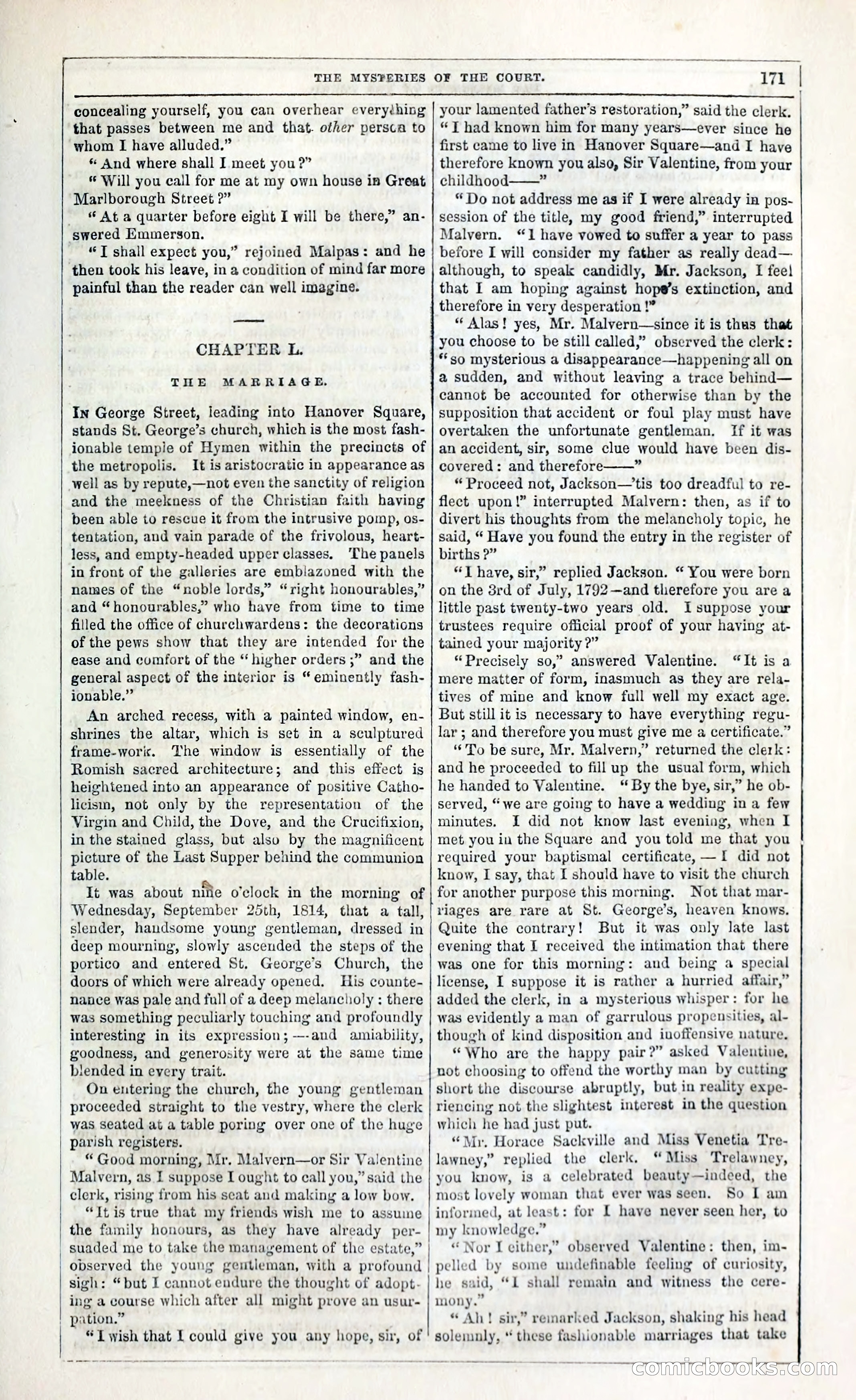
A restored page from Penny Dreadfuls, 1849. Page through the whole issue in the reader above.
📄 Transcribed text from this page (OCR, searchable)
Machine-transcribed from the original scan — historical spelling and the odd misread are preserved.
THE MYS?PERIES concealing yourself, you can overhear everything that passes between me and that. olher persca to whom I have alluded.” * And where shall I meet you ?” * Will you call for me at my own house in Great Marlborough Street ?” Ata quarter before eight I will be there,” an- swered Emmerson. “TJ shall expect you,” rejoined Malpas: and he then took his leave, in a condition of mind far more painful than the reader can well imagine. CHAPTER L. THE MARRIAGE. In George Street, leading into Hanover Square, stands St. George’s church, which is the most fash- ionable tempie of Hymen within the precincts of the metropolis. It is aristocratic in appearance as well as by repute,—not even the sanctity of religion and the meekness of the Christian faith having been able to rescue it from the intrusive pomp, os- tentation, and vain parade of the frivolous, heart- less, and empty-headed upper classes. ‘The panels in front of the galleries are emblazoned with the names of the “noble lords,” “right honourables,” and “honourables,” who have from time to time filled the office of churchwardens: the decorations of the pews show that they are intended for the ease and comfort of the “ higher orders ;” and the general aspect of the interior is “eminently fash- ionable.” An arched recess, with a painted window, en- shrines the altar, which is set in a sculptured frame-work. ‘The window is essentially of the Romish sacred architecture; and this effect is heightened into an appearance of positive Catho- licism, not only by the representation of the Virgin and Child, the Dove, and the Crucifixion, in the stained glass, but also by the magnificent picture of the Last Supper behind the communion table. It was about nile o'clock in the morning of Wednesday, September 25th, 1814, that a tall, slender, handsome young gentleman, dressed in deep mourning, slowly ascended the steps of the portico and entered St. George’s Church, the doors of which were already opened. His counte- nance was pale and full of a deep melancholy : there was something peculiarly touching and profoundly interesting in its expression; -—--aud amiability, goodness, and generosity were at the same time lended in every trait. On entering the church, the young gentleman proceeded straight to the vestry, where the clerk was seated at a table poring over one of the huge parish registers. “ Good morning, Mr. Malvern—or Sir Valentine Malvern, as I suppose I ought to call you,” said the clerk, rising from his seat and making a low bow. “It is true that my friends wish me to assume the family honours, as they have already per- suaded me to take the management of the estate,” observed the young gentleman, with a profound sigh: “but I cannot endure the thought of adopt- ing a course which after all might prove an usur- pation.” ee ee ee OF THE COURT. ae 171 your lamented father’s restoration,” said the clerk. “JT had known him for many years—ever since he first came to live in Hanover Square—and I have therefore known you also, Sir Valentine, from your childhood———” “Do not address me as if I were already in pos- session of the title, my good friend,” interrupted Malvern. “1 have vowed to suffer a year to pass before I will consider my father as really dead— although, to speak candidly, Mr. Jackson, I fee} that I am hoping against hope’s extinction, and therefore in very desperation !” * Alas! yes, Mr. Malvern—since it is thus that you choose to be still called,” observed the clerk: **so mysterious a disappearance—happening all on a sudden, and without leaving a trace behind— cannot be accounted for otherwise than by the supposition that accident or foul play must have overtaken the unfortunate gentleman. If it was an accident, sir, some clue would have been dis- covered: and therefore——” * Proceed not, Jackson—’tis too dreadful to re- flect upon!” interrupted Malvern: then, as if to divert his thoughts from the melancholy topic, he said, “ Have you found the entry in the register of births ?” “1 have, sir,” replied Jackson. “ You were born on the 3rd of July, 1792—and therefore you area little past twenty-two years old. Lsuppose your trustees require official proof of your having at- tained your majority ?” “Precisely so,” answered Valentine. “It is a mere matter of form, inasmuch as they are rela- tives of mine and know full well my exact age. But still it is necessary to have everything regu- lar ; and therefore you must give me a certificate.” ‘To be sure, Mr. Malvern,’ returned the clerk: and he proceeded to fill up the usual form, which he handed to Valentine. ‘ By the bye, sir,” he ob- served, “we are going to have a wedding in a few minutes. IL did not know last evening, when I met you in the Square and you told me that you required your baptismal certificate, —I did not know, I say, that I should have to visit the church for another purpose this morning. Not that mar- viages are rare at St. George’s, heaven knows. Quite the contrary! But it was only late last evening that I received the intimation that there was one for this morning: and being a special license, I suppose it is rather a hurried affair,” added the clerk, in a mysterious whisper: for he was evidently a man of garrulous propensities, al- though of kind disposition and iuoffensive nature. * Who are the happy pair?” asked Valentine, not choosing to offend the worthy man by cutting short the discourse abruptly, but in reality expe- riencing not the slightest interest in the question which he had just put. “Mr, Horace Sackville and Miss Venetia Tre- lawney,” replied the clerk. “Miss Trelawney, you know, is a celebrated beauty—indeed, the most lovely woman that ever was seen. So I am informed, at least: for L have never seen her, to my knowledge.” “ Nor I either,” observed Valentine: then, im- | pelled by some undefinable feeling of curiosity, he said, “1 shall remain and witness the cere- mony.” “Ah! sir,” remarked Jackson, shaking his head “T wish that L could give you any hope, sir, of ' solemnly, “these fashionable marriages that take oe ome we re eee en — GO MTG OO)