
Penny Dreadfuls, 1849 · page 371 of 394
The Mysteries of the Court of London — page 371: what you’re looking at
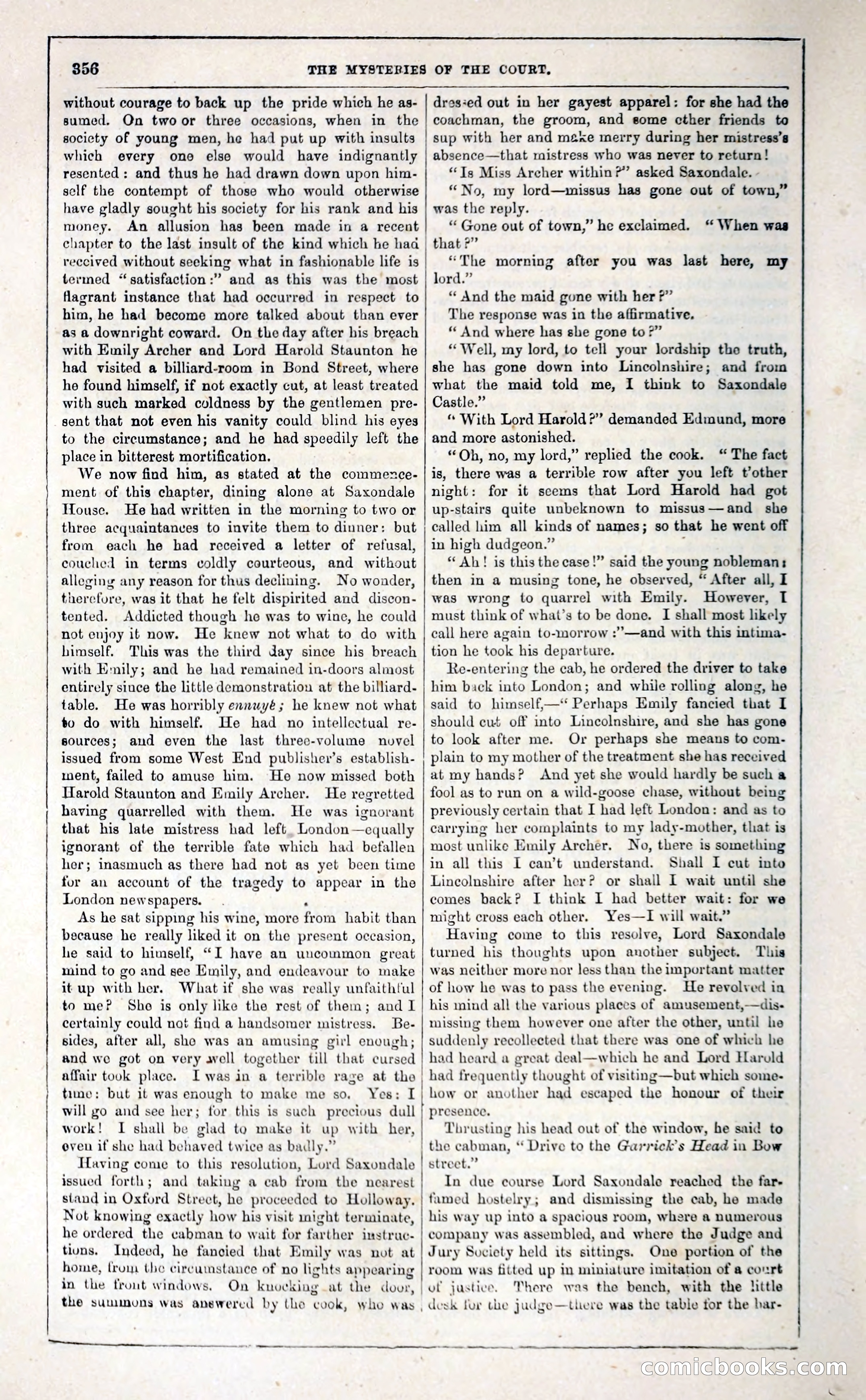
A restored page from Penny Dreadfuls, 1849. Page through the whole issue in the reader above.
📄 Transcribed text from this page (OCR, searchable)
Machine-transcribed from the original scan — historical spelling and the odd misread are preserved.
356 THE MYSTERIES OF THE COURT, without courage to back up the pride which he as- sumed. Qn twoor three occasions, when in the socicty of young men, he had put up with insults which every one else would have indignantly resented : and thus he had drawn down upon him- self the contempt of those who would otherwise have gladly sought his society for his rank and his money. An allusion has been made in a recent chapter to the last insult of the kind which he haa reccived without seeking what in fashionable life is termed “ satisfaction:” and as this was the most flagrant instance that had occurred in respect to him, he had become more talked about than ever as a downright coward. On the day after his breach with Emily Archer and Lord Harold Staunton he had visited a billiard-room in Bond Street, where he found himself, if not exactly cut, at least treated with such marked coldness by the gentlemen pre- sent that not even his vanity could blind his eyes to the circumstance; and he had speedily left the place in bitterest mortification. We now find him, as stated at the commence- ment of this chapter, dining alone at Saxondale House. He had written in the morning to two or three acquaintanves to invite them to dinner: but from each he had received a letter of refusal, couched in terms coldly courteous, and without alleging any reason for thus declining. No wonder, therefore, was it that he felt dispirited and discon- tented. Addicted though he was to wine, he could not enjoy it now. He knew not what to do with himself. This was the third day since his breach with Emily; and he had remained in-doors almost entirely siuce the little demonstration at the billiard- table. He was horribly ennuyé; he knew not what to do with himself. He had no intellectual re- sources; and even the last three-volume novel issued from some West End publisher’s establish- ment, failed to amuse him. He now missed both Harold Staunton and Emily Archer. He regretted having quarrelled with them. He was ignorant that his late mistress had left_ London —equally ignorant of the terrible fate which had befallen her; inasmuch as there had not as yet been time for an account of the tragedy to appear in the London new spapers. As he sat sipping his wine, more from habit than because he really liked it on the present occasion, he said to himself, “I have an uncommon great mind to go and see Emily, and endeavour to make it up with her. What if she was really unfaithful to meP Sho is only like the rest of them; and I certainly could not find a handsomer mistress. Be- sides, after all, she was an amusing girl enough; and we got on very avell together till that cursed affair took place. Iwas in a terrible rage at the time; but 1t was enough to make me so, Yes: I will go and see her; for this is sueh precious dull work! I shall be glad to make it up with her, even if she had behaved twice as badly.” Tflaving come to this resolution, Lord Saxondale issued forth; and taking a eab from the nearest siand in Oxford Street, he proceeded to Holloway. Not knowing exactly how his visit wight terminate, he ordered the cabman to wait for farther instruc- tiuns. Indeed, he fancied that Emily was not at home, from the circumstance of no lights appearing in the front windows. On knocking at the door, the summons was answered by the ‘cook, who Was ' the cabman, dres:ed out in her gayest apparel: for she had the coachman, the groom, and some cther friends to sup with her and méke merry during her mistress’s absence—that mistress who was never to return! “Ts Miss Archer within?” asked Saxondale. - * No, my lord—missus has gone out of town,” was the reply. “ Gone out of town,” he exclaimed. that ?” “The morning after you was last here, my lord.” “ And the maid gone with her ?” The response was in the affirmative. “ And where has she gone to?” “Well, my lord, to tell your lordship the truth, she has gone down into Lincolnshire; and from what the maid told me, I think to Saxondale Castle.” “ With Lord Harold?” demanded Edmund, more and more astonished. “Oh, no, my lord,” replied the cook. “ The fact is, there was a terrible row after you left t’other night: for it scems that Lord Harold had got up-stairs quite unbeknown to missus—and she called him all kinds of names; so that he went off in high dudgeon.” « Ah! is this the case!” said the young nobleman: then in a musing tone, he observed, “ After all, I was wrong to quarrel with Emily. However, I must think of what’s to be done. I shall most likely call here again to-morrow :’—and with this intima- tion he took his departure. Re-entering the cab, he ordered the driver to take him back into London; and while rolling along, he said to himself,—‘‘ Perhaps Emily fancied that I should cut off into Lincolnshire, and she has gone to look after me. Or perhaps she means to com- plain to my mother of the treatment she has received at my hands? And yet she would hardly be such a fool as to run on a wild-goose chase, without being previously certain that I had left London: and as to carrying her complaints to my lady-mother, that is most unlike Emily Archer. No, there is something in all this I can’t understand. Shall I eut into Lincolnshire after her? or shall I wait until she comes back? I think I had better wait: for we might cross each other. Yes—I will wait.” Having come to this resolve, Lord Saxondale turned his thoughts upon another subject. This was neither more nor less than the important matter of how he was to pass the evening. He revolved in his mind all the various places of amusement,—dis- missing them however one after the other, until he suddenly recollected that there was one of which he had heard a great deal—which he and Lord Harold had frequently thought of visiting—but which some- how or another had escaped the honour of their presence. Thrusting hig head out of the window, he said to “Drive to the Garrick’s Head in Bow “When was street.” In due course Lord Saxondale reached the far- fumed hostelry; and dismissing the cab, he made his way up into a spacious room, where a numerous company was assembled, and where the Judge and Jury Society held its sittings. One portion of the room was fitted up in miniature imitation of a court of justice. There was the bench, with the httle , desk for the judge—there was the table tor the bar- ~--— —— GomiGodooks (EC)