
Penny Dreadfuls, 1849 · page 370 of 394
The Mysteries of the Court of London — page 370: what you’re looking at
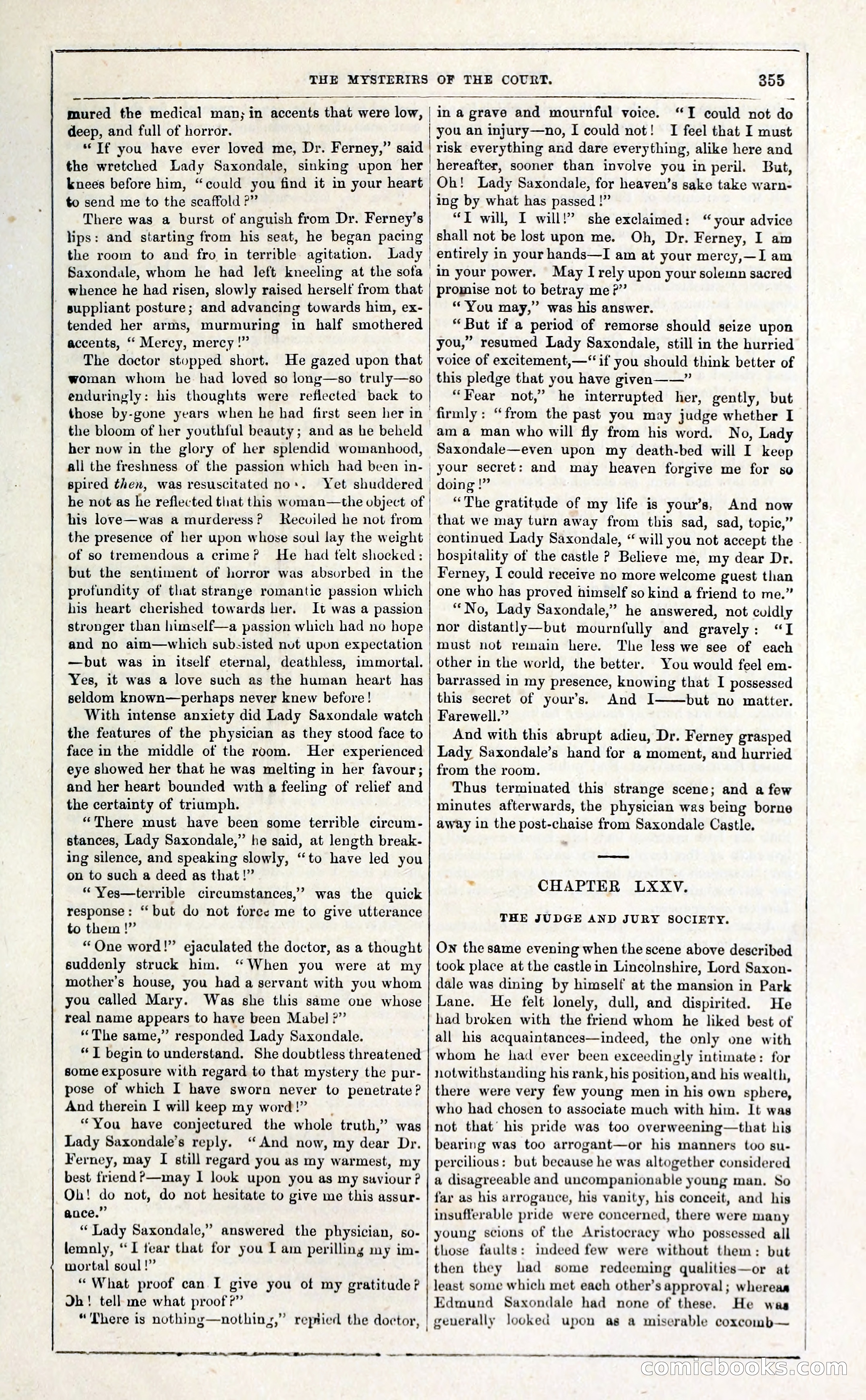
A restored page from Penny Dreadfuls, 1849. Page through the whole issue in the reader above.
📄 Transcribed text from this page (OCR, searchable)
Machine-transcribed from the original scan — historical spelling and the odd misread are preserved.
THE MYSTERIRS OF THE COURT. —_—-— deep, and full of horror. mured the medical man; in accents that were low, | in a grave and mournful voice. “TI could not do you an injury—no, I could not! I feel that I must ““Tf you have ever loved me, Dr. Ferney,” said | risk everything and dare everything, alike here and the wretched Lady Saxondale, sinking upon her | hereafter, sooner than involve you in peril. But, knees before him, “could you find it in your heart to send me to the scaffold ?” There was a burst of anguish from Dr. Ferney’s lips: and starting from his seat, he began pacing the room to and fro in terrible agitation. Lady Saxondale, whom he had left kneeling at the sota whence he had risen, slowly raised herself from that suppliant posture; and advancing towards him, ex- tended her arms, murmuring in half smothered accents, ‘ Mercy, mercy!” The doctor stopped short. He gazed upon that woman whom he had loved so long—so truly—so enduringly: his thoughts were reflected back to those by-gone years when he had first seen her in the bloom of her youthful beauty; and as be beheld her now in the glory of her splendid womanhood, all the freshness of the passion which had been in- spired then, was resuscitated no». Yet shuddered he not as he reflected that this woman—the object of his love—was a murderess? Recviled he not from of so tremendous a crime? He had telt shocked: but the sentiment of horror was absorbed in the profundity of that strange romantic passion which his heart cherished towards ler. It was a passion stronger than himself—a passion which had no hope and no aim—which subsisted nut upon expectation —but was in itself eternal, deathless, immortal. Yes, it was a love such as the human heart has seldom known—perhaps never knew before! With intense anxiety did Lady Saxondale watch the features of the physician as they stood face to face in the middle of the room. Her experienced eye showed her that he was melting in her favour; and her heart bounded with a feeling of relief and the certainty of triumph. “There must have been some terrible circum- stances, Lady Saxondale,” he said, at length break- ing silence, and speaking slowly, “to have led you on to such a deed as that!” “ Yes—terrible circumstances,’ was the quick response: “but do not force me to give utterance to them !” “One word!” ejaculated the doctor, as a thought suddenly struck him. ‘When you were at my mother’s house, you had a servant with you whom you called Mary. Was she this same one whose real name appears to have been Mabel ?” “The same,” responded Lady Saxondale. “1 begin to understand. She doubtless threatened some exposure with regard to that mystery the pur- pose of which I have sworn never to penetrate? And therein I will keep my word!” “You have conjectured the whole truth,” was Lady Saxondale’s reply. ‘And now, my dear Dr. Ferney, may I still regard you as my warmest, my best friend Pp—may I look upon you as my suviour? Oh! do not, do not hesitate to give me this assur- ance.” “Lady Saxondale,” answered the physician, so- lemnly, “I fear that for you I am perilling my im- mortal soul!” “What proof can I give you of my gratitude? Jh! tell me what proof?” “There is nothiny—nothin,,’ ) Oh! Lady Saxondale, for heaven’s sake take warn- ing by what has passed !” “YT will, I will!” she exclaimed: “your advice shall not be lost upon me. Oh, Dr. Ferney, I am entirely in your hands—I am at your mercy,—I am in your power. May I rely upon your solemn sacred promise not to betray me?” “You may,” was his answer. “But if a period of remorse should seize upon you,” resumed Lady Saxondale, still in the hurried voice of excitement,—“‘ if you should think better of this pledge that you have given——” “Fear not,” he interrupted her, gently, but firmly: “from the past you may judge whether I ama man who will fly from his word. No, Lady Saxondale—even upon my death-bed will I keep your secret: and may heaven forgive me for so doing !” “The gratitude of my life is your’s, And now _that we may turn away from this sad, sad, topic,” the presence of her upon whose soul lay the weight | SL LO: TD i Ie NE a ltt ly i ttt tt continued Lady Saxondale, “ will you not accept the - hospitality of the castle ? Believe me, my dear Dr. Ferney, I could receive no more welcome guest than one who has proved himself so kind a friend to me.” “No, Lady Saxondale,” he answered, not culdly nor distantly—but mournfully and gravely: “I must not remain here. The less we see of each other in the world, the better. You would feel em- barrassed in my presence, knowing that I possessed this secret of your’s. And I but no matter. Farewell.” And with this abrupt adieu, Dr. Ferney grasped Lady Saxondale’s hand for a moment, and hurried from the room. Thus terminated this strange scene; and a few minutes afterwards, the physician was being borne away in the post-chaise from Saxondale Castle. == CHAPTER LXXV. THE JUDGE AND JURY SOCIETY. On the same evening when the scene above described took place at the castle in Lincolnshire, Lord Saxon- dale was dining by himself at the mansion in Park Lane. He felt lonely, dull, and dispirited. He had broken with the friend whom he liked best of all his acquaintances—indeed, the only one with whom he had ever been exceedingly intimate: for notwithstanding his rank, his position, and his wealth, there were very few young men in his own sphere, who had chosen to associate much with him. It was not that’ his pride was too overweening—that his bearing was too arrogant—or his manners too su- percilious: but because he was altogether considered a disagreeable and uncompanionable young man. So far as his arrogance, his vanity, his conceit, and his insufferable pride were concerned, there were many young scions of the Aristocracy who possessed all those faults: indeed few were without them: but then they had some redeeming qualities—or at least some which met each other’s approval; whereas Edmund Saxondale had none of these. He was reynied the doctor, | geuerally looked upon as a miserable coxcomb~ _—_————— Se ee Com ClOOOKS (CO)