
Penny Dreadfuls, 1849 · page 346 of 394
The Mysteries of the Court of London — page 346: what you’re looking at
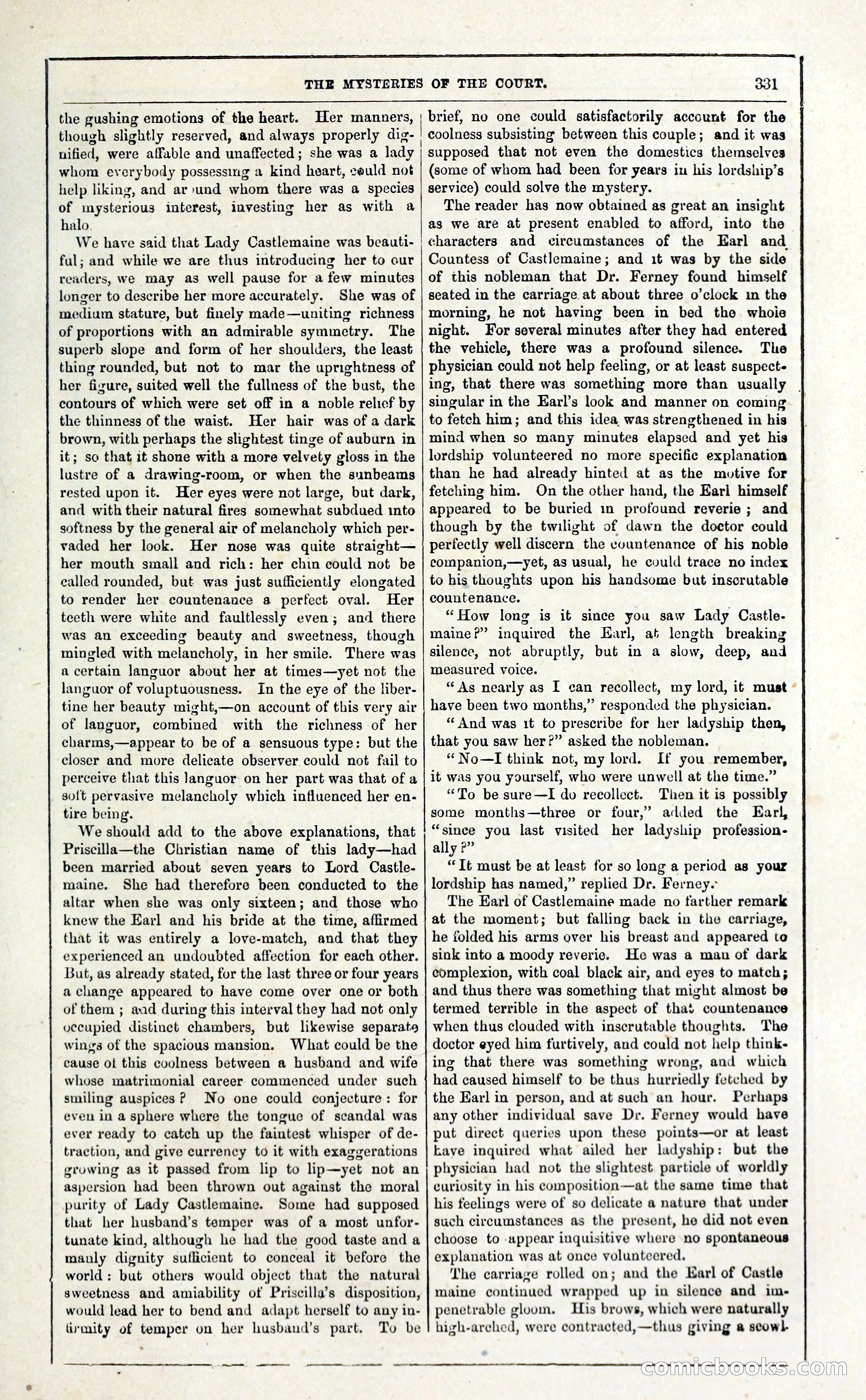
A restored page from Penny Dreadfuls, 1849. Page through the whole issue in the reader above.
📄 Transcribed text from this page (OCR, searchable)
Machine-transcribed from the original scan — historical spelling and the odd misread are preserved.
THE MYSTERIES OF THE COURT. Jol the gushing emotions of the heart. Her manners, though slightly reserved, and always properly dig- uified, were affable and unaffected; she was a lady whom everybody possessing a kind heart, could not help liking, and ar»und whom there was a species of mysterious interest, investing her as with a halo. We have said that Lady Castlemaine was beauti- ful; and while we are thus introducing her to our readers, we may as well pause for a few minutes longer to describe her more accurately. She was of medium stature, but finely made—uniting richness of proportions with an admirable symmetry. The superb slope and form of her shoulders, the least thing rounded, but not to mar the uprightness of her fizure, suited well the fullness of the bust, the contours of which were set off in a noble relief by the thinness of the waist. Her hair was of a dark brown, with perhaps the slightest tinge of auburn in it; so that it shone with a more velvety gloss in the lustre of a drawing-room, or when the sunbeams rested upon it. Her eyes were not large, but dark, and with their natural fires somewhat subdued into softness by the general air of melancholy which per- vaded her look. Her nose was quite straicht— her mouth small and rich: her chin could not be ealled rounded, but was just sufficiently elongated to render her countenance a perfect oval. Her teeth were white and faultlessly even; and there was an exceeding beauty and sweetness, though mingled with melancholy, in her smile. There was a certain languor about her at times—yet not the languor of voluptuousness. In the eye of the liber- tine her beauty might,—on account of this very air of languor, combined with the richness of her charms,—appear to be of a sensuous type: but the closer and more delicate observer could not fail to perceive that this Janguor on her part was that of a soft pervasive melancholy which influenced her en- tire being. We should add to the above explanations, that Priscilla—the Christian name of this lady—had been married about seven years to Lord Castle- maine. She had therefore been conducted to the altar when she was only sixteen; and those who knew the Earl and his bride at the time, affirmed that it was entirely a love-match, and that they experienced an undoubted affection for each other. But, as already stated, for the last three or four years a change appeared to have come over one or both of them ; aad during this interval they had not only vecupied distinct chambers, but lkewise separate wings of the spacious mansion. What could be the cause of this coolness between a husband and wife whose matrimonial career commenced under such smiling auspices? No one could conjecture: for even in a sphere where the tongue of scandal was ever ready to catch up the faintest whisper of de- traction, and give currency to it with exagcerations growing as it passed from lip to lip—yet not an aspersion had been thrown out against the moral purity of Lady Castlemaine. Some had supposed that her husband’s temper was of a most unfor- tunate kind, although he had the good taste and a manly dignity suflicient to conceal it before the world: but others would object that the natural sweetness and amiability of Priscilla’s disposition, would lead her to bend and adapt herself to any in- irmity of temper on her husband’s part. To be brief, no one could satisfactorily account for the coolness subsisting between this couple; and it was supposed that not even the domestics themselves (some of whom had been for years in his lordship’s service) could solve the mystery. The reader has now obtained as great an insight as we are at present enabled to afford, into the characters and circumstances of the Earl and Countess of Castlemaine; and 1t was by the side of this nobleman that Dr. Ferney found himself seated in the carriage at about three o’clock in the morning, he not having been in bed the whoie night. For several minutes after they had entered the vehicle, there was a profound silence. The physician could not help feeling, or at least suspect ee —————— sss ing, that there was something more than usually | singular in the Karl’s look and manner on coming to fetch him; and this idea was strengthened in his mind when so many minutes elapsed and yet his lordship volunteered no more specific explanation than he had already hinted at as the motive for fetching him. On the other hand, the Earl himself appeared to be buried in profound reverie; and though by the twilight of dawn the doctor could perfectly well discern the countenance of his noble companion,—yet, as usual, he could trace no index to his thoughts upon his handsome but inscrutable countenance. “How long is it since you saw Lady Castle- maine?” inquired the Earl, at length breaking silence, not abruptly, but in a slow, deep, and measured voice. “As nearly as I can recollect, my lord, it must - have been two months,” responded the physician. “And was 1t to prescribe for her ladyship then, that you saw her?” asked the nobleman. “ No—I think not, my lord. If you remember, it was you yourself, who were unwell at the time.” “To be sure—I do recollect. Then it is possibly some months—three or four,’ added the Earl, “since you last visited her ladyship profession- ally P” “Tt must be at least for so long a period as your lordship has named,” replied Dr. Ferney. The Earl of Castlemaine made no tarther remark at the moment; but falling back in the carriage, he folded his arms over his breast and appeared te sink into a moody reverie. He was a man of dark complexion, with coal black air, and eyes to match; and thus there was something that might almost be termed terrible in the aspect of that countenance when thus clouded with inscrutable thoughts. The doctor eyed him furtively, and could not help think- ing that there was something wrong, and which had caused himself to be thus hurriedly fetched by the Earl in person, and at such an hour. Perhaps any other individual save Dr. Ferney would have put direct queries upon these points—or at least kave inquired what ailed her ladyship: but the physician had not the slightest particle of worldly curiosity in his composition—at the same time that his feelings were of so delicate a nature that under such circumstances as the present, he did not even choose to appear inquisitive where no spontaneous explanation was at once volunteered. The carriage rolled on; and the Karl of Castle maine continued wrapped up in silence and im- penetrable gloom. His brows, which were naturally hirh-arched, were contracted,—thus giving a scowl —evewe mre eS Olml iGDOO) RS (CO)