
Penny Dreadfuls, 1849 · page 345 of 394
The Mysteries of the Court of London — page 345: what you’re looking at
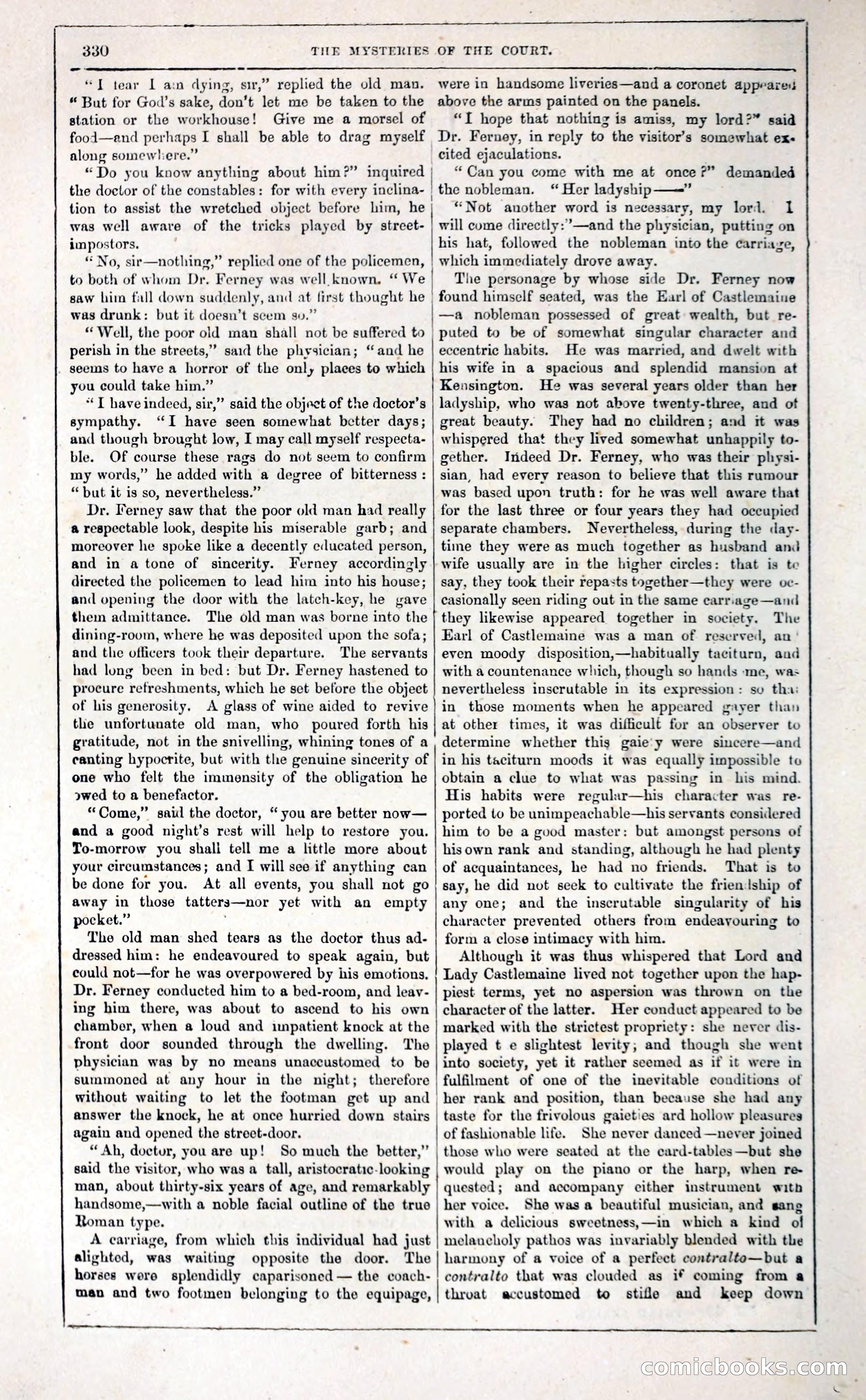
A restored page from Penny Dreadfuls, 1849. Page through the whole issue in the reader above.
📄 Transcribed text from this page (OCR, searchable)
Machine-transcribed from the original scan — historical spelling and the odd misread are preserved.
330 TILE MYSTERIES OF THE COURT. “JT tear LI am dying, sir,” replied the old man. were in handsome liveries—and a coronet appeared “ But for God’s sake, don’t let me be taken to the above the arms painted on the panels. station or the workhouse! Give me a morsel of “I hope that nothing is amiss, my lord?” said fooi—end perhaps I shall be able to drag myself Dr. Ferney, in reply to the visitor’s somewhat ex- along somewhere.” cited ejaculations. “Do you know anything about him?” inquired | “Can you come with me at once?” demanded the doctor of the constables: for with every inclina- | the nobleman. “Her ladyship—” tion to assist the wretched object before him, ria “Not another word is necessary, my lord. IL was well aware of the tricks played by street- impostors. “ No, sir—nothing,” replied one of the policemen, to both of whom Dr. Ferney was well known, “ We saw him fall down suddenly, and at first thought he | was drunk: but it doesn’t scem sv.” “Well, the poor old man shall not be suffered to perish in the streets,” said the physician; “ and he _ seems to have a horror of the only places to which you could take him.” ““T have indeed, sir,” said the object of the doctor’s sympathy. “I have seen somewhat better days; and though broucht low, I may call myself respecta- ble. Of course these rags do not seem to confirm my words,” he added with a degree of bitterness : “but it is so, nevertheless.” Dr. Ferney saw that the poor old man had really a respectable look, despite his miserable garb; and moreover he spoke like a decently educated person, and in atone of sincerity. Ferney accordingly directed the policemen to lead him into his house; andl opening the door with the latch-key, he gave them admittance. The old man was borne into the dining-room, where he was deposited upon the sofa; and the officers took their departure. The servants had long been in bed: but Dr. Ferney hastened to procure refreshments, which he set before the object of his generosity, A glass of wine aided to revive the unfortunate old man, who poured forth his gratitude, not in the snivelling, whining tones of a canting hypocrite, but with the genuine sincerity of one who felt the immensity of the obligation he »wed to a benefactor. “Come,” sail the doctor, “ you are better now— and a good night’s rest will help to restore you. To-morrow you shall tell me a little more about your circumstances; and I will see if anything can be done for you. At all events, you shall not go away in those tatters—nor yet with an empty pocket.” ' The old man shed tears as the doctor thus ad- dressed him: he endeavoured to speak again, but could not—for he was overpowered by his emotions. Dr. Ferney conducted him to a bed-room, and leav- ing him there, was about to ascend to his own chamber, when a loud and impatient knock at the front door sounded through the dwelling. The physician was by no means unaccustomed to be summoned at any hour in the night; therefore without waiting to let the footman get up and answer the knock, he at once hurried down stairs again and opened the street-door. “Ah, doctur, you are up! So much the better,’ said the visitor, who was a tall, aristocratic-looking man, about thirty-six years of age, and remarkably handsome,—with a noble facial outline of the true Roman type. A carriage, from which this individual had just alighted, was waiting opposite the door. The horses were splendidly caparisoned — the coach- man and two footmen belonging to the equipage, will come directly:’—and the physician, putting on his hat, followed the nobleman into the carriage, which immediately drove away. The personage by whose side Dr. Ferney now found himself seated, was the Earl of Castlemaine —a nobleman possessed of great wealth, but re- puted to be of somewhat singular character and eccentric habits. He was married, and dwelt with his wife in a spacious and splendid mansion at Kensington. He was several years older than her ladyship, who was not above twenty-three, and of great beauty. They had no children; and it was whispered that they lived somewhat unhappily to- gether. Irideed Dr. Ferney, who was their plysi- sian, had every reason to believe that this rumour was based upon truth: for he was well aware that for the last three or four years they had occupied separate chambers. Nevertheless, during the day- time they were as much together as husband and wife usually are in the higher circles: that is te say, they took their repasts together—they were oc- casionally seen riding out in the same carriage —andl they likewise appeared together in society. The Earl of Castlemaine was a man of reserved, an’ even moody disposition,—habitually taciturn, aad with a countenance which, though so hands ‘me, was nevertheless inscrutable in its expression: so tha: in those moments when he appeared gayer than at other times, it was difficult for an observer to determine whether this gaie’y were sincere—and in his taciturn moods it was equally impossible to obtain a clue to what was passing in his mind. His habits were regulur—his character was re- ported to be unimpeachable—his servants considered him to be a good master: but amongst persons of hisown rank and standing, although he had plenty of acquaintances, he had no friends. That is to say, he did not seek to cultivate the frien:tship of any one; and the inscrutable singularity of his character prevented others from endeavouring to form a close intimacy with him. Although it was thus whispered that Lord and Lady Castlemaine lived not together upon the hap- piest terms, yet no aspersion was thrown on the character of the latter. Her conduct appeared to be marked with the strictest propriety: she never dis- played t e slightest levity; and though she went into society, yet it rather seemed as if it were in fulfilment of one of the inevitable conditions of her rank and position, than because she had any taste for the frivolous gaieties ard hollow pleasures of fashionable life. She never danced —never joined those who were seated at the card-tables—but she would play on the piano or the harp, when re- quested; and accompany cither instrument with her voice. She was a beautiful musician, and sang with a delicious sweetness,—in which a kind of melaucholy pathos was invariably blended with the harmony of a voice of a perfect contralto—but a contralto that was clouded as if coming from a throat accustomed to stifle and keep down CORNIELOOOMKS (€©) r