
Penny Dreadfuls, 1849 · page 327 of 394
The Mysteries of the Court of London — page 327: what you’re looking at
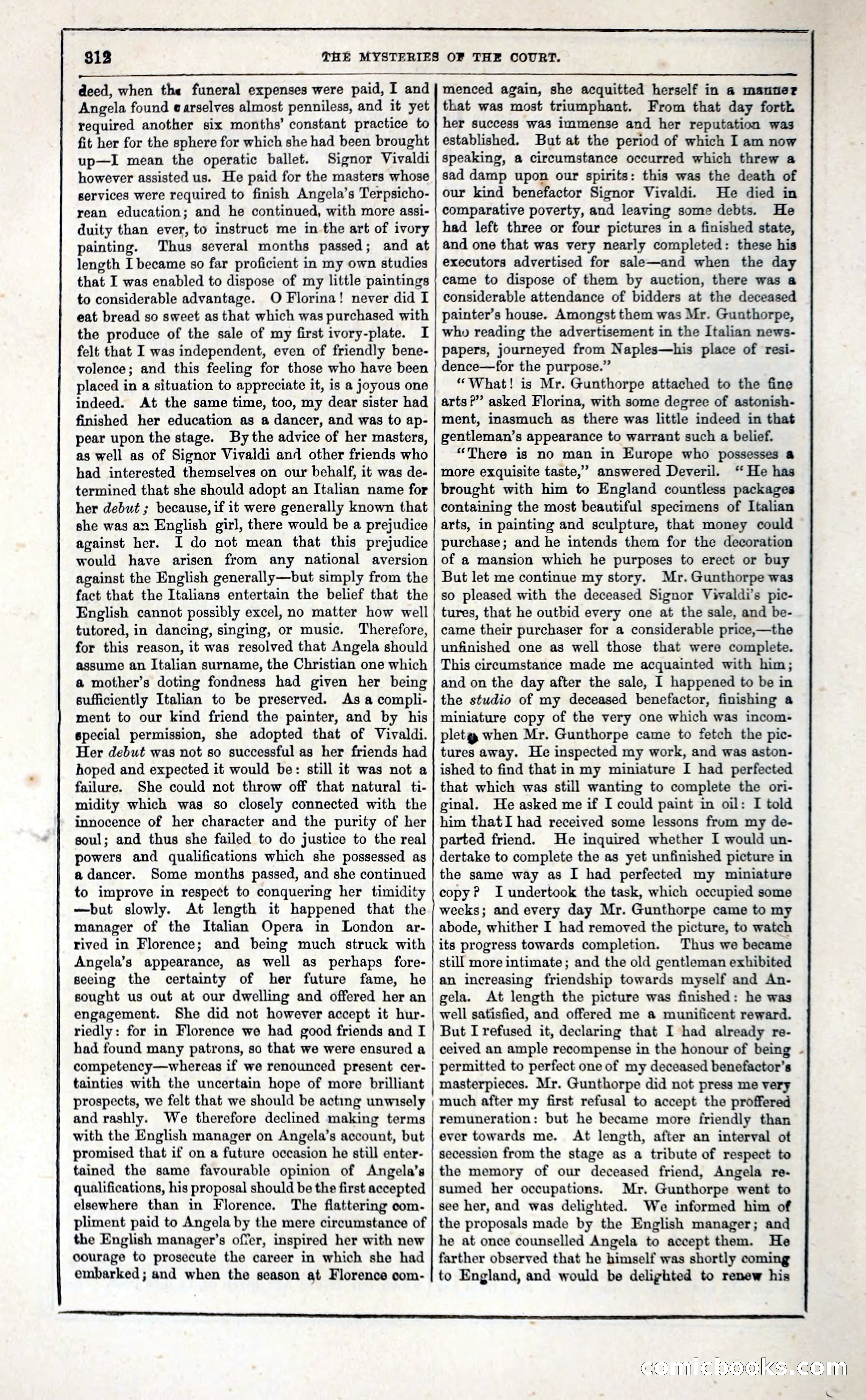
A restored page from Penny Dreadfuls, 1849. Page through the whole issue in the reader above.
📄 Transcribed text from this page (OCR, searchable)
Machine-transcribed from the original scan — historical spelling and the odd misread are preserved.
$12 THE MYSTERIES OF THE COURT. deed, when the funeral expenses were paid, I and Angela found earselves almost penniless, and it yet required another six months’ constant practice to fit her for the sphere for which she had been brought up—I mean the operatic ballet. Signor Vivaldi however assisted us. He paid for the masters whose services were required to finish Angela’s Terpsicho- rean education; and he continued, with more assi- duity than ever, to instruct me in the art of ivory painting. Thus several months passed; and at length I became so far proficient in my own studies that I was enabled to dispose of my little paintings to considerable advantage. O Florina! never did I eat bread so sweet as that which was purchased with the produce of the sale of my first ivory-plate. I felt that I was independent, even of friendly bene- volence; and this feeling for those who have been placed in a situation to appreciate it, is a joyous one indeed. At the same time, too, my dear sister had finished her education as a dancer, and was to ap- pear upon the stage. By the advice of her masters, as well as of Signor Vivaldi and other friends who had interested themselves on our behalf, it was de- termined that she should adopt an Italian name for her debut ; because, if it were generally known that she was an English girl, there would be a prejudice against her. I do not mean that this prejudice would have arisen from any national aversion against the English generally—but simply from the fact that the Italians entertain the belief that the English cannot possibly excel, no matter how well tutored, in dancing, singing, or music. Therefore, for this reason, it was resolved that Angela should assume an Italian surname, the Christian one which a mother’s doting fondness had given her being sufficiently Italian to be preserved. As a compli- ment to our kind friend the painter, and by his special permission, she adopted that of Vivaldi. Her debut was not so successful as her friends had hoped and expected it would be: still it was not a failure. She could not throw off that natural ti- midity which was so closely connected with the innocence of her character and the purity of her soul; and thus she failed to do justice to the real powers and qualifications which she possessed as a dancer. Some months passed, and she continued to improve in respect to conquering her timidity —but slowly. At length it happened that the manager of the Italian Opera in London ar- rived in Florence; and being much struck with Angela’s appearance, as well as perhaps fore- seeing the certainty of her future fame, he sought us out at our dwelling and offered her an engagement. She did not however accept it hur- riedly: for in Florence we had good friends and I had found many patrons, so that we were ensured a competency—whereas if we renounced present cer- tainties with the uncertain hope of more brilliant prospects, we felt that we should be acting unwisely and rashly. We therefore declined making terms with the English manager on Angela’s account, but promised that if on a future occasion he still enter- tained the same favourable opinion of Angela’s qualifications, his proposal should be the first accepted elsewhere than in Florence. The flattering com- pliment paid to Angela by the mere circumstance of the English manager’s offer, inspired her with new courage to prosecute the career in which she had embarked; and when the season at Florence com- menced again, she acquitted herself in a manner that was most triumphant. From that day forth her success was immense and her reputation was established. But at the period of which I am now speaking, a circumstance occurred which threw a sad damp upon our spirits: this was the death of our kind benefactor Signor Vivaldi. He died in comparative poverty, and leaving some debts. He had left three or four pictures in a finished state, and one that was very nearly completed: these his executors advertised for sale—and when the day came to dispose of them by auction, there was a considerable attendance of bidders at the deceased painter’s house. Amongst them was Mr. Gunthorpe, who reading the advertisement in the Italian news- papers, journeyed from Naples—his place of resi- dence—for the purpose.” ‘““What! is Mr. Gunthorpe attached to the fine arts?” asked Florina, with some degree of astonish- ment, inasmuch as there was little indeed in that gentleman’s appearance to warrant such a belief. “There is no man in Europe who possesses @ more exquisite taste,” answered Deveril. ‘“‘ He has brought with him to England countless packages containing the most beautiful specimens of Italian arts, in painting and sculpture, that money could purchase; and he intends them for the decoration of a mansion which he purposes to erect or buy But let me continue my story. Mr. Gunthorpe was so pleased with the deceased Signor Vivaldi’s pic- tures, that he outbid every one at the sale, and be- came their purchaser for a considerable price,—the unfinished one as well those that were complete. This circumstance made me acquainted with him; and on the day after the sale, I happened to be in the studio of my deceased benefactor, finishing a miniature copy of the very one which was incom- pletg when Mr. Gunthorpe came to fetch the pic- tures away. He inspected my work, and was aston- ished to find that in my miniature I had perfected that which was still wanting to complete the ori- ginal. He asked me if I could paint in oil: I told him thatI had received some lessons from my de- parted friend. He inquired whether I would un- dertake to complete the as yet unfinished picture in the same way as I had perfected my miniature copy? I undertook the task, which occupied some weeks; and every day Mr. Gunthorpe came to my abode, whither I had removed the picture, to watch its progress towards completion. Thus we became still more intimate; and the old gentleman exhibited an increasing friendship towards myself and An- gela. At length the picture was finished: he was well satisfied, and offered me a munificent reward. But I refused it, declaring that I had already re- ceived an ample recompense in the honour of being permitted to perfect one of my deceased benefactor’s masterpieces. Mr. Gunthorpe did not press me very much after my first refusal to accept the proffered remuneration: but he became more friendly than ever towards me. At length, after an interval of secession from the stage as a tribute of respect to the memory of our deceased friend, Angela re- sumed her occupations. Mr. Gunthorpe went to see her, and was delighted. We informed him of the proposals made by the English manager; and he at once counselled Angela to accept them. He farther observed that he himself was shortly coming to England, and would be delighted to renew his dee mn “eS (E) ECORRICLOO