
Penny Dreadfuls, 1849 · page 326 of 394
The Mysteries of the Court of London — page 326: what you’re looking at
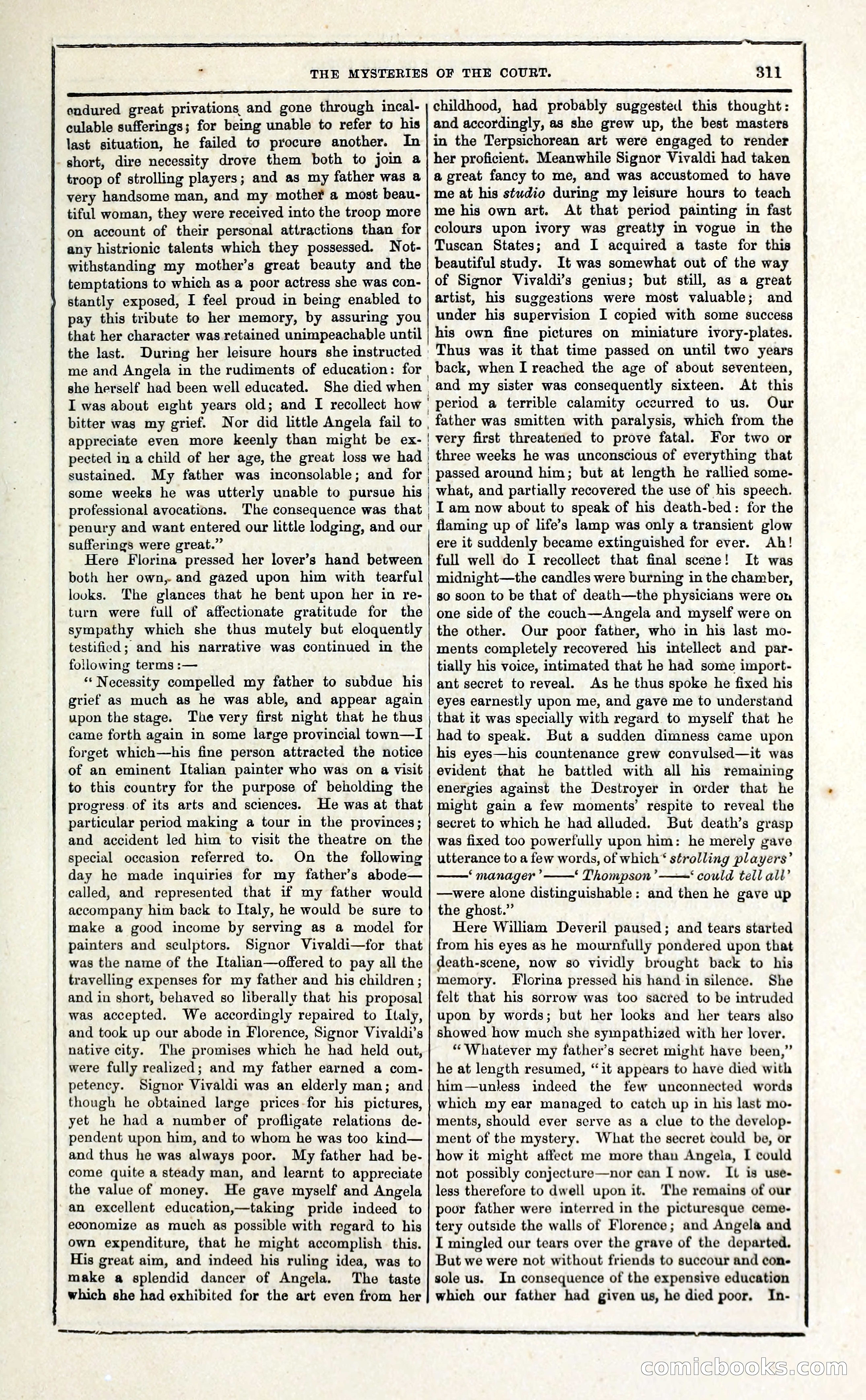
A restored page from Penny Dreadfuls, 1849. Page through the whole issue in the reader above.
📄 Transcribed text from this page (OCR, searchable)
Machine-transcribed from the original scan — historical spelling and the odd misread are preserved.
THE MYSTERIES ondured great privations and gone through incal- culable sufferings; for being unable to refer to his last situation, he failed to procure another. In short, dire necessity drove them both to jom a troop of strolling players; and as my father was a very handsome man, and my mother a most beau- tiful woman, they were received into the troop more on account of their personal attractions than for any histrionic talents which they possessed. Not- withstanding my mother’s great beauty and the temptations to which as a poor actress she was con- stantly exposed, I feel proud in being enabled to pay this tribute to her memory, by assuring you that her character was retained unimpeachable until the last. During her leisure hours she instructed | me and Angela in the rudiments of education: for she herself had been well educated. She died when | I was about eight years old; and I recollect how | bitter was my grief. Nor did little Angela fail to , appreciate even more keenly than might be ex- | pected in a child of her age, the great loss we had | sustained. My father was inconsolable; and for | some weeks he was utterly unable to pursue his | professional avocations. The consequence was that | penury and want entered our little lodging, and our sufferings were great.” Here Florina pressed her lover’s hand between both her own, and gazed upon him with tearful looks. The glances that he bent upon her in re- turn were full of affectionate gratitude for the sympathy which she thus mutely but eloquently testified; and his narrative was continued in the following terms :— ** Necessity compelled my father to subdue his grief as much as he was able, and appear again upon the stage. The very first night that he thus came forth again in some large provincial town—I forget which—his fine person attracted the notice of an eminent Italian painter who was on a visit to this country for the purpose of beholding the progress. of its arts and sciences. He was at that particular period making a tour in the provinces; and accident led him to visit the theatre on the special occasion referred to. On the following day he made inquiries for my father’s abode— called, and represented that if my father would accompany him back to Italy, he would be sure to make a good income by serving as a model for painters and sculptors. Signor Vivaldi—for that was the name of the Italian—offered to pay all the travelling expenses for my father and his children; and in short, behaved so liberally that his proposal was accepted. We accordingly repaired to Italy, and took up our abode in Florence, Signor Vivaldi’s native city. The promises which he had held out, were fully realized; and my father earned a com- petency. Signor Vivaldi was an elderly man; and though he obtained large prices-for his pictures, yet he had a number of profligate relations de- pendent upon him, and to whom he was too kind— and thus he was always poor. My father had be- come quite a steady man, and learnt to appreciate the value of money. He gave myself and Angela an excellent education,—taking pride indeed to economize as much as possible with regard to his own expenditure, that he might accomplish this. His great aim, and indeed his ruling idea, was to make a splendid dancer of Angela. The taste which she had exhibited for the art even from her 31l OF THE COURT. childhood, had probably suggested this thought: and accordingly, as she grew up, the best masters in the Terpsichorean art were engaged to render her proficient. Meanwhile Signor Vivaldi had taken a great fancy to me, and was accustomed to have me at his studio during my leisure hours to teach me his own art. At that period painting in fast colours upon ivory was greatly in vogue in the Tuscan States; and I acquired a taste for this beautiful study. It was somewhat out of the way of Signor Vivaldi’s genius; but still, as a great artist, his suggestions were most valuable; and under his supervision I copied with some success his own fine pictures on miniature ivory-plates. Thus was it that time passed on until two years back, when I reached the age of about seventeen, and my sister was consequently sixteen. At this period a terrible calamity occurred to us. Our father was smitten with paralysis, which from the very first threatened to prove fatal. For two or three weeks he was unconscious of everything that passed around him; but at length he rallied some- what, and partially recovered the use of his speech. I am now about to speak of his death-bed: for the flaming up of life’s lamp was only a transient glow ere it suddenly became extinguished for ever. Ah! full well do I recollect that final scene! It was midnight—the candles were burning in the chamber, so soon to be that of death—the physicians were on one side of the couch—Angela and myself were on the other. Our poor father, who in his last mo- ments completely recovered his intellect and par- tially his voice, intimated that he had some import- ant secret to reveal. As he thus spoke he fixed his eyes earnestly upon me, and gave me to understand that it was specially with regard to myself that he had to speak. But a sudden dimness came upon his eyes—his countenance grew convulsed—it was evident that he battled with all his remaining energies against the Destroyer in order that he might gain a few moments’ respite to reveal the secret to which he had alluded. But death’s grasp was fixed too powerfully upon him: he merely gave utterance to a few words, of which * strolling players’ ‘manager’ ‘ Thompson ’——‘ could tell all’ —were alone distinguishable: and then he gave up the ghost.” Here William Deveril paused; and tears started from his eyes as he mournfully pondered upon that death-scene, now so vividly brought back to his memory. Florina pressed his hand in silence. She felt that his sorrow was too sacred to be intruded upon by words; but her looks and her tears also showed how much she sympathized with her lover. “Whatever my father’s secret might have been,” he at length resumed, “it appears to have died with him—uniess indeed the few unconnected words which my ear managed to catch up in his last mo- ments, should ever serve as a clue to the develop- ment of the mystery. What the secret could be, or how it might affect me more than Angela, I could not possibly conjecture—nor can I now. It is use- less therefore to dwell upon it. The remains of our poor father were interred in the picturesque ceme- tery outside the walls of Florence; and Angela and I mingled our tears over the grave of the departed. But we were not without friends to succour and cone sole us. In consequence of the expensive education which our father had given us, he died poor. In- re cme raat , .L see ECORNICLOO (Cc S (Cc)