
Penny Dreadfuls, 1849 · page 284 of 394
The Mysteries of the Court of London — page 284: what you’re looking at
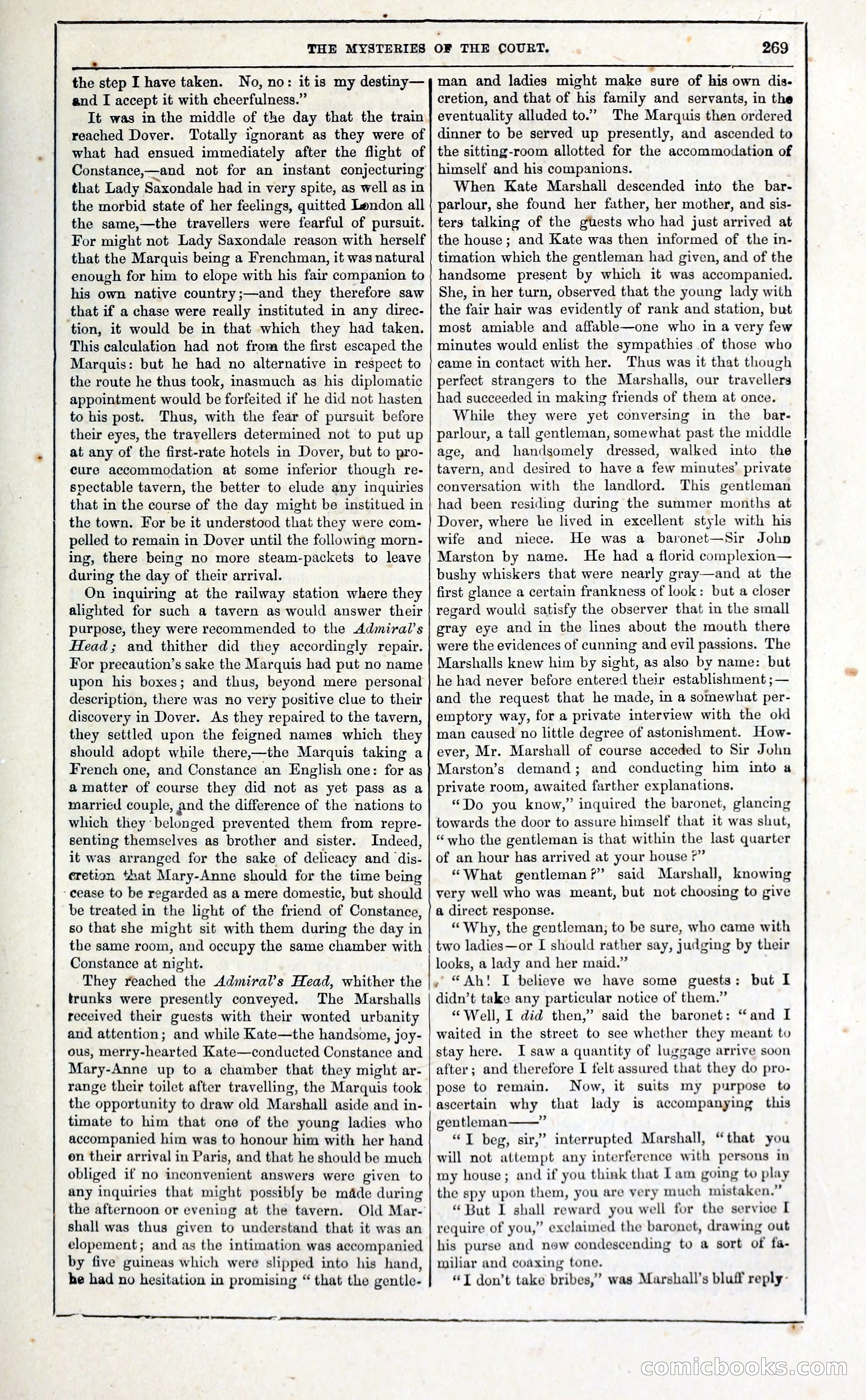
A restored page from Penny Dreadfuls, 1849. Page through the whole issue in the reader above.
📄 Transcribed text from this page (OCR, searchable)
Machine-transcribed from the original scan — historical spelling and the odd misread are preserved.
THE MYSTERIES OF THE COURT. —— the step I have taken. No, no: it is my destiny— and I accept it with cheerfulness.” It was in the middle of the day that the train reached Dover. Totally ignorant as they were of what had ensued immediately after the flight of Constance,—and not for an instant conjecturing that Lady Saxondale had in very spite, as well as in the morbid state of her feelings, quitted London all the same,—the travellers were fearful of pursuit. For might not Lady Saxondale reason with herself that the Marquis being a Frenchman, it was natural enough for him to elope with his fair companion to his own native country ;—and they therefore saw that if a chase were really instituted in any direc- tion, it would be in that which they had taken. This calculation had not from the first escaped the Marquis: but he had no alternative in respect to the route he thus took, inasmuch as his diplomatic appointment would be forfeited if he did not hasten to his post. Thus, with the fear of pursuit before their eyes, the travellers determined not to put up at any of the first-rate hotels in Dover, but to pro- cure accommodation at some inferior though re- spectable tavern, the better to elude any inquiries that in the course of the day might be institued in the town. For be it understood that they were com- pelled to remain in Dover until the following morn- ing, there being no more steam-packets to leave during the day of their arrival. On inquiring at the railway station where they alichted for such a tavern as would answer their purpose, they were recommended to the Admiral’s Head; and thither did they accordingly repair. For precaution’s sake the Marquis had put no name upon his boxes; and thus, beyond mere personal description, there was no very positive clue to their discovery in Dover. As they repaired to the tavern, they settled upon the feigned names which they should adopt while there,—the Marquis taking a French one, and Constance an English one: for as a matter of course they did not as yet pass as a married couple, and the difference of the nations to which they belonged prevented them from repre- senting themselves as brother and sister. Indeed, it was arranged for the sake of delicacy and dis- cretion that Mary-Anne should for the time being “cease to be regarded as a mere domestic, but should be treated in the light of the friend of Constance, so that she might sit with them during the day in the same room, and occupy the same chamber with Constance at night. They reached the Admiral’s Head, whither the trunks were presently conveyed. The Marshalls received their guests with their wonted urbanity and attention; and while Kate—the handsome, joy- ous, merry-hearted Kate—conducted Constance and Mary-Anne up to a chamber that they might ar- range their toilet after travelling, the Marquis took the opportunity to draw old Marshall aside and in- timate to him that one of the young ladies who accompanied him was to honour him with her hand on their arrival in Paris, and that he should be much obliged if no inconvenient answers were given to any inquiries that might possibly be made during the afternoon or evening at the tavern. Old Mar- shall was thus given to understand that it was an elopement; and as the intimation was accompanied by five guineas which were slipped into his hand, he had no hesitation in promising “ that the gentle- 269 man and ladies might make sure of his own dis- cretion, and that of his family and servants, in the eventuality alluded to.” The Marquis then ordered dinner to be served up presently, and ascended to the sitting-room allotted for the accommodation of himself and his companions. When Kate Marshall descended into the bar- parlour, she found her father, her mother, and sis- ters talking of the gtests who had just arrived at the house; and Kate was then informed of the in- timation which the gentleman had given, and of the handsome present by which it was accompanied. She, in her turn, observed that the young lady with the fair hair was evidently of rank and station, but most amiable and affable—one who in a very few minutes would enlist the sympathies of those who came in contact with her. Thus was it that though perfect strangers to the Marshalls, our travellers had succeeded in making friends of them at once. While they were yet conversing in the bar- parlour, a tall gentleman, somewhat past the middle age, and handsomely dressed, walked into the tavern, and desired to have a few minutes’ private conversation with the landlord. This gentleman had been residing during the summer months at Dover, where he lived in excellent style with his wife and niece. He was a baronet—Sir John Marston by name. He had a florid complexion— bushy whiskers that were nearly gray—and at the first glance a certain frankness of look: but a closer regard would satisfy the observer that in the small gray eye and in the lines about the mouth there were the evidences of cunning and evil passions. The Marshalls knew him by sight, as also by name: but he had never before entered their establishment ;— and the request that he made, in a somewhat per- emptory way, for a private interview with the old man caused no little degree of astonishment. How- ever, Mr. Marshall of course acceded to Sir John Marston’s demand; and conducting him into a private room, awaited farther explanations. “Do you know,” inquired the baronet, glancing towards the door to assure himself that 1t was shut, “who the gentleman is that within the last quarter of an hour has arrived at your house ?” “What gentleman?” said Marshall, knowing very well who was meant, but not choosing to give a direct response. “Why, the gentleman; to be sure, who came with two ladies—or I should rather say, judging by their looks, a lady and her maid.” » “Ah! I believe we have some guests: but I didn’t take any particular notice of them.” “Well, I did then,’ said the baronet: “and I waited in the street to see whether they meant to stay here. I saw a quantity of luggage arrive soon after; and therefore I felt assured that they do pro- pose to remain. Now, it suits my purpose to ascertain why that lady is accompanying this gentleman a “TI beg, sir,’ interrupted Marshall, “that you will not attempt any interference with persons in my house; and if you think that Lam going to play the spy upon them, you are very much mistaken.” “But I shall reward you well for the service I require of you,” exclaimed the baronet, drawing out his purse and now condescending to a sort of fa- miliar and coaxing tone. “T don’t take bribes,” was Marshall’s bluff reply: te ee ee COMMICcbookxs Cc (CO)