
Penny Dreadfuls, 1849 · page 283 of 394
The Mysteries of the Court of London — page 283: what you’re looking at
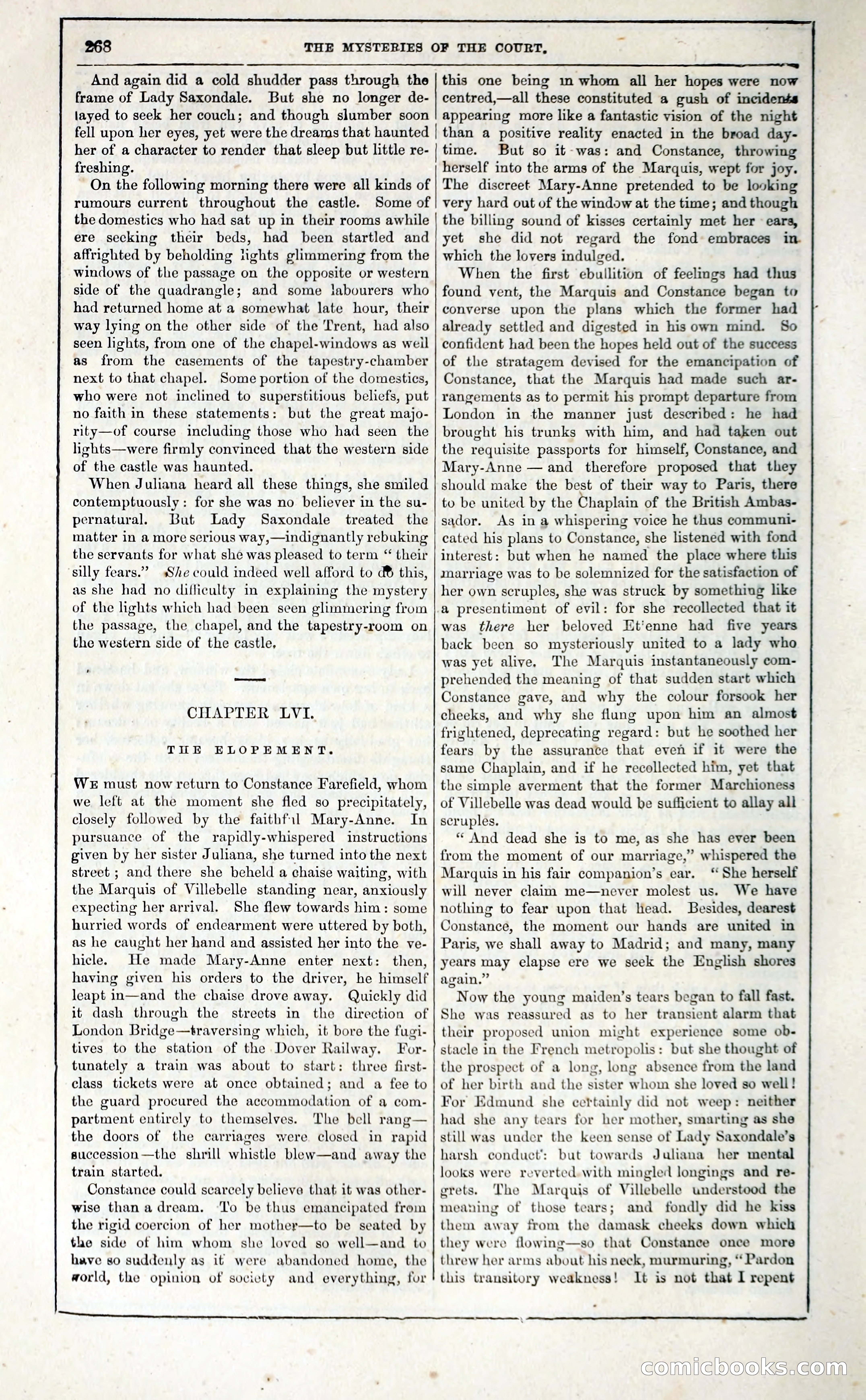
A restored page from Penny Dreadfuls, 1849. Page through the whole issue in the reader above.
📄 Transcribed text from this page (OCR, searchable)
Machine-transcribed from the original scan — historical spelling and the odd misread are preserved.
268 THE MYSTERIES OF THE COURT, And again did a cold shudder pass through the frame of Lady Saxondale. But she no longer de- layed to seek her couch; and though slumber soon this one being m whom all her hopes were now centred,—all these constituted a gush of incidents appearing more like a fantastic vision of the night fell upon her eyes, yet were the dreams that haunted | than a positive reality enacted in the broad day- her of a character to render that sleep but little re- freshing. On the following morning there were all kinds of rumours current throughout the castle. Some of the domestics who had sat up in their rooms awhile ere secking their beds, had been startled and affrighted by beholding lights glimmering from the windows of the passage on the opposite or western side of the quadrangle; and some labourers who had returned home at a somewhat late hour, their way lying on the other side of the Trent, had also seen lights, from one of the chapel-windows as weil as from the casements of the tapestry-chamber next to that chapel. Some portion of the domestics, who were not inclined to superstitious beliefs, put no faith in these statements: but the great majo- rity—of course including those who had seen the hehts—were firmly convinced that the western side of the castle was haunted. When Juliana heard all these things, she smiled contemptuously: for she was no believer in the su- pernatural. But Lady Saxondale treated the matter in a more serious way,—indignantly rebuking the servants for what she was pleased to term ‘‘ their ‘silly fears.” sShe could indeed well afford to d® this, as she had no difficulty i explaining the mystery of the hghts which had been seen glimmering from the passage, the chapel, and the tapestry-room on the western side of the castle, ’ ae CHAPTER LVI. THE ELOPEMENT. WE must now return to Constance Farefield, whom we left at the moment she fled so precipitately, closely followed by the faithfil Mary-Anne. In pursuance of the rapidly-whispered instructions given by her sister Juliana, she turned into the next street ; and there she beheld a chaise waiting, with the Marquis of Villebelle standing near, anxiously expecting her arrival. She flew towards him: some hurried words of endearment were uttered by both, as he caught her hand and assisted her into the ve- hicle. He made Mary-Anne enter next: then, having given his orders to the driver, he himself leapt in—and the chaise drove away. Quickly did it dash through the streets in the direction of London Bridge—traversing which, it bore the fugi- tives to the station of the Dover Railway, For- tunately a train was about to start: three first- class tickets were at once obtained; and a fee to the guard procured the accommodation of a com- partment entirely to themselves. The bell rang— the doors of the carriages were closed in rapid puccession—the shrill whistle blew—and away the train started. Constance could scarcely believe that it was other- wise thanadream. ‘To be thus emancipated from the rigid coercion of her mother—to be seated by the side of him whom she loved so well—and to have so suddenly as it were abandoned home, the world, the opinion of society and everything, for A time. But so it-was: and Constance, throwing herself into the arms of the Marquis, wept for joy. The discreet Mary-Anne pretended to be looking very hard out of the window at the time; and though the billing sound of kisses certainly met her ears, yet she did not regard the fond embraces in which the lovers indulged. When the first ebullition of feelings had thus found vent, the Marquis and Constance began to converse upon the plans which the former had already settled and digested in his own mind. So confident had been the hopes held out of the success of the stratagem devised for the emancipation of Constance, that the Marquis had made such ar- rangements as to permit his prompt departure from London in the manner just described: he had brought his trunks with him, and had taken out the requisite passports for himself, Constance, and Mary-Anne — and therefore proposed that they should make the best of their way to Paris, there to be united by the Chaplain of the British Ambas- sador. As in a whispering voice he thus communi- cated his plans to Constance, she listened with fond interest: but when he named the place where this marriage was to be solemnized for the satisfaction of her own scruples, she was struck by something like a presentiment of evil: for she recollected that it was there her beloved Et‘enne had five years back been so mysteriously united to a lady who was yet alive, The Marquis instantaneously com- prehended the meaning of that sudden start which Constance gave, and why the colour forsook her cheeks, and why she flung upon him an almost frightened, deprecating regard: but he soothed her fears by the assurance that even if it were the same Chaplain, and if he recollected him, yet that the simple averment that the former Marchioness of Villebelle was dead would be sufficient to allay all scruples. “ And dead she is to me, as she has ever been from the moment of our marriage,” whispered the Marquis in his fair companion’s ear. “She herself will never claim me—never molest us. We have nothing to fear upon that lead. Besides, dearest Constance, the moment our hands are united in Paris, we shall away to Madrid; and many, many years may elapse ere we seek the English shores again.” Now the young maiden’s tears began to fall fast. She was reassured as to her transient alarm that their proposed union might experience some ob- stacle in the French metropolis: but she thought of the prospect of a long, long absence from the land of her birth and the sister whom she loved so well! For Edmund she certainly did not weep: neither had she any tears for her mother, smarting as she still was under the keen sense of Lady Saxondale’s harsh conduct’: but towards Juliana her mental looks were reverted. with mingled longings and re- grets. The Marquis of Villebelle understood the meaning of those tears; and fondly did he kiss them away from the damask cheeks down which they were flowing—so that Constance once more threw her arms about his neck, murmuring, “Pardon this transitory weakness! It is not that I repent CORMICOOOKS .eO)