
Penny Dreadfuls, 1849 · page 230 of 394
The Mysteries of the Court of London — page 230: what you’re looking at
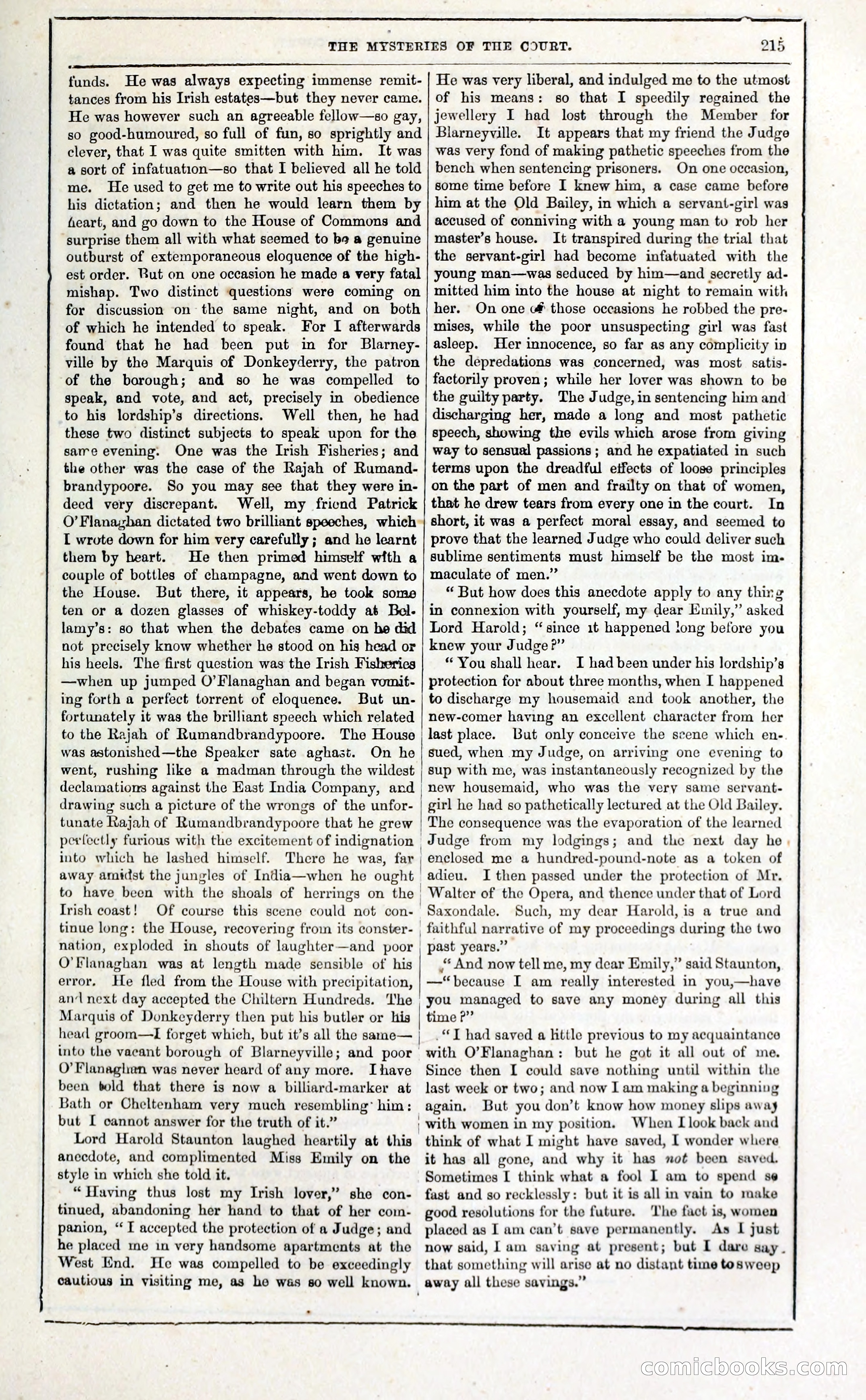
A restored page from Penny Dreadfuls, 1849. Page through the whole issue in the reader above.
📄 Transcribed text from this page (OCR, searchable)
Machine-transcribed from the original scan — historical spelling and the odd misread are preserved.
THE MYSTERIES OF THE COURT. 215 funds. He was always expecting immense remit- tances from his Irish estates—but they never came. He was however such an agreeable fellow—so gay, so good-humoured, so full of fun, so sprightly and clever, that I was quite smitten with him. It was a sort of infatuation—so that I believed all he told me. He used to get me to write out his speeches to his dictation; and then he would learn them by feart, and go down to the House of Commons and ‘surprise them all with what seemed to be a genuine outburst of extemporaneous eloquence of the high- est order. Rut on one occasion he made a very fatal mishap. Two distinct questions were coming on for discussion on the same night, and on both of which he intended to speak. For I afterwards found that he had been put in for Blarney- ville by the Marquis of Donkeyderry, the patron of the borough; and so he was compelled to speak, and vote, and act, precisely in obedience to his lordship’s directions. Well then, he had these two distinct subjects to speak upon for the sare evening. One was the Irish Fisheries; and the other was the case of the Rajah of Rumand- brandypoore. So you may see that they were in- deed very discrepant. Well, my fricnd Patrick O’ Flanazhan dictated two brilliant speeches, which I wrote down for him very carefully; and he learnt them by heart. He then primed himeelf with a couple of bottles of champagne, and went down to the House. But there, it appears, he took some ten or a dozen glasses of whiskey-toddy at Bel- lamy’s: so that when the debates came on he did not precisely know whether he stood on his head or his heels. The first question was the Irish Fisheries —when up jumped O’Flanaghan and began vomift- ing forth a perfect torrent of eloquence. But un- fortunately it was the brilliant speech which related to the Rajah of Rumandbrandypoore. The House was astonished—the Speaker sate aghast. On he went, rushing like a madman through the wildest declamations against the East India Company, and drawing such a picture of the wrongs of the unfor- tunate Rajah of Rumandbrandypoore that he grew | perlectly furious with the excitement of indignation into which he lashed himself. There he was, far away amidst the jungles of India—when he ought to have been with the shoals of herrings on the Irish coast! Of course this scene could not con- tinue long: the House, recovering from its conster- , nation, exploded in shouts of laughter—and poor O’lanaghan was at length made sensible of his error. He fled from the House with precipitation, an‘ next day accepted the Chiltern Hundreds. he Marquis of Donkeyderry then put his butler or his head groom—4I forget which, but it’s all the same— | into the vacant borough of Blarneyville; and poor O’ Flanaglen was never heard of any more. Ihave been bold that there is now a billiard-marker at Bath or Cheltenham very much resembling’ him: but [ cannot answer for the truth of it.” Lord Harold Staunton laughed heartily at this anecdote, and complimented Miss Emily on the style in which she told it. “ Having thus lost my Irish lover,’ she con- tinued, abandoning her hand to that of her com- panion, “ I accepted the protection of a Judge; and he placed me in very handsome apartments at the West Ind. He was compelled to be exceedingly cautious in visiting me, as he was so well known. | SN asin La: IE I I TE ET a I a Sk Saxondale. He was very liberal, and indulged me to the utmost of his means: so that I speedily regained the jewellery I had lost through the Member for Blarneyville. It appears that my friend the Judge was very fond of making pathetic speeches from the bench when sentencing prisoners. On one occasion, some time before I knew him, a case came before him at the Old Bailey, in which a servant-girl was accused of conniving with a young man to rob her master’s house. It transpired during the trial that the servant-girl had become infatuated with the young man—was seduced by him—and secretly ad- mitted him into the house at night to remain with her. On one @ those occasions he robbed the pre- mises, while the poor unsuspecting girl was fast asleep. Her innocence, so far as any complicity in the depredations was concerned, was most satis- factorily proven; while her lover was shown to be the guilty party. The Judge, in sentencing him and discharging her, made a long and most pathetic speech, showing the evils which arose trom giving way to sensual passions; and he expatiated in such terms upon the dreadful effects of loose principles on the part of men and frailty on that of women, that he drew tears from every one in the court. In short, it was a perfect moral essay, and seemed to prove that the learned Judge who could deliver such sublime sentiments must himself be the most im- maculate of men.” “ But how does this anecdote apply to any thing in connexion with yourself, my dear Emily,” asked Lord Harold; “since it happened long before you knew your J udge BY “You shall hear. I had been under his lordship’s protection for about three months, when I happened to discharge my housemaid and took another, the new-comer having an excellent character from her last place. But only conceive the seene which en- sued, when my Judge, on arriving one evening to sup with me, was instantaneously recognized by the new housemaid, who was the very same servant- girl he had so pathetically lectured at the Old Bailey. The consequence was the evaporation of the learned Judge from my lodgings; and the next day he. enclosed me a hundred-pound-note as a token of adieu. I then passed under the protection of Mr. Walter of the Opera, and thence under that of Lord Such, my dear Harold, is a true and faithful narrative of my proceedings during the two past years.” . And now tell me, my dear Emily,” said Staunton, —“because I am really interested in you,—have you managed to save any money during all this time P” .“T had saved a little previous to my acquaintance with O’Flanaghan: but he got it all out of me. Since then [ could save nothing until within the last week or two; and now I am making a beginning again. But you don’t know how money slips away with women in my position. When I look back and think of what I might have saved, | wonder where it has all gone, and why it has not been saved. Sometimes I think what a fool 1 am to spend se fast and so recklessly: but it is all in vain to make good resolutions for the future. The fact is, women placed as I am can’t save permanently. As IL just now said, I am saving at present; but I dare say. that something will arise at no distant time tosweep away all these savings.” CORNICLOO S (CO)