
Penny Dreadfuls, 1849 · page 229 of 394
The Mysteries of the Court of London — page 229: what you’re looking at
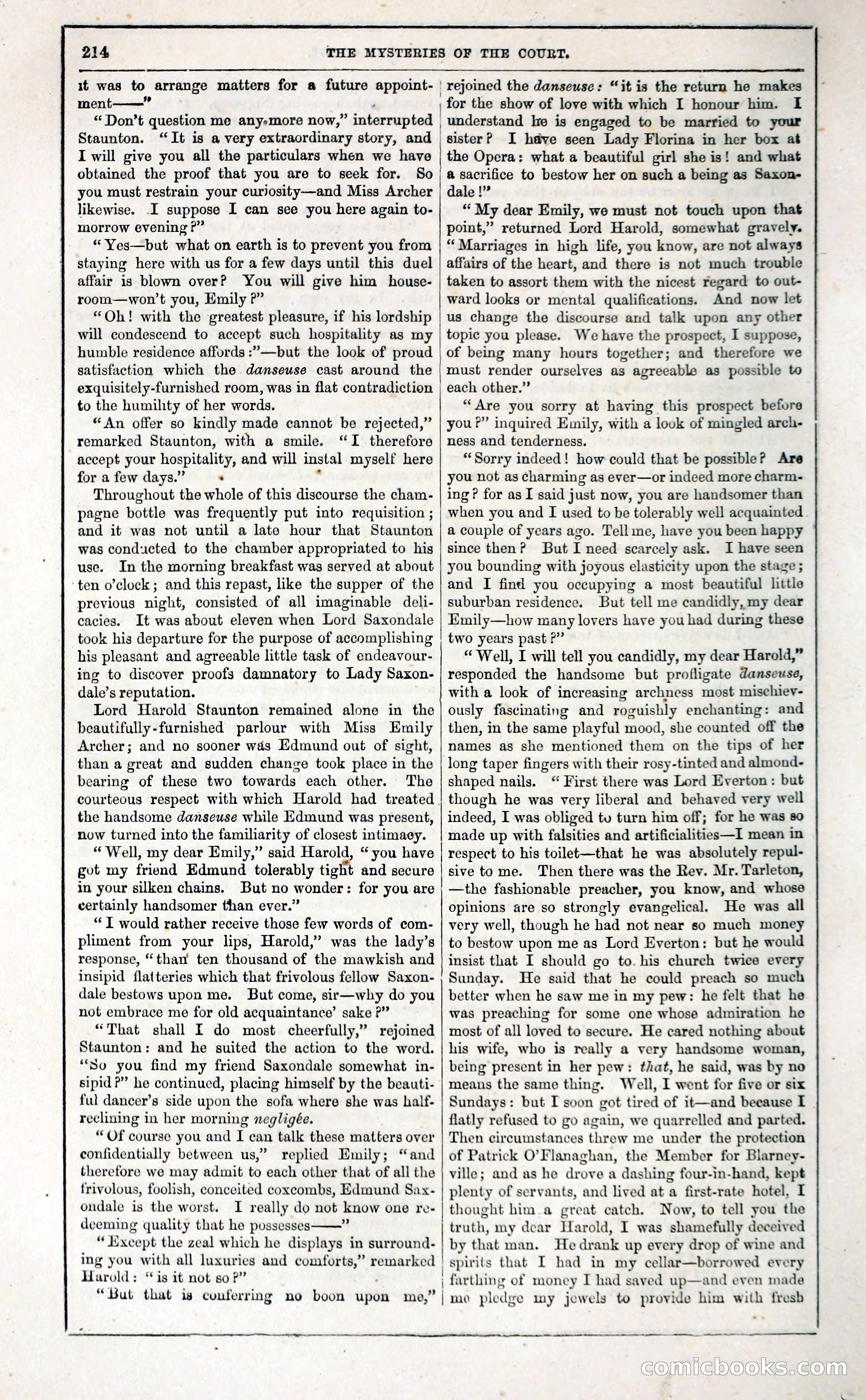
A restored page from Penny Dreadfuls, 1849. Page through the whole issue in the reader above.
📄 Transcribed text from this page (OCR, searchable)
Machine-transcribed from the original scan — historical spelling and the odd misread are preserved.
214 it was to arrange matters for a future appoint- | rejoined the danseuse : ment——” THE MYSTERIES OF THE COURT. “it is the return he makes | for the show of love with which I honour him. IL “Don’t question me any-more now,’ ' interrupted understand he is engaged to be married to your Staunton. “It is a very extraordinary story, and I will give you all the particulars when we have obtained the proof that you are to seek for. So you must restrain your curjosity—and Miss Archer likewise. .I suppose I can see you here again to- morrow evening ?” “ Yes—but what on earth is to prevent you from staying here with us for a few days until this duel affair is blown over? You will give him house- room—won’t you, Emily ?” “Oh! with the greatest pleasure, if his lordship will condescend to accept such hospitality as my humble residence affords :’—but the look of proud satisfaction which the danseuse cast around the exquisitely-furnished room, was in flat contradiction to the humihty of her words. “An offer so kindly made cannot be rejected,” remarked Staunton, with a smile. “I therefore accept your hospitahty, and will instal myself here for a few days.” . Throughout the whole of this discourse the cham- pagne bottle was frequently put into requisition ; and it was not until a late hour that Staunton was conducted to the chamber appropriated to his use. In the morning breakfast was served at about ‘ten o’clock; and this repast, like the supper of the previous night, consisted of all imaginable deli- cacies. It was about eleven when Lord Saxondale took his departure for the purpose of accomplishing his pleasant and agreeable little task of endeavour- ing to discover proofs damnatory to Lady Saxon- dale’s reputation. Lord Harold Staunton remained alone in the beautifully-furnished parlour with Miss Emily Archer; and no sooner was Edmund out of sight, than a great and sudden change took place in the bearing of these two towards each other. The courteous respect with which Harold had treated | the handsome danseuse while Edmund was present, now turned into the familiarity of closest intimacy. “ Well, my dear Emily,” said Harold, “ you have got my friend Edmund tolerably tight and secure in your silken chains. But no wonder: for you are certainly handsomer than ever.” “YT would rather receive those few words of com- pliment from your lips, Harold,” was the lady’s response, “than ten thousand of the mawkish and insipid flatteries which that frivolous fellow Saxon- dale bestows upon me. But come, sir—why do you not embrace me for old acquaintance’ sake ?” “That shall I do most cheerfully,” rejoined Staunton: and he suited the action to the word. “So you find my friend Saxondale somewhat in- sipid P” he continued, placing himself by the beauti- ful dancer’s side upon the sofa where she was half- reclining in her morning xegligée. “Of course you and I can talk these matters over confidentially between us,” replied Emily; “and therefore we may admit to each other that of all the frivolous, foolish, conceited coxcombs, Edmund Sax- ondale is the worst. I really do not know one re- deeming quality that he possesses " “Except the zeal which he displays in surround- | by that man. —————_— ————_—— ‘sister? I have seen Lady Florina in her box at the Opera: what a beautiful girl she is! and what a sacrifice to bestow her on such a being as Saxon- dale !” “My dear Emily, we must not touch upon that point,” returned Lord Harold, somewhat gravely. “Marriages in high life, you know, are not always affairs of the heart, and there is not much trouble taken to assort them with the nicest regard to out- ward looks or mental qualifications. And now let us change the discourse and talk upon any other topic you please. We have the prospect, I suppose, of being many hours together; and therefore we must render ourselves as agreeable as possible to each other.” “Are you sorry at having this prospect before you P” inquired Emily, with a look of mingled arch- ness and tenderness. “Sorry indeed! how could that be possible? Are you not as charming as ever—or indeed more charm- ing ? for as I said just now, you are handsomer than when you and I used to be tolerably well acquainted a couple of years ago. Tell me, have you been happy since then? But I need scarcely ask. I have seen you bounding with joyous elasticity upon the stage; and I find you occupying a most beautiful little suburban residence. But tell me candidly, my dear Emily—how many lovers have you had during these two years past P” “ Well, I will tell you candidly, my dear Harold,” responded the handsome but profligate danseuse, with a look of increasing archness most mischiev- ously fascinating and roguishly enchanting: and then, in the same playful mood, she counted off the names as she mentioned them on the tips of her long taper fingers with their rosy-tinted and almond- shaped nails. “ First there was Lord Everton: but though he was very liberal and behaved very well indeed, I was obliged tu turn him off; for he was so made up with falsities and artificialities—I mean im respect to his toilet-—that he was absolutely repul- sive tome. Then there was the Rey. Mr. Tarleton, —the fashionable preacher, you know, and whose opinions are so strongly evangelical. He was all very well, though he had not near so much money to bestow upon me as Lord Everton: but he would insist that I should go to. his church twice every Sunday. He said that he could preach so much better when he saw me in my pew: he felt that he was preaching for some one whose admiration he most of all loved to secure. He cared nothing about his wife, who is really a very handsome woman, being present in her pew: that, he said, was by no meaus the same thing. Well, I went for five or six Sundays: but I soon got tired of it—and because I flatly refused to go again, we quarrelled and parted. Then circumstances threw me under the protection of Patrick O’Flanaghan, the Member for Blarney- ville; and as he drove a dashing four-in-hand, kept plenty of servants, and lived at a first-rate hotel, I thought him a great catch. Now, to tell you the tr uth, my dear Harold, I was shamefully deceived He dr ank up every drop of wine and ing you with all luxuries and comforts,” remarked | spirits that I had in my cellar—borrowed every Harold: “is it not so P” | farthing of money I had saved up—and even made “But that is conferring no boon upon mae,’ ee pledge my jewels to provide him with fresh ore - ee ee ee ee eee ee ECORNICLOO (C SS (E)